Foldable Home Gym Equipment Small Space: What Packs Away
Foldable home gym equipment for a small space, judged by where it lives: under the bed, in a closet or on a wall. Measure three things before you buy.
Short answer: foldable home gym equipment for a small space only works if you judge it by where it will live, not by how it looks folded in a product photo. Every piece needs three measurements: its folded size against the storage spot (under the bed, a closet, or a wall), its in-use size against the floor you can actually clear, and the effort it takes to move between the two. Benches, bands, mats and compact free weights pass all three in most rooms. Anything that needs tools, two people or a wall fixing to deploy usually ends up staying out, and then it is not foldable in any way that matters.
Why "folds flat" is the wrong question
Search for foldable equipment and most of page one is written by the companies selling it: rack makers, bench makers, cable-machine makers. Their pages are accurate about the product. What they cannot tell you is whether your room has somewhere for the folded thing to go, because they have never seen your room.
"Folds flat" answers a question about the product. The question you actually have is about the room: when someone visits, where does this go, and will I bother putting it there? That splits into three storage destinations, each with its own limit:
- Under the bed: limited by clearance height and by what you have to lift over the bed frame.
- In a closet: limited by the door opening, the closet depth, and what else lives there.
- On a wall: limited by the wall itself, which is a structural question, not a storage one.
The rest of this page takes them one at a time, then covers what fails on equipment that is folded and unfolded constantly.
Measurement 1: folded size against the storage spot
Folded dimensions are on most spec sheets. Storage dimensions are not, so you have to take them yourself. The method in how to measure space for gym equipment applies here too, with one change: you are measuring the hole the equipment disappears into, not the floor it stands on.
Under the bed. Measure the clearance from floor to the lowest point of the frame or slats, not to the mattress. Then measure the width of the gap you can slide into, which is often narrower than the bed because of legs, a center rail, or storage bins already under there. A folding bench or a boxed set of adjustable dumbbells has to clear both, with enough room left to get your hands around it.
In a closet. Measure three things: the door opening (width and height), the depth from the door frame to the back wall, and the height under the shelf or rail. The door opening is the one people skip, and it is the one that stops a folded bench from going in upright.
On a wall. Equipment that "stores on the wall" either leans against it or is fixed to it. Leaning is a floor-space question with a tip-over risk. Fixing is a wall-structure question, and it belongs in a separate decision.
Measurement 2: in-use size against the floor you can clear
A folded item still needs its full working footprint every time you use it, plus room around it to move. That working footprint is the number that decides whether the room works at all, and it is often the one the product page makes least prominent.
The general rules for working clearance around equipment are in home gym space requirements. For foldable gear, apply them to the floor you can realistically clear in a couple of minutes, not the floor that exists if you move the couch. If using the equipment means relocating furniture first, count that as part of the setup time.
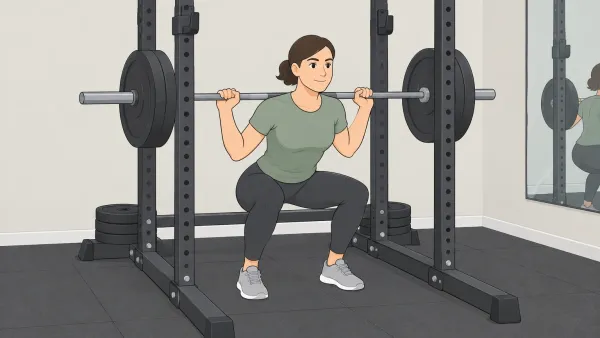
Wall-mounted folding racks show how far apart the two sizes can be. PRx Performance's product page for its Profile PRO folding squat rack (read 2026-09-27) lists the pull-up bar at 11.25 inches from the wall when folded up and 29.25 inches from the wall when folded down, and gives recommended ceiling heights from 99 to 113 inches depending on rack height. Folded, it is shallow. In use, it needs the depth of the rack plus the space in front of it to load and walk out. The folded number is real, and it is not the number that decides whether you can use it.
Measurement 3: the effort to switch
This is the measurement nobody publishes, and it predicts more than either dimension. Equipment that is hard to put away does not get put away. Then the room is simply a room with gym equipment in it, and you have paid for a folding mechanism you do not use.
Ask these before you buy:
- Can one person do it? If folding or unfolding needs a second pair of hands, it will usually stay out.
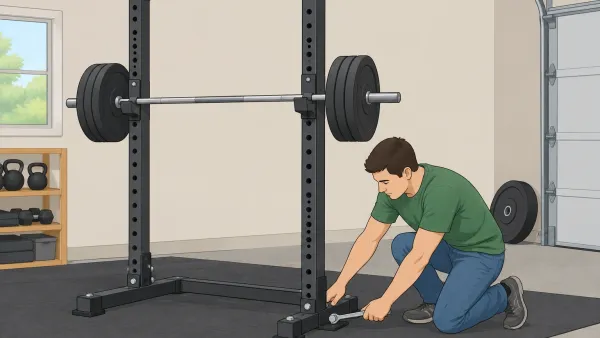
- Does it need tools or pins? A pin you pull by hand is fine. A bolt you have to undo is not a fold, it is a disassembly.
- How heavy is it to carry? Check the product weight on the spec sheet, then picture lifting it over a bed rail or into a closet at the end of a session.
- Does it have to be carried past anything? A doorway, a hallway corner or a bed frame between the use spot and the storage spot turns a short move into an awkward one.
A realistic test: if you would not do the full fold-and-store routine on a tired weekday, assume the item will live out in the open, and plan the room around that.
What packs away well, and what usually does not
The categories below are grouped by how they behave in the three measurements, not ranked, and this page is not a product review.
| Equipment type | Typical storage spot | Where it tends to fail |
|---|---|---|
| Resistance bands, suspension straps | Drawer, closet hook | Rarely fails storage; anchoring is the weak point (door anchors are covered separately) |
| Exercise or rubber mats | Rolled in a closet, flat under the bed | Rolled rubber can hold a curl and may carry an odor at first |
| Folding flat bench | Closet, under a tall bed, upright against a wall | Hinge and pin wear; the folded shape may not clear the closet door |
| Adjustable dumbbells in a base | Closet floor, under the bed if clearance allows | Weight and bulk of the base; mechanism failures (see below) |
| Kettlebells, small fixed dumbbells | Closet floor, low shelf | Weight concentrated on a small shelf or floor spot |
| Folding cardio machines | Upright against a wall or on its side | Weight, casters, and whether the fold locks securely |
| Wall-mounted folding racks and trainers | Stays on the wall | The wall and fixing are the real decision, not the fold |
If you are choosing between compact free weights, the trade-off between adjustable and fixed dumbbells matters more in a small room than in a garage, because an adjustable set replaces a rack of fixed weights with one closet-sized box.
What fails on equipment that folds every day
Folding equipment works harder than equipment that stays in place. Every fold is a cycle on the hinge, the pin and the lock, and a storage spot adds knocks and dust that a fixed setup never sees.
Hinges and locking pins. Check that the lock engages fully every time before using the equipment. A pin that no longer seats cleanly, a hinge with visible play, or a latch that needs forcing is a reason to stop using it and contact the maker, not to push on.
Mechanisms on adjustable weights. Selector dials and locking mechanisms are the part of an adjustable dumbbell that can fail, and moving the set in and out of storage adds wear. This is not theoretical. The US Consumer Product Safety Commission's recall notice 25-311 (dated June 5, 2025, read 2026-09-27) covers about 3,844,200 BowFlex 552 and 1090 adjustable dumbbells because "the weight plates can dislodge from the handle during use," and reports 337 incidents, 111 with injuries, received by Nautilus Inc. If you own a set or are buying one used, check the model against that notice. The failure points to inspect on any brand are covered in how adjustable dumbbell mechanisms fail.
Storage damage. Under-bed storage collects dust and gets bumped by the frame. Closets can be damp against an outside wall. Neither hurts a band or a mat much, but both matter for anything with a moving mechanism, a painted steel frame or an electronic console.
Tip-over. Anything stored upright and leaning, whether a folded bench, a folded cardio machine or a stack of mats, can fall. Where children or pets share the room, check the manual for how the maker says the item may be stored, and do not improvise a lean against a wall the manual does not describe.
Who foldable equipment is wrong for
Packing away is a genuine solution for some rooms and an expensive workaround in others. It is probably the wrong plan if:
- The room's floor space is too small in use, not just in storage. Folding fixes the second problem, never the first.
- You would need to move furniture every session. That setup cost tends to end the habit of putting things away.
- The equipment only packs away by fixing it to a wall you are not allowed to drill. In a rental, that is a lease question before it is an equipment question.
- You are buying the folding version of a heavy machine to save space you do not use for anything else. If the space would stay empty, a non-folding version may be simpler and have fewer moving parts to wear.
Do not buy the folding version yet if you have not measured the storage spot. That one measurement rules out more products than any spec comparison.
Frequently asked questions
What is the best foldable home gym equipment for a small space?
There is no single best item, because the right choice depends on where it will be stored. Bands, mats, a folding bench and compact free weights tend to pack away in most rooms because they are light, need no tools and fit a closet or under a bed. Heavier folding machines and wall-mounted racks can work, but each brings a weight, fixing or clearance problem you should measure first.
Can I store gym equipment under my bed?
Often, yes, for flat and light items. Measure the clearance to the lowest part of the bed frame, not the mattress, and the width of the gap between legs or rails. Leave enough room to get your hands around the item. Anything with a mechanism, such as adjustable dumbbells, is better kept where dust and knocks are limited.
Do folding benches wear out faster than fixed benches?
A folding bench has more moving parts, so it has more places to wear: hinges, pins and locks. Whether that shortens its life depends on the build and how often it is folded. Check the lock every time before use, and stop using it and contact the maker if a pin no longer seats cleanly or the frame shows play at the hinge.
Is a wall-mounted folding rack a good idea for a small room?
It can be, but the fold is the easy part. The real decision is whether the wall can take the fixing, what is inside the wall where you would drill, and whether your lease allows it. Folded depth is small; in-use depth is not, so measure the floor in front of the wall too.
How do I stop folded equipment from falling over?
Store it the way the manufacturer's manual describes. Do not lean folded equipment against a wall unless the manual says that is an intended storage position, and keep leaning items out of rooms where children or pets play unsupervised.