Adjustable or Fixed Dumbbells: The Trade-off Sellers Skip
Adjustable or fixed dumbbells is sold as space versus cost. The trade-off sellers skip is increments, parts that can fail, and resale.
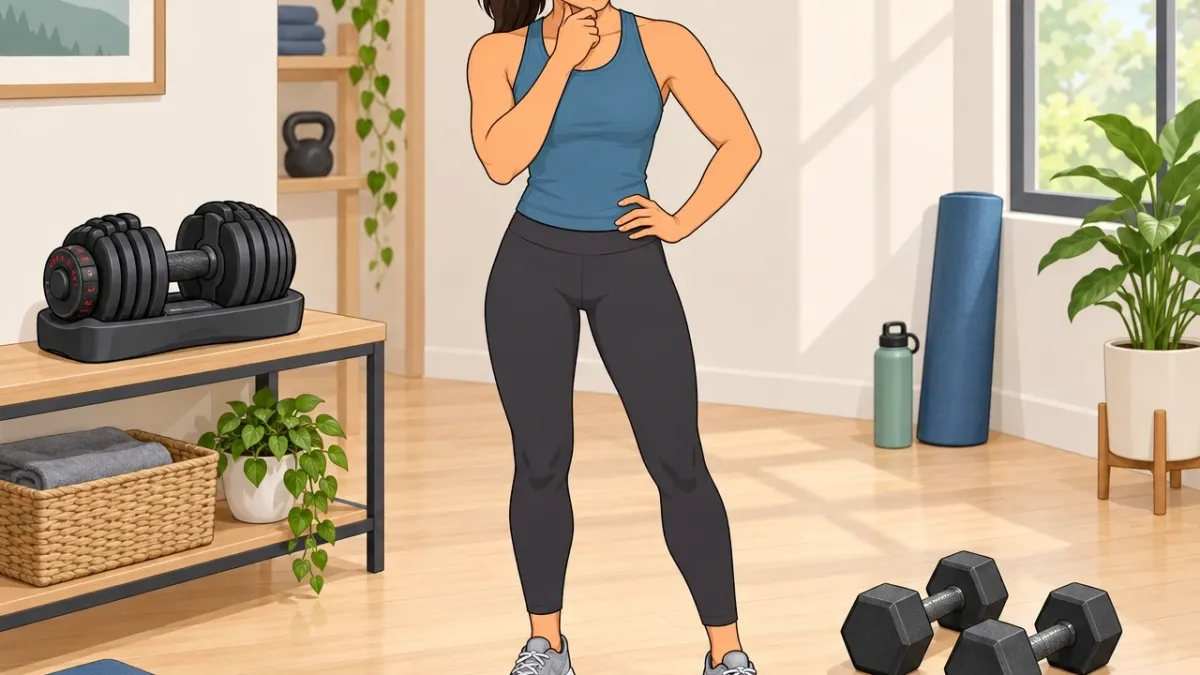
Short answer: adjustable dumbbells buy you range in a small footprint, and they buy it with a mechanism.
Fixed dumbbells have nothing to fail and nothing to adjust, and they cost you floor space that grows with every pair. The trade-off almost nobody publishes is not space against price.
It is weight increments, the parts count, what the warranty actually covers, and which of the two you can sell again.
We have not tested either kind. Nobody at this site owns, has handled or has worn out an adjustable or a fixed dumbbell, and no test record exists here.
What follows is a way of reading published specifications and a comparison of what the two formats are, not a report on how they held up for us.
What is on this results page, and why that matters
We read the results for this query on 2026-09-07. The set is close to what we recorded when this site's topical map was built in July.
The pages are published by PowerBlock, which makes adjustable dumbbells, by the retailers Strength Warehouse USA, Ativafit, NUO Athletics and Hamilton Home Fitness, by Boots Health Hub, which is a UK pharmacy chain, and by Garage Gym Reviews, which tests equipment and does not sell it.
That is the structural problem of this whole category in one screen.
On the question "should I buy adjustable dumbbells", several of the most authoritative-looking answers are published by companies that make or sell adjustable dumbbells. Their pages are not wrong.
They are just written by people for whom one of the two answers ends the visit without a sale.
The comparison almost everyone makes is against the wrong thing
Here is the first skipped trade-off, and it changes the arithmetic more than anything else on the page.
Adjustable dumbbells are almost always compared against a complete rack of fixed pairs: ten, twelve, fifteen pairs, the whole wall of a commercial gym.
Against that, one adjustable pair wins on both money and floor space, easily, and every page in the results set makes exactly that comparison.
Very few home setups need a complete rack. The honest comparison is against the two, three or four pairs a person actually reaches for, plus whatever they would add later.
Run the comparison that way and the result changes for a lot of readers, because a few pairs of fixed dumbbells is a much smaller purchase than a wall of them, and it carries none of the mechanism risk.
Nobody selling an adjustable set has any reason to frame it this way.
Increments: the specification that decides regret
The second skipped trade-off is the size of the jump between settings.
Garage Gym Reviews, which is not a seller, puts it plainly: "The weight increments usually range from 5-10 pounds, but are different for each brand and model." (garagegymreviews.com, read 2026-09-07).
Every maker publishes its own increment table, and on most designs the steps are coarser at the top of the range than at the bottom.
That number is checkable before you buy and it is the one most likely to be the reason a set is replaced rather than kept.
A large jump in the middle of the range is a gap you cannot fill without buying something else.
Fixed dumbbells have the same issue in a different form: you fill a gap by buying another pair, which costs money and floor space but requires no compatibility with anything.
Read the increment table on the listing before the marketing copy. It is a harder number than any adjective on the page.
Parts count, and what the warranty is really covering
A fixed dumbbell is one object. A cast iron hex dumbbell has no moving parts, no pins, no dials, no plates to seat and nothing to seize.
An adjustable dumbbell is an assembly with a selection mechanism.
Garage Gym Reviews states it directly: "Adjustable dumbbells, on the other hand, have a lot more delicate parts and most can't withstand being dropped, as you'll risk damaging the lock mechanism or the plates themselves." (read 2026-09-07).
How those mechanisms fail, and how to search the public recall record before buying, is its own subject and it is covered separately in this cluster.
The buying consequence is the part to take away here.
Every adjustable dumbbell listing publishes a warranty, and the warranty term and what it covers are comparable between models before you spend anything. A fixed dumbbell rarely needs one.
When a maker's warranty is short, or covers the plates but not the mechanism, that is the maker telling you which part it expects to be asked about.
The changeover, stated neutrally
Changing an adjustable dumbbell takes a few seconds, every time, and Garage Gym Reviews names this as something to account for: "You also have to take into account the time it will take to change to a different amount of weight during your home workouts." (read 2026-09-07).
Whether that matters is a question about how you train, and this site does not tell anyone how to train.
What we can say is that it is a real, repeating cost that no specification lists, it is larger on some mechanisms than others, and it is worth simulating in a store or from a video before buying rather than discovering afterward.
Footprint, which is the one thing everybody gets right
Adjustable dumbbells win on space and it is not close.
One pair occupies roughly the volume of the heaviest pair you would otherwise own, and the storage trays or stands that come with them fit in a corner.
Fixed dumbbells scale in every direction: each pair added takes its own floor area, and a rack to hold them takes more.
That footprint has to come out of the same room as everything else, which is why measuring the room before ordering matters more in this category than in most: what space a home gym actually needs covers how to work out what you have to give.
There is a second-order effect worth naming. Fixed dumbbells are usually left out, which makes them easy to pick up.
Adjustable sets are often bought precisely so they can be put away, and equipment that gets put away is easier to stop using. That is an observation about storage, not a claim about anyone's habits.
Materials, coatings and the word commercial
Both formats are sold in bare cast iron, in rubber and in urethane, and the coating changes the noise, the floor marking and the rust behavior rather than the weight.
Bare iron in a garage is a standing maintenance item, which is worth factoring in before choosing a finish.
The word to be careful with on both formats is commercial. It has no agreed definition in this industry and no body certifies it, which is why it appears on listings at every price.
What the term does and does not mean is set out in what commercial grade actually means on gym equipment.
Treat it as marketing language until a specification behind it is published.
The two costs that are not on the product page
Freight. Dumbbells are dense, and a full fixed set is heavy enough that it often ships as freight rather than as parcels.
That charge is frequently larger than the difference the reader is agonizing over, and it appears at checkout.
What shipping actually costs on gym equipment explains why the number moves so much between sellers and how to get it before you commit.
Resale. This is the last skipped trade-off and the one that decides how expensive a mistake can be.
Cast iron fixed dumbbells are close to a commodity: they are heavy, they do not go out of date, and their condition is visible in a photograph.
An adjustable set resells as a working mechanism, which means it depends on completeness, on the condition of the parts and on the model still being supported.
What the resale market does with unused home gym equipment is worth reading before either purchase, because an item that resells easily is a smaller mistake than one that does not, and when buying cheap and upgrading later works applies very differently to an object with a mechanism in it than to a lump of iron.
Side by side, on the axes that are usually left out
| Adjustable | Fixed | |
|---|---|---|
| Parts that can fail | Selection mechanism, pins or dials, plate seating | None |
| Increments | Set by the design, published by the maker, commonly 5 to 10 pounds per Garage Gym Reviews (read 2026-09-07) | Set by what you buy, filled by buying another pair |
| Time to change weight | Seconds, every change | None |
| Footprint | One pair, plus a tray or stand | Grows with every pair, plus a rack |
| Warranty relevance | High. Read the term and what it excludes | Low. There is little to claim on |
| Drops | Generally not tolerated by the mechanism | Tolerated by the object, though not by your floor |
| Resale | Depends on completeness and condition of the mechanism | Close to a commodity |
| Top end | The published maximum of the model | Whatever you keep buying |
What this page does not do
We publish no price, no per-pound figure and no bracket, including the figures Garage Gym Reviews publishes on its own page, because those numbers move and a wrong one costs a reader more than a missing one.
We name no best dumbbell and we rank nothing. We have handled neither format, and every claim above is either attributed to the page that published it or is a description of what the objects are.
Frequently asked questions
Are adjustable dumbbells worth it for a home gym? They are worth it when floor space is the binding constraint and when the published increments and top-end weight suit you, and they are a worse deal when you would only have bought two or three fixed pairs anyway.
The comparison usually shown is against a full commercial rack, which very few home setups need. Compare against what you would actually have bought.
Do adjustable dumbbells break? They have parts that can, which fixed dumbbells do not.
Garage Gym Reviews states that adjustable dumbbells "have a lot more delicate parts and most can't withstand being dropped, as you'll risk damaging the lock mechanism or the plates themselves." (read 2026-09-07).
How specific mechanisms fail, and how to check the public recall record for a model before buying, is covered separately in this cluster. We have not tested any of them.
Are fixed dumbbells better than adjustable ones? Neither is better as an object. Fixed dumbbells are more durable and simpler and resell more easily.
Adjustable dumbbells give more range per square foot and per dollar spent on weight.
The question that decides it is which constraint you are actually up against: room, budget, or the number of different weights you want available without a change.
What weight increments do adjustable dumbbells use? It varies by model and every maker publishes it.
Garage Gym Reviews gives a common range of 5 to 10 pounds and notes that it differs by brand and model (read 2026-09-07).
The detail that matters is where the coarse steps sit, because increments are often larger at the top of the range, and a gap you cannot fill is the usual reason a set stops being enough.
Can you drop adjustable dumbbells? Makers generally say not to, and the reason is structural rather than cosmetic: the selection mechanism and the plate seating are what take the impact.
Check the specific maker's own instructions for the model you are considering, because that is the document that governs the warranty. This site has dropped nothing and tests nothing.