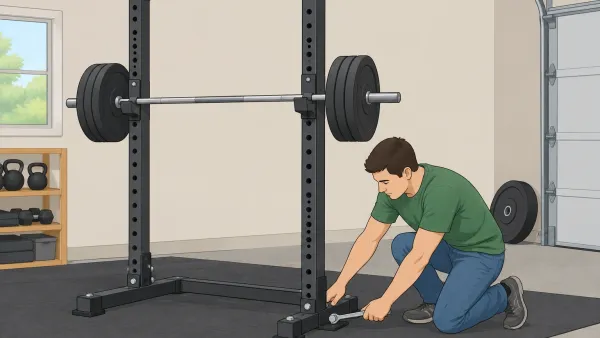
Anchor a Squat Rack Without Bolting: Options and Limits
Renting or cannot drill? Platforms, stabilizers, flat-foot bases and added weight compared, with the attachments a maker says need real bolts.
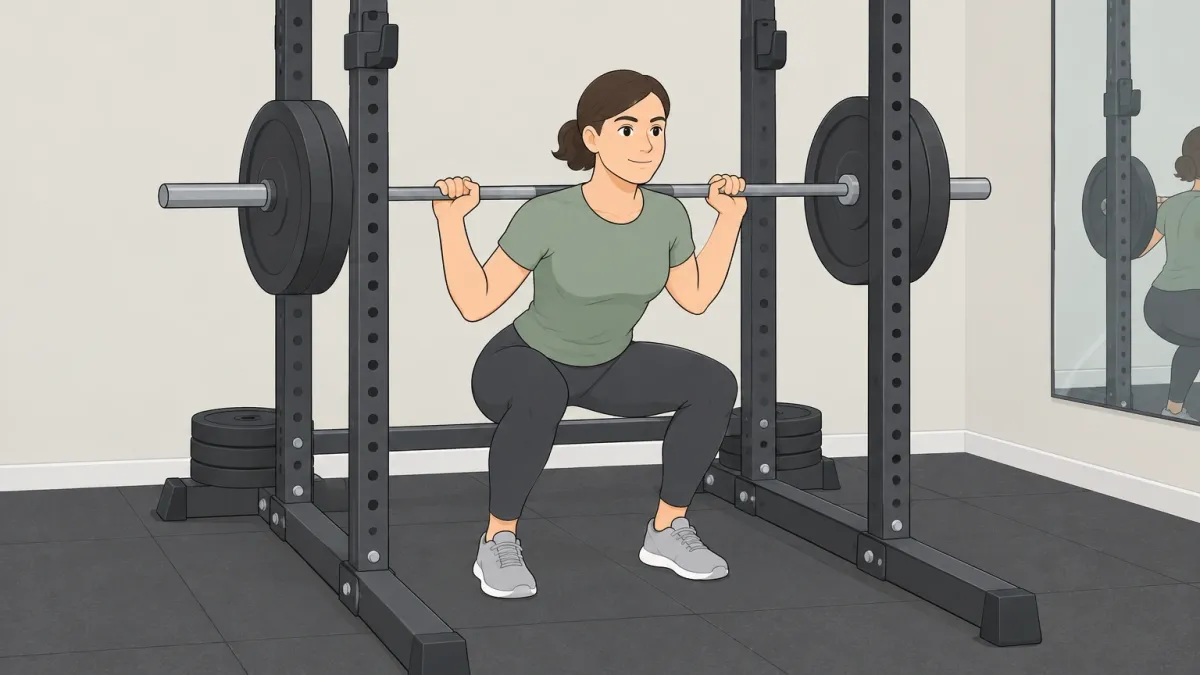
Short answer: there are four real routes, and they are not equal. The strongest is to use a configuration the maker rates for free-standing use, such as a deeper base, a stabilizer kit, front foot extensions or a flat-foot base. Next is to bolt the rack to a platform instead of the floor, where the maker permits it. Third, and weakest, is adding weight to the base, which some sellers suggest but no maker page we read rates as a substitute. The fourth route is simply choosing a frame designed never to be bolted, and living within its limits. If you want to anchor a squat rack without bolting, know this first: some attachments need real bolts whatever you do. REP Fitness names Iso Arms, Spotter Arms and its Globe Pull-Up Bar.
We have not owned, installed or used any product on this page. Every maker statement was read on the maker's own page on 2026-09-11. Methods proposed in search results are reported as proposals, not endorsed.
What the search results propose
We read the results for this query on 2026-09-11. The first page is Horton Barbell, Gym Crafter, YourWorkoutBook, Again Faster, Iron Bull Strength, Fringe Sport and Garage Gym Pro, plus Reddit, a DIY Stack Exchange thread, a LumberJocks thread and a video.
The methods proposed fall into a few groups. Platforms: YourWorkoutBook suggests building "an entire lifting platform," a DIY Stack Exchange thread describes plywood platforms with lag bolts into the wood, and Garage Gym Pro describes T-nuts set under a platform. Weight: ShunTool proposes using "weight plates to stabilise the rack," and Again Faster suggests "weight plates or sandbags to weigh down the base." Some suggest buying a different rack: Horton Barbell recommends wider, heavier frames, and Gym Crafter notes some racks are "specifically designed not to be bolted down." A Reddit thread even suggests car jacks pressing into the ceiling.
What the list does not do is separate what a maker has rated from what a buyer has improvised. That distinction is the whole question for a renter. A maker-rated free-standing configuration comes with conditions you can read. An improvised one comes with none.
Four ways to anchor a squat rack without bolting, compared
| Route | What it resists | What it does not | Who decides whether it is enough |
|---|---|---|---|
| Maker-rated free-standing configuration (deeper base, stabilizer, foot extensions, flat-foot base) | The tipping and walking the maker designed it against | Attachments the maker still says need bolts | The maker, in writing, per model and attachment |
| Bolting the rack to a platform | Sliding and tipping, by making the rack and platform one wider, heavier unit | Anything outside the platform's own stability; it adds weight to the floor | The maker (whether platform mounting is permitted) and, on upper floors, a structural engineer |
| Adding weight to the base | Some tipping, in some directions, by lowering the center of mass | Sliding, and forward tipping from loads outside the footprint; it is not a rated method | Nobody has rated it, which is the problem |
| A frame designed never to be bolted | What it was designed for, within the maker's usage limits | Uses the maker excludes | The maker's limits, followed |
Route one: the maker's free-standing configuration
This is the only route where someone who designed the rack has told you, in writing, what it is stable for.
REP Fitness's PR-4000 FAQ, read on 2026-09-11, says a 41-inch-deep rack with the Rear Base Stabilizer does not need to be bolted for general use. REP's Spotter Arms page gives three acceptable conditions: "Rack must be bolted down, have front foot extensions, or a flat foot base." Titan Fitness's comparison page notes that it "offers bolt-down options on select power racks" and calls anchoring "good practice for both" racks and stands, which tells you the lighter two-post frame is where free-standing is hardest.
Then read the exception. On the PR-5000 FAQ, the attachment rule for Iso Arms, Spotter Arms and the Globe Pull-Up Bar applies "even with the Rear Base Stabilizer, regardless of your rack's depth." A stabilizer kit changes what the base resists. It does not remove every condition.
Route two: bolting to a platform instead of the floor
The idea is to fasten the rack to a wide, heavy platform, so the rack and platform act as one unit and nothing goes into the floor. Our explainer on what each layer of a deadlift platform is doing covers how a platform is built up and why.
Three checks before relying on it:
- Does your rack's maker permit mounting to a platform, and with what fasteners? If the manual specifies concrete anchors only, a platform is a variation the maker has not rated.
- Is the platform wide enough in the direction the load pushes? A platform helps most where it extends beyond the rack's feet on the side a load would tip it toward.
- Can the floor take the platform as well as the rack? A platform adds real weight. On a ground-floor slab this is rarely the limit. On an upper floor, it is part of the question in what a home gym floor weight limit means, and that question belongs to a structural engineer or, in an apartment, to the building.
The surface layer on top matters too. Horse stall mats vs rubber tiles covers how the common rubber layers compare.
Route three: adding weight to the base, and its limits
Plates stacked on a rack's rear base lower its center of mass and make it harder to tip backward. That is real, and it is why the idea keeps appearing in search results.
It has three limits. Added weight does little against forces that act outside the footprint, such as a bar landing on spotter arms that reach forward. It does not stop a frame from sliding on a smooth surface. And no maker page we read rates stacked plates as a substitute for bolting or for its own stabilizer. Iron Bull Strength, in the results, says weight-based alternatives "might not offer the same level of security as bolting." If the maker's rule for your attachment says bolts, a stack of plates does not meet it.
Plates stored on one side of a frame shift its balance in exactly the wrong way. Keep storage balanced, and follow the maker's guidance on storage attachments.
Route four: a frame built to stand on its own
Some racks are designed to be free-standing, and their makers limit how they are used instead. REP Fitness says its PR-1100 "cannot" be bolted down, and notes that because of "the potential for tipping, banded movements are not recommended." If you rent, a frame like this, used within those limits, may be more honest than a bolt-down rack with improvised anchoring.
Methods to leave alone
- Jacks or struts pressing into the ceiling. A ceiling is not designed as a clamp, and no maker page we read describes it.
- Sandbags or loose weight standing in for a maker's bolting requirement. Weight on a base is not an anchor.
- Screwing into a rented floor or a finished floor without the owner's written permission. That is a lease question before it is a hardware question.
- Wall anchoring into unknown framing. Wall-mounted racks and wall ties have to go into framing as the maker specifies. If you do not know what the wall is, ask a qualified installer.
Renters, apartments and carpet
Renters usually face two constraints at once: no drilling, and flooring that is not bare concrete. Our guide to a home gym over carpet, laminate or tile covers setting up on the floor you have. Upper-floor units add the floor-load question, which belongs to the building's management or a structural engineer, not to a product page.
Children
The CPSC's Anchor It campaign concerns furniture and TVs, not gym equipment. It states that "anchoring all furniture with drawers, doors, and shelves to the wall prevents tip-over injuries and deaths" (read 2026-09-11). An unanchored rack is a tall steel frame in the same family of risk. Where children share the home, keep the gym closed to them and unload bars after use.
What you do in the rack, and whether it suits your body, is outside this page. Pain, injury, pregnancy or a heart condition are questions for a clinician.
Frequently asked questions
Can you use a power rack without bolting it down? Many can, in configurations the maker rates. REP Fitness, for example, says a 41-inch-deep PR-4000 with the Rear Base Stabilizer needs no bolting for general use. It also says certain attachments still require bolts. Your own rack's FAQ or manual is the authority.
Do weight plates on the base stop a rack from tipping? They can make backward tipping harder, but they are not a rated anchoring method. They do little against forward loads on spotter arms or against sliding. If the maker's rule for your setup says bolts, added weight does not meet it.
Can I bolt my rack to a platform in an apartment? Only if your rack's maker permits platform mounting and the floor can take the platform plus the rack. On an upper floor that second question belongs to the building's management or a structural engineer. Your lease governs any fixing into the floor.
Which attachments need bolting even without drilling? It is set per maker. REP Fitness names Iso Arms, Spotter Arms and its Globe Pull-Up Bar as requiring a bolted PR-4000 or PR-5000, even with the Rear Base Stabilizer on the PR-5000. Check each attachment's page for your rack.
The short version
If you cannot drill, start with the maker: pick a frame and configuration it rates as free-standing, and read every attachment's conditions. A platform can work where the maker permits it and the floor can carry it. Added weight is a supplement, not an anchor. And anything improvised against a ceiling or a rented floor is not a method.