Do You Need to Bolt Down a Squat Rack? Read the Manual
Whether a rack must be bolted depends on its base, its depth and the attachments you add. How to read the maker's rule, and what bolting needs.
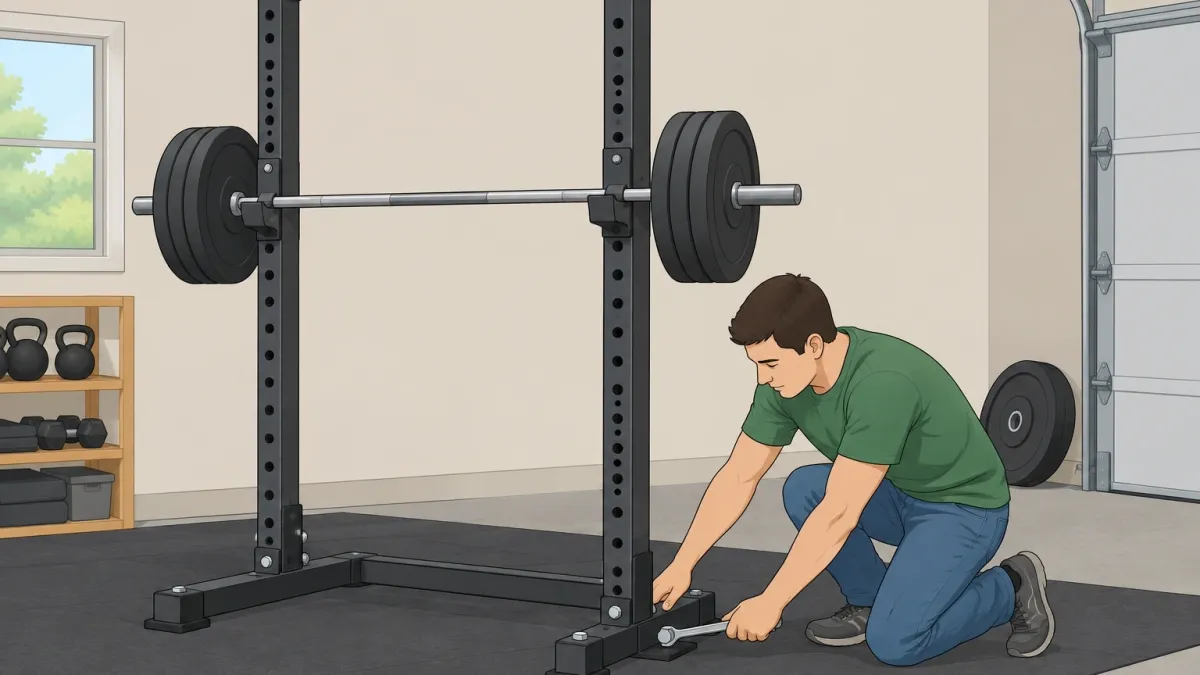
Short answer: it depends on what the rack's own maker says for that model in the configuration you will use. There is no general rule. Some racks are designed never to be bolted: REP Fitness says its PR-1100 "cannot" be. Some free-standing configurations do not need it, such as REP's PR-4000 at 41-inch depth with the Rear Base Stabilizer. And some attachments bring the requirement back whatever the base: REP names Iso Arms, Spotter Arms and its Globe Pull-Up Bar. Titan Fitness calls anchoring "good practice for both" racks and stands, "especially a squat stand." So the answer is written in your manual and on the maker's FAQ, per attachment.
We have not owned, installed or used any rack on this page. Every maker statement below was read on the maker's own page on 2026-09-11.
What the search results say, and who is saying it
We read the results for this query on 2026-09-11. Most of the first page is rack sellers: three pages from Iron Bull Strength, plus Gym Mikolo, Bells of Steel and Garage Gym Pro. Gym Crafter, YourWorkoutBook, Home Gym Magazine and Horton Barbell are independents, and there is a Reddit thread.
The majority answer is "yes, bolt it." YourWorkoutBook calls bolting "the best, safest, and smartest solution." Home Gym Magazine says yes "because this will support you with the utmost stability." Garage Gym Pro says "most manufacturers still recommend that you bolt them down." Iron Bull Strength, which sells both types, has a separate page explaining that flat-footed racks "achieve stability without bolts."
Two things are missing. The first is the maker-by-maker detail: the same company can sell one rack that must be bolted and another that cannot be. The second is what bolting itself requires: the slab, what is inside it, the flooring on top, and whether you are allowed to drill at all. The second question can stop the first.
How makers set the rule, with real examples
| Maker statement (read 2026-09-11) | What it tells you |
|---|---|
| REP PR-1100 FAQ: "No, you cannot bolt the PR-1100 Home Gym Power Rack down." The same page: "Due to the weight of the rack (130lbs) and the potential for tipping, banded movements are not recommended." | Some racks are designed free-standing only. Stability then comes from limiting how they are used |
| REP PR-4000 FAQ: bolting is not required for general use at 41-inch depth with the Rear Base Stabilizer, but "if you're using the Iso Arms, Spotter Arms, or Globe Pull-Up Bar, you do need to bolt your rack down" | Base depth and a stabilizer can remove the need, and specific attachments bring it back |
| REP PR-5000 FAQ: the same attachment rule applies "even with the Rear Base Stabilizer, regardless of your rack's depth" | An attachment rule can override the base |
| REP Spotter Arms page: "Rack must be bolted down, have front foot extensions, or a flat foot base to safely use the Spotter Arms" | Accessories carry their own conditions |
| Titan Fitness: anchoring is "good practice for both, especially a squat stand, since it's lighter and less stable than a full cage" | A general recommendation, strongest for light two-post frames |
The pattern is consistent. Makers attach the bolting rule to forces that act outside the base or pull the frame off the floor: arms that reach forward, pull-up bars, bands pegged to the frame. It is not tied to how much weight sits on the J-cups.
Do you need to bolt down a squat rack in your setup? Five questions
- What does the manual or FAQ say for this model? If it says the rack cannot be bolted, that settles whether to bolt. The question becomes which uses the maker limits.
- Which attachments will you add? Check each one's page for a bolting or base condition. Arms and pull-up bars are the usual ones.
- How deep is the base, and is there a stabilizer or flat-foot option? Makers sometimes offer these as the alternative to bolting.
- Does anything pull the frame sideways or upward? Bands pegged to the base, plate storage loaded on one side, and anything hung from the top change how a frame behaves. Follow the maker's limits on these.
- Is the floor under it something you are allowed and able to drill? If not, the remaining options are the maker's free-standing configurations.
What bolting into a slab requires
Sellers mostly present bolting as a hardware purchase. It is really a question about the floor.
The anchors and the pattern are the maker's. Anchor type, size, embedment depth, the number of anchors and the tightening method all belong to your rack's manual. The manual may also specify a minimum slab condition. We give none of those figures here, because the only ones that apply are the ones for your rack.
The slab has to be sound. A cracked or crumbling slab, or one that has settled unevenly, is a poor base for anchors. Our guide to protecting a concrete slab from cracking in a home gym covers what to look for before anything is drilled.
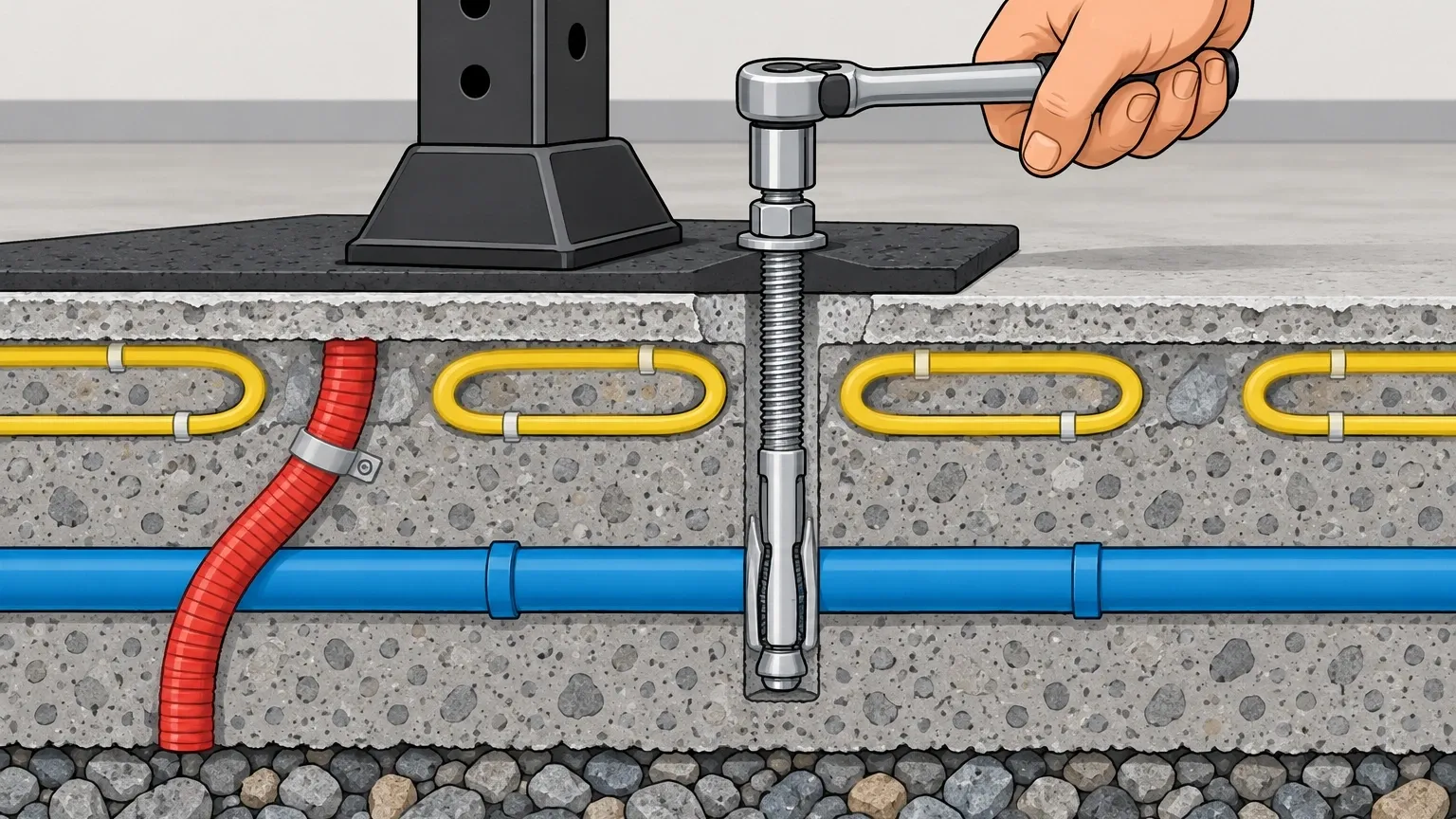
Know what is inside the slab before you drill. This is the stop condition, and it is not optional. A slab can contain electrical conduit, plumbing, or tubing for radiant heating. Some slabs, particularly in some newer houses and in multi-story buildings, are post-tensioned: they contain steel cables held under very high tension. Drilling into one is dangerous, and cutting a tendon can damage the building. A wall or concrete scanner finds some of these things, not all of them. If you do not know how your slab was built, stop there. The builder, the building's management or a structural engineer should answer before any drill touches it.
The flooring on top changes the job. Anchors that pass through rubber mats have to allow for the mat, and a mat that compresses under the rack's feet changes how the base sits. How much rubber a home gym floor needs covers thickness. Some people bolt the rack to a platform instead of the slab, which is the subject of what each layer of a deadlift platform does. Whether your maker permits that is a question for the manual.
When the floor is not a slab
A garage or basement slab on grade is the usual case for bolting. Upper floors and suspended wood floors are different. Anchoring into a wood subfloor does not behave like anchoring into concrete, and a rack plus its load is a concentrated weight on a structure that was not designed around it.
Do not improvise here. What changes with a home gym on the second floor and what a home gym floor weight limit really means both set out why the answer belongs to a licensed structural engineer who has seen your building. In an apartment or condo, the building's management comes first.
If you rent and cannot drill at all, the options are narrower. Look at the free-standing configurations the maker rates, and do not treat an improvised fix as equivalent to what the maker specifies.
Children, and why this is not only about you
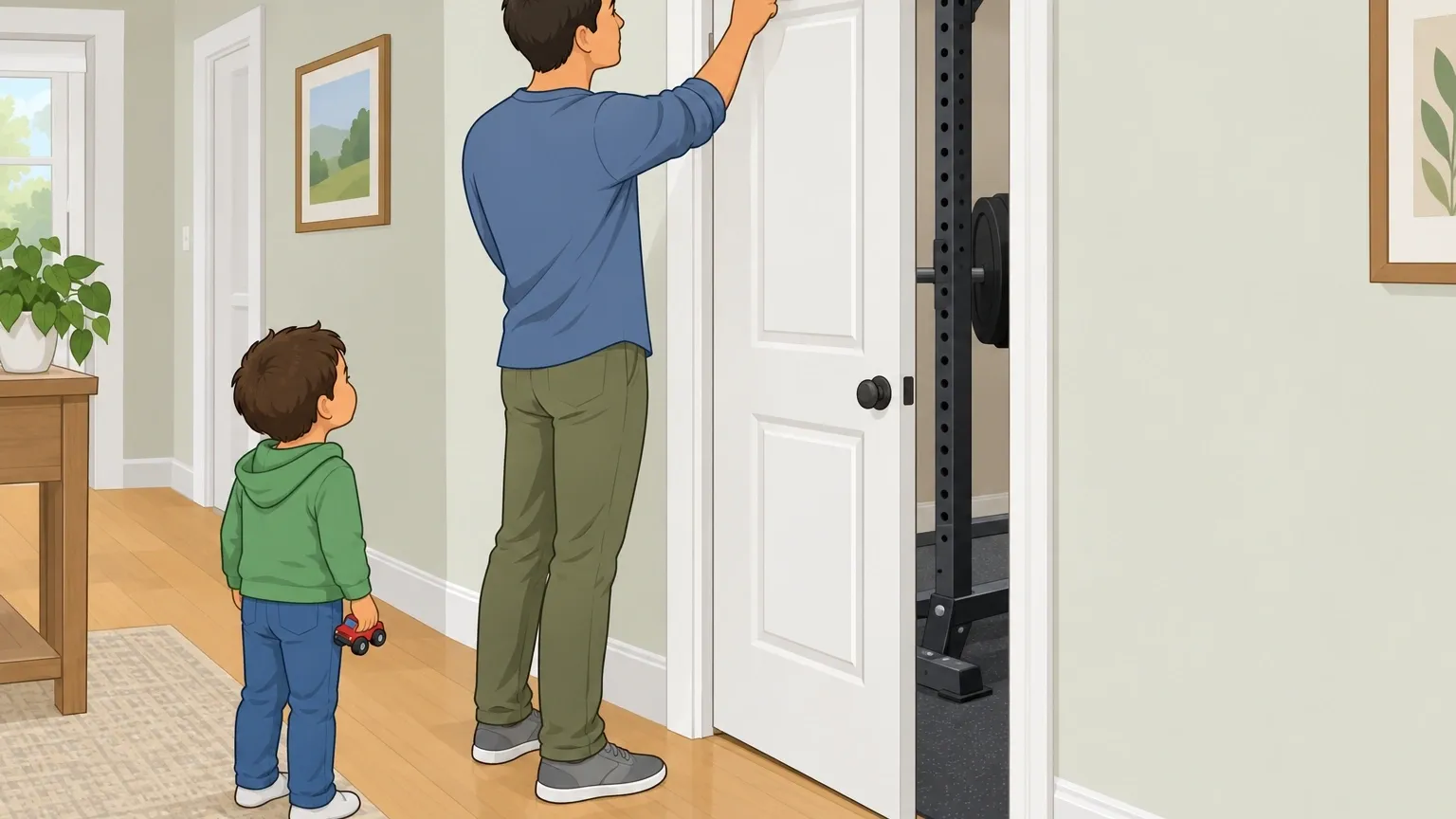
The CPSC's Anchor It campaign concerns furniture and TVs. It states that "anchoring all furniture with drawers, doors, and shelves to the wall prevents tip-over injuries and deaths" (read 2026-09-11). A rack is not furniture under that rule, but a tall steel frame with a pull-up bar and hooks is climbable, and an unanchored frame that tolerates an adult may still respond differently to a child hanging from one side. Where children are in the house, keep the gym closed to them, and treat the maker's anchoring instructions as a floor, not a ceiling.
What and how you train in the rack is not covered here. Pain, injury, pregnancy or a heart condition are questions for a clinician.
What this page does not do
It gives no anchor sizes, depths or slab specifications, because those belong to your rack's manual. It names no prices and makes no picks. It does not tell you what your floor or slab can take. And it does not describe drilling into a slab whose contents you do not know, because the correct instruction there is to stop.
Frequently asked questions
Do I need to bolt down a power rack to do pull-ups? It depends on the maker. REP Fitness, for example, names its Globe Pull-Up Bar among the attachments that require the PR-4000 and PR-5000 to be bolted down. Read the rule for your own rack and pull-up bar in the manual or FAQ.
What if my rack's maker says it cannot be bolted down? Then it is designed to be free-standing, and the maker's usage limits are what keep it stable. REP Fitness says its PR-1100 cannot be bolted, and does not recommend banded movements on it because of the potential for tipping. Follow those limits.
Can I bolt a squat rack through rubber mats? Sometimes. The anchor has to allow for the mat, and compressible flooring changes how the feet sit. Your rack's manual governs the anchors. Some people bolt to a platform instead of the slab, but only where the maker permits it.
Can I bolt a squat rack to a wood floor or an upper story? That is a structural question, not a hardware one. Anchoring into a wood subfloor does not behave like concrete, and a rack is a concentrated load. A licensed structural engineer, or your building's management in an apartment, should answer it before anything is fixed.
The short version
Read the maker's rule for your model, then for each attachment. If it says bolt, the next question is the slab: whether it is sound, whether you may drill it, and what is inside it. If you do not know what is inside it, stop and ask the builder, building management or a structural engineer. If the maker says the rack cannot be bolted, follow the maker's usage limits instead.