How Adjustable Dumbbell Mechanisms Fail, and Where to Check
No maker publishes a cycle rating for the mechanism, so the only public record of how these fail is the regulator's. Here is how to search it before you buy.
Adjustable dumbbells are a mechanism holding weight above the floor, and sometimes above a person. That is the whole reason this question is worth asking, and it is why the answer should come from a regulator rather than from a review.
Nobody publishes a durability rating for one of these mechanisms. No cycle count, no drop rating, no expected life.
What you get instead is adjectives, which is a pattern this site keeps meeting: "commercial grade" has no definition and no certifying body, while ISO 20957-1:2024 publishes real class designations, and on the same product page the marketing can say commercial while the warranty voids on commercial use.
That is on what commercial grade actually means.
So the one public record of how these actually fail is the recall database, and this page is about how to use it.
An honest limit, stated first: we did not retrieve or read any recall record while writing this. No product, brand, model or incident is named anywhere below, because naming one would mean asserting something we have not read.
What this page gives you is the method and what the notices contain, which is the durable half anyway.
The mechanisms, and where each one has something to fail
Adjustable dumbbells work in one of a few ways, and each has a different critical part.
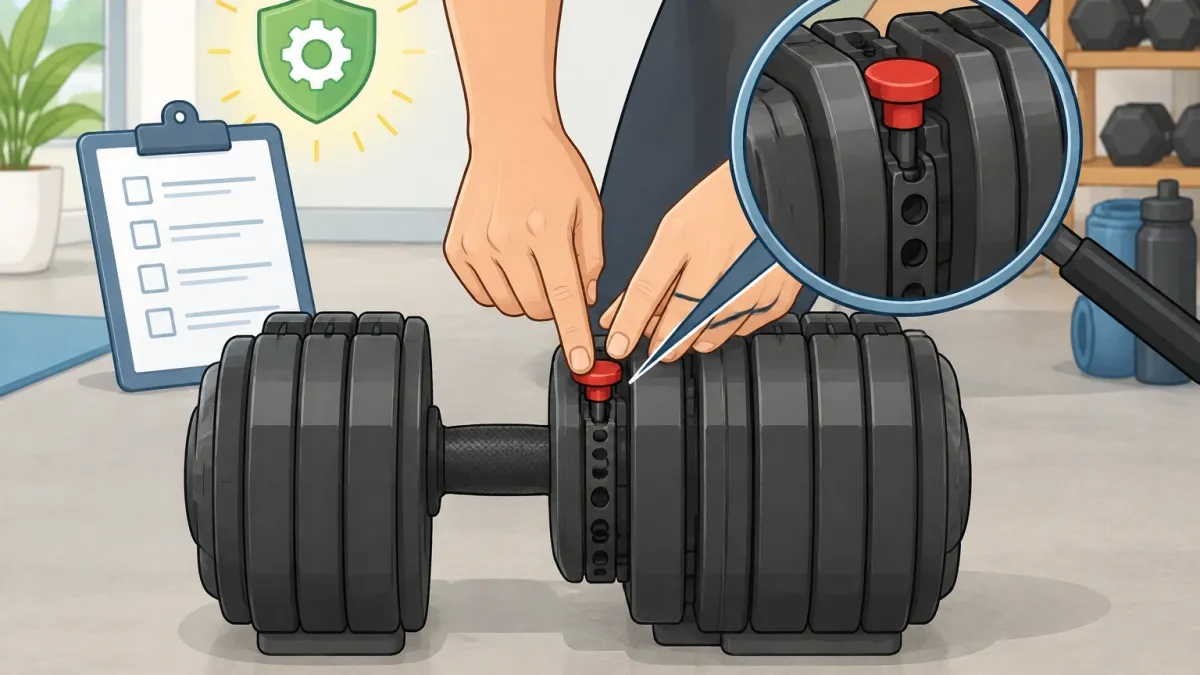
Selector pin. A pin drops into the plate stack and holds the selected plates to the handle.
The pin and its seat are the load path. A pin not fully seated is the classic failure, and it is a user-facing one: the plates it is not holding stay behind, or worse, come off partway through a movement.
Dial or twist selection. A rotating mechanism engages the plates.
More moving parts inside a housing you cannot inspect, and the failure mode is usually the engagement not being complete rather than the mechanism breaking outright.
Spin-lock collars. The oldest and simplest: a threaded collar screwed down onto loose plates.
Nothing hidden, nothing to fail invisibly, and the failure is a collar working loose over time, which is a check rather than a surprise.
Block or plate-cradle systems. The handle lifts selected plates out of a cradle.
The critical part is the connection between handle and plate, and the cradle position matters: a handle lifted from a badly seated cradle can take the wrong plates or none.
The general shape: simpler mechanisms fail visibly and gradually; more complex ones fail invisibly and suddenly. That is the trade, and it is not the trade the marketing describes.
How to search the recall record, which is the part worth keeping
This is the method and it takes about five minutes per product.
Go to the CPSC's recall database at cpsc.gov and search by the product type and by the brand name. Do both: a recall may be listed under a name you do not associate with the product.
Search the manufacturer's name as well as the model, because recalls are issued against a firm and one firm may sell under several names.
Read the notice, not the headline. A recall notice names the hazard, the units affected, the date range of manufacture, the model or lot identifiers, the number of incidents and injuries reported, and the remedy.
The date range and the identifiers are the part that matters to you, because a recall covers specific production and not everything a company has ever sold.
Check before you buy, not after. This is a five-minute check that is worth doing on any adjustable dumbbell, new or used.
And check for the country you are in. Recall databases are national, and a product recalled in one country may be listed differently or not at all in another. Search the equivalent body where you live.
The used market, and the legal point nobody mentions
It is unlawful to resell a recalled consumer product.
This site established that in its earlier used-market work, citing section 19 of the Consumer Product Safety Act at 15 U.S.C.
2068 and the CPSC's Resellers Guide, Publication 254, May 2021. Those are named here as that dated finding rather than as something re-verified today.
Two consequences for a buyer.
A second-hand listing has no obligation to tell you, and a private seller may not know.
The recall check is entirely yours to run, and it is the single most valuable thing you can do before buying a used mechanism.
And if you sell one on, the obligation is yours. The broader used-equipment reasoning, including what is checkable before you buy, is on what resale tells you about unused equipment.
What to check on an item in front of you
Not a substitute for the recall search, and worth doing.
Does the mechanism engage positively and audibly? A definite click or stop is a design feature.
Does the handle lift only the plates you selected? Test it at several settings, not one.
Is there play between the handle and the plates once selected? Movement in the load path is a finding.
Are the plastic parts in the load path? On many designs some of the housing is plastic, and plastic in a load path is a different life expectancy from metal.
Does the cradle or tray position the dumbbell reliably? On cradle systems this is part of the mechanism, not an accessory.
Is there a published maximum weight, in figures? Look for a number. An adjective is not a rating.
The safe-use points that follow from the mechanism
Check engagement every time you change the weight. Every time, not the first time. Lift it an inch off the cradle before lifting it properly.
Do not drop them. These are mechanisms, not solid iron, and impact is what mechanisms fail from. Every maker says this and it is the instruction most often ignored.
Follow the maker's own instructions for your specific model, which is the authority on that product and outranks any general article, including this one.
And keep the cradle clear. A dumbbell returned to a cluttered cradle is a dumbbell that will not seat properly next time.
The honest summary
A simple mechanism you can see is easier to trust than a complex one you cannot, and no published rating exists to overturn that intuition for any product in the category.
Search the recall database before you buy. It is free, it takes five minutes, and it is the only public record of how these actually fail.
If you are still deciding what to buy first at all, that is on what to buy first for a home gym.
What this page does not publish
No brand, product, model or recall is named, because we retrieved and read none while writing this.
No cycle count, load rating or durability figure. No maker publishes one.
No prices or rankings. We have bought nothing and tested nothing.
No load, rep or programming guidance. This is an equipment site.