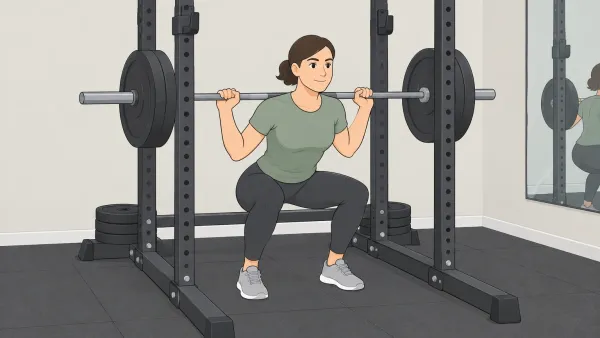
Weightlifting Noise Apartment Downstairs: What They Hear
Weightlifting noise in an apartment reaches downstairs as a thud or a click, depending on the floor. Learn which one you have before you buy a mat.
Short answer: weightlifting noise reaches the apartment downstairs mostly as impact sound, energy that goes into the floor structure and comes out of the ceiling below. What your neighbor hears depends on the floor. Over a concrete slab it tends to be a sharp click or clack, which a thick rubber surface can cushion well. Over a wood-joist floor it tends to be a low thud or boom, which a mat reduces far less. That is why the same mat can end complaints in one building and change nothing in another. Find out which floor you have first, then choose the fix.
Two floors, two different noises
The most useful single source on this question is not a gym equipment page. It is a building research paper: Controlling the Transmission of Impact Sound through Floors by A.C.C. Warnock, National Research Council of Canada, Construction Technology Update No. 35 (December 1999, read 2026-09-25). It describes the two floor types found in most apartment buildings and the noise each one produces.
Concrete slab floors. According to the NRC paper, impact sounds on concrete finished with a hard surface "can be described by terms such as 'click,' 'clack' or 'sharp tap,'" and most of their energy is at high frequencies.
Lightweight wood-joist floors. The same paper says impacts on joist floors are "usually described by terms such as 'thump,' 'boom' or 'thud,'" with most of the energy at low frequencies, "sometimes below the frequency limit" of the standard test.
So when your neighbor says "I hear you lifting," they may be describing two very different problems. A click from a concrete building and a boom from a wood-frame building need different answers.
How to tell which floor you have
You usually cannot see the structure, but you can ask and observe:
- Ask the building manager or landlord whether the floors between units are concrete or wood-framed. This is the single most useful question in this article.
- Building type is a clue, not proof. Taller buildings are often concrete, and low-rise walk-ups, converted houses and townhouse-style buildings are often wood-framed. Mixed construction exists, so confirm rather than assume.
- Listen to your own building. If you already hear footsteps from above as a low thump, you are probably under a joist floor, and your neighbor below is likely hearing you the same way.
Why the mat rating on the product page may not apply to you
Flooring sellers sometimes quote an Impact Insulation Class (IIC) figure or an improvement in IIC. Before you trust one, know what the rating measures.
IIC is derived using a standard tapping machine defined in ASTM E492: per the NRC paper, five steel-faced hammers strike the test floor while noise is measured in the room below, and the calculation covers a frequency range of 100 to 3150 Hz. The current classification standard, ASTM E989-21 (ASTM International, read 2026-09-25), states plainly in its scope that it "does not deal with low frequency sounds below 100 Hz that are typically generated below lightweight joist floors when they are walked on," and that it "strictly only applies to excitation by the standard tapping machine."
Three consequences for anyone lifting at home:
- A dumbbell is not a tapping machine. The rating describes a light, rapid, standardized impact. A heavy object set down or dropped is a different event.
- The low thud may sit outside the rating entirely. On a joist floor, the sound that bothers the neighbor can fall below the 100 Hz floor of the test.
- The same topping behaves differently on different floors. The NRC paper reports that vinyl on concrete improved IIC by 8 points but offered no improvement on a basic wood-joist floor, and that a wood floor on strapping improved IIC by 30 on concrete but only 10 on the joist floor. Its conclusion: "to compare toppings, they must be tested on the same basic floor."
So a product rating measured on a concrete test slab tells you little about a wood-frame apartment.
What actually reduces the noise downstairs
With that in mind, here are the levers, roughly in the order they matter.
1. What hits the floor, and how
The largest variable is not the mat. It is whether a weight reaches the floor at all, and how hard. Setting equipment down with control, using a bench or a stand to rest weights on, and choosing gear that is designed to be placed rather than dropped all cut the impact at the source. If your setup depends on dropping weight, no mat fixes that in an upper-floor apartment. What rubber-coated and bumper equipment changes, and what it does not, is covered in our comparison of bumper plates and iron plates.
2. A soft, thick surface, which helps most on concrete
The NRC paper states that on concrete, "the softer and thicker the floor covering, the better the IIC," and it lists carpet with underlay among the highest-rated toppings on both floor types. For a home gym, a thick rubber surface does the cushioning job carpet does in the paper's tables, while also protecting the floor. On a concrete building, this is often the fix that works.
3. On a joist floor, softness alone is not enough
For wood-joist floors, the same paper reports that resilient coverings "that significantly increase the IIC for concrete floors are normally much less effective on joist floors with wood subfloors," and that the common approach to the thumping problem is adding mass so the floor is "less likely to vibrate." In building terms, that means construction work such as a concrete topping, which is not something a tenant does. What a tenant can do is spread the load and add mass and stiffness on top of the existing floor, which is the logic behind layered platforms of rubber and plywood. Our guide to protecting a wood subfloor and the ceiling below it walks through those layers, and what changes for a home gym on the second floor covers the structural side.
4. Pads made for the drop
Purpose-built drop pads and crash pads sit under the landing point rather than across the whole floor. What each type is designed to absorb is laid out in crash pads, drop pads and silencer pads. They help, but on a joist floor they reduce the thud rather than remove it.
5. Where and when
Train over a room that is not a bedroom if you can, and train outside quiet hours. Timing costs nothing and often matters more than equipment.
Diagnosing weightlifting noise in the apartment downstairs
| What the neighbor reports | Likely floor | Most likely source | What tends to help |
|---|---|---|---|
| Sharp clicks, taps, clanks | Concrete | Metal or hard objects meeting a hard surface | Thick rubber surface; controlled set-downs |
| Low thuds, booms, a shaking ceiling | Wood joist | Heavy impacts making the floor vibrate | Controlled set-downs first; layered platform; relocating over a less sensitive room |
| Rhythmic thumping | Either | Repetitive impacts, jumping, footwork | Changing what you do in that spot, and when |
| Rattling fixtures below | Wood joist | Floor vibration | Reducing impact at the source; a structural question if severe |
Where this becomes a building question
If the ceiling below visibly moves, fixtures rattle, or cracks appear, stop treating it as a noise problem. That is a structural question for the building owner and a structural engineer, not a mat purchase. Do not add heavy layers such as plywood platforms, stacked mats or concrete pavers to a floor you know little about without asking what it can carry.
Talk to the neighbor, then test
The fastest way to find out what the unit below hears is to ask. If you are on good terms, agree on a short test: you run through your normal session at your normal time, and they tell you what they heard and when. Change one thing, such as the mat, the spot or the time, and test again. It turns an argument into a measurement.
Do not buy a mat yet if...
- You do not know whether your floor is concrete or wood-framed.
- The product's noise claim is based on an IIC figure with no statement of the test floor.
- Your plan depends on dropping heavy weights onto an upper floor.
- The neighbor's complaint describes a thud or shaking and the fix you are considering is a thin mat.
FAQ
Can the neighbor downstairs hear me lifting weights?
Often, yes. Setting down or dropping weights creates impact sound that travels through the floor structure. On concrete floors it tends to sound like clicks or taps; on wood-joist floors it tends to sound like thuds, according to the National Research Council of Canada.
Do gym mats stop weightlifting noise for downstairs neighbors?
Mats reduce impact noise, and they work best on concrete floors. On wood-joist floors, the NRC reports that resilient coverings are much less effective, because the problem is low-frequency vibration of the floor itself.
What does an IIC rating mean for a gym mat?
IIC is measured with a standard tapping machine over 100 to 3150 Hz. ASTM E989-21 says it does not cover sounds below 100 Hz typical of joist floors, and it applies only to the tapping machine, not to dropped weights.
Is it better to lift in a concrete apartment building?
Concrete floors generally respond better to soft, thick surfaces, according to the NRC paper, which makes impact noise easier to control. Ground floor units avoid the problem of a neighbor below altogether.
What should I do if my downstairs neighbor complains?
Ask what they hear and when, find out your floor type, stop dropping weights, move off bedrooms and out of quiet hours, then test changes one at a time with the neighbor's feedback. Check your lease's noise clause too.