Bumper Plates vs Iron Plates: It Is Really a Floor Question
Bumper or iron plates is sold as a lifting-style choice. It is a building question: what is under the plates, and what the maker's drop rating assumes.
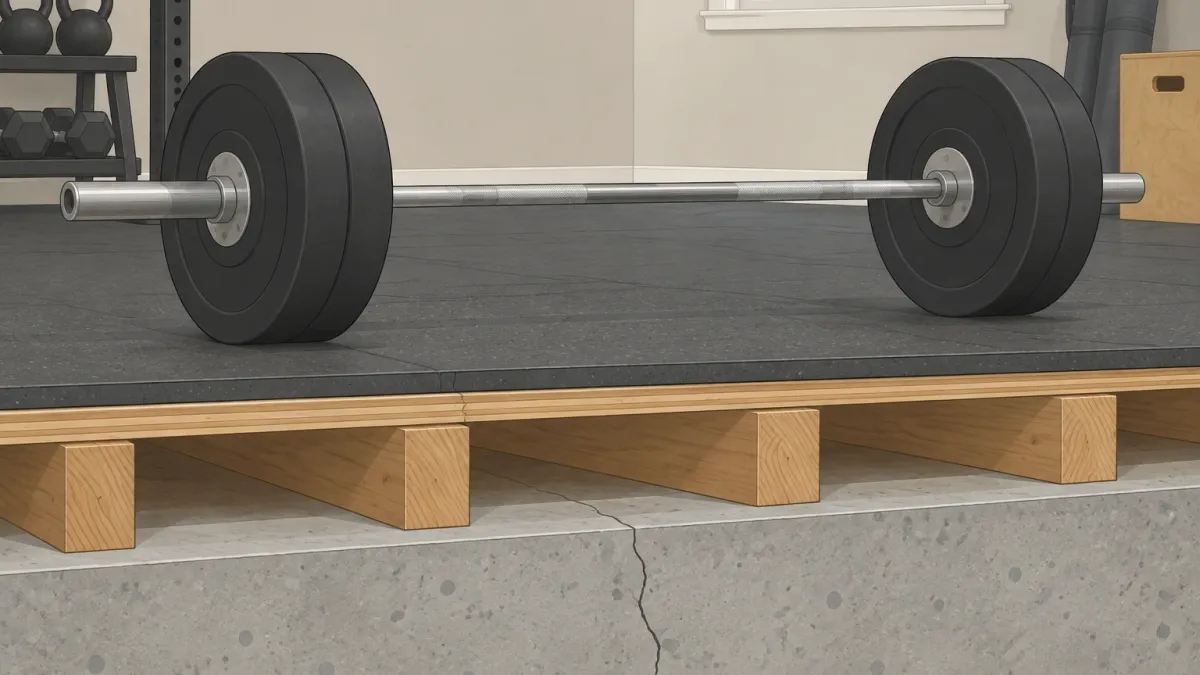
Short answer: bumper plates vs iron plates is sold as a question about how you lift, and it is mostly a question about what sits under the bar. Bumper plates are rubber over a steel insert and are built to survive being dropped. Iron plates are not, and the companies that make them say so in writing. But the drop rating that justifies the extra cost is always written against a surface. Manufacturers test onto a competition platform, not onto your garage slab, your joists, or a rented apartment floor. Work out what your building can take first. The plate is the second decision and it is the easier one.
We own no plates, have dropped nothing, and have tested none of the products named below. Every specification here is attributed to the company that published it, with the date we read it.
Why every page answers this as a lifting question
We read the results for this query on 2026-09-02. Six of the first ten pages are published by companies that sell weight plates. One, Garage Gym Reviews, does hands-on testing and is not a seller. The other three are independent blogs, one of them a coaching site.
They agree closely, and the shape is always the same: bumpers if you do Olympic lifts or drop the bar, iron if you train in a controlled range, bumpers cost more per pound, bumpers take up more room on the sleeve, bumpers are quieter.
None of that is wrong. It is just the wrong axis. It answers "which plate suits my training", and the money you are actually risking is not in the plates. A seller can recommend a plate from a warehouse. A seller cannot see your floor, and the floor is where the loss happens.
What the two objects actually are
| Bumper plate | Iron plate | |
|---|---|---|
| Material | Rubber over a metal hub. Eleiko publishes "proprietary SBR rubber" with "precision engineered zinced steel hubs" for its IWF plates (eleiko.com, read 2026-09-02). Hammer Strength publishes a "stainless steel insert, pressed and flared" (Life Fitness store, read 2026-09-02) | Cast iron, sometimes coated in rubber or urethane |
| Diameter | Full-size discs are 450 mm. The IWF's Technical and Competition Rules put the largest discs at 450 mm with a tolerance of plus or minus 1 mm and require them to be covered with rubber or plastic; discs lighter than 10 kg may be metal. Hammer Strength publishes 450 mm for its standard rubber bumper (read 2026-09-02) | Varies with weight. A light iron plate is a small disc |
| Width | Eleiko publishes 35 mm at 10 kg, 39 mm at 15 kg, 50 mm at 20 kg and 58 mm at 25 kg (read 2026-09-02). Hammer Strength publishes widths from 1.0 to 3.25 inches across its range (read 2026-09-02) | Thinner for the same weight, because iron is denser than rubber |
| Hardness | Published as a Shore A durometer. Hammer Strength states 88 Shore A for its standard bumper (read 2026-09-02). Higher on that scale means harder and less bounce | Not applicable |
| Dropping | Designed for it, within the maker's stated conditions | Rep Fitness, on its Equalizer iron plates: "We do not recommend dropping iron plates, as it can damage the bar, the plates, and the floor." (repfitness.com, read 2026-09-02) |
| Warranty | Eleiko states 10 years on the plates above (read 2026-09-02). Hammer Strength states 1 year per plate (read 2026-09-02) | Rep states 1 year on the Equalizer plates, with a 2 percent weight tolerance (read 2026-09-02) |
Notice what every one of those warranties covers. The plate. None of them covers a slab, a joist, a floor covering, or a ceiling in the room below.
The sentence the marketing usually cuts in half
This is the part worth the read, and it is hiding in plain sight on a manufacturer's own page.
Eleiko publishes its drop testing like this: "We test plates by dropping them from 2.3 meters onto our wooden competition platform. With the new plates, we reached 100,000 drops with no damage." (eleiko.com, read 2026-09-02). The 25 kg competition page carries the same claim at 2 meters.
That is a strong, specific, checkable number and there is no reason to doubt it. Now read the second half of the sentence. The test is a claim about a system, and the system includes a wooden competition platform. The plate survived 100,000 drops because it was landing on a surface engineered to receive them, and because the energy that did not go into the rubber went into that platform.
"Designed to be dropped" nearly always gets quoted without its second half. Buy the plate and skip the surface and you have bought half of a tested system. The rubber will still protect the rubber. It was never the part of the claim that protected your building.
Bumper plates vs iron plates, decided by what is under them
| What is under the bar | What the drop energy meets | What usually fails first | What the plate choice really changes |
|---|---|---|---|
| Concrete slab on grade, garage or basement | Ground, through the slab | The slab surface: chipping, spalling, cracks spreading from a repeated landing spot | Genuine. Bumpers plus a proper landing surface is the setup this whole category is built around |
| Suspended wood floor over a living space | Joists, then the room below | Nothing visible. The cost shows up as noise, cracked ceiling finish, and deflection you cannot inspect from above | Very little. Rubber does not reduce what the structure carries |
| Upper floor of an apartment or condo | Shared structure, and a neighbor | The relationship, then possibly the lease | Almost nothing. Bumpers are the wrong answer to this problem |
| Rented anything | Somebody else's building | A deposit | Nothing, because the damage you would cause is not the damage a plate prevents |
| Ground-floor room with a finished floor over slab | The finish, then the slab | The floor covering, immediately | Real, but the covering decides more than the plate does |
Two of those columns are about the building and one is about the plate. That is roughly the correct weighting, and it is the opposite of how the category is sold.
The order in which things fail
A dropped loaded barbell puts energy into a short chain, and the plate is only the first link.
- The plate itself. Rubber deforms and recovers. Cast iron does not, which is why it chips and cracks.
- The bar and the sleeve. A bar that lands on one end takes a bending load, and the collar takes the shock of the plates moving.
- The surface. Mats, tiles or a platform, and this is the layer most home setups underspend on.
- The slab or the joists. Concrete chips and cracks. Wood deflects and transmits.
- The room below, and whoever is in it.
A bumper plate moves the protection to the top of that list. It defends links one and two very well. It does something for link three. It does far less than people expect for links four and five, and nothing at all for the last one that a change in behavior would not do better and for free.
The case for iron that nobody selling bumpers will make
Here is the argument you will not find on a seller's page, because there is no product at the end of it.
On a suspended floor, buying bumpers can be the worse purchase, precisely because they work. A set of bumper plates removes the thing that was stopping you from releasing the bar. Cast iron enforces control: you cannot drop it without damaging it, so you do not drop it, so the structure never sees the impact. Bumpers license a behavior your building may not be able to take, and the plates will be entirely fine while the ceiling below develops a crack.
That is not an argument that iron is better. It is an argument that the plate does not decide this. If your floor is wood-framed over a room, the honest sequence is to establish what the structure will take, decide whether releasing the bar is on the table at all, and only then choose plates. Our page on what a home gym floor weight limit really means sets out why the code figure people quote does not answer that question, and putting a home gym on the second floor covers what changes when the floor is not the ground.
What bumpers genuinely buy you
Conceding the other side properly, because there are four real advantages and they are not always the ones led with.
A consistent bar height. Every full-size disc is 450 mm, so the bar starts at the same height whether it is loaded light or heavy. Iron plates change diameter with weight, so the starting height moves with the load.
Survivability of the bar. The plate absorbing the landing is also protecting the sleeve and the collar.
Less sharp noise. Rubber against a surface is quieter than iron against a surface. This is real, and it is about the sound in your own room rather than the thump the structure carries.
No rust. Bare cast iron in a garage is a standing maintenance item, which is a live issue in this niche. What humidity does to iron over a year is covered in garage gym humidity and rust.
What neither plate fixes, stated plainly
Structure-borne noise. Rubber at the top of the stack does very little about low-frequency energy traveling through a building. That is a decoupling problem, not a surfacing problem, and the reasoning is set out in what a home gym floor actually has to survive.
Floor capacity. No plate changes what your floor carries. If the question is whether your joists will take a loaded rack and a person, that is a licensed structural engineer's assessment of your specific building, and it belongs before the equipment order rather than after it. We do not answer it and neither does any article.
The surface underneath. Whether that is stall mats, tiles or a built platform is a separate decision with its own trade-offs, and it matters more than the plate does. The comparison is in horse stall mats versus rubber tiles, and the reason a single thickness across a whole room is usually the wrong purchase is in how much rubber is enough.
The sleeve arithmetic, which you can do yourself
The one number in this comparison you can check in your own garage.
The IWF's Technical and Competition Rules specify a men's bar of 20 kg and 2200 mm in length, with sleeves 50 mm in diameter and 415 mm long. Set that against the published plate widths above: Eleiko lists 50 mm for a 20 kg bumper and 58 mm for a 25 kg bumper, and Hammer Strength lists widths up to 3.25 inches across its range.
Measure your own sleeve, subtract the space your collar needs, and divide. Bumper plates fill a sleeve considerably faster than iron does for the same total weight, which is why heavy loading in bumper form uses thin change plates or calibrated steel, and why a set of light bumpers can occupy more of the bar than their weight suggests. This is arithmetic rather than opinion, and it is worth doing before ordering rather than after.
What this page does not do
We publish no price, because prices move and a wrong one costs a reader more than a missing one does. We name no best plate and we rank nothing. We have not handled any product mentioned here, and every figure above is attributed to the company that published it with the date we read it.
And we do not tell you what your building will carry. That is an engineer's judgment about your specific floor, and it is the decision this whole article is really about.
Frequently asked questions
Do I need bumper plates for a home gym? Only if you intend to release a loaded bar, and only if the surface and the structure under it can receive that. Bumper plates are designed to be dropped, and manufacturers demonstrate it on a platform. Eleiko publishes 100,000 drops from 2.3 meters with no damage, onto its own wooden competition platform (read 2026-09-02). If you set the bar down under control, iron plates do the same job in less space on the sleeve.
Can you drop iron plates? The makers advise against it. Rep Fitness states on its Equalizer iron plates page, "We do not recommend dropping iron plates, as it can damage the bar, the plates, and the floor." (read 2026-09-02). Cast iron does not deform and recover the way rubber does, so the energy goes into chipping the plate, loading the bar, and marking whatever it lands on.
Will bumper plates stop my downstairs neighbor hearing me? Not on their own, and treat any product claim that says otherwise with suspicion. Rubber reduces the sharp noise in your own room. The thump a neighbor feels is low-frequency energy moving through the structure, which is a decoupling problem rather than a surfacing one. If the person below you is the constraint, the plate is not the intervention.
Can I mix bumper plates and iron plates on the same bar? People do, and the constraint is geometric rather than a rule. If a smaller-diameter iron plate sits outside a 450 mm bumper, the bumper takes the landing and the iron plate never touches down, which is what most mixed setups are trying to achieve. If the iron sits where it will hit the floor, you have an iron plate landing on your floor and the bumpers are doing nothing for you. Check which of the two you have actually built before loading it.
What does the durometer number on a bumper plate mean? It is a hardness rating on the Shore A scale, and manufacturers publish it because it tracks bounce. Hammer Strength publishes 88 Shore A for its standard rubber bumper (read 2026-09-02). Higher is harder and bounces less, lower is softer and bounces more. It is a useful comparison between plates, and it says nothing about what your floor will take.