Weight Plate Storage for a Home Gym: Off the Floor
Racks, trees and wall storage compared on footprint, load concentration and handling, plus why a pile of plates on the floor is not storage.
Short answer: plate storage is decided by three things, and tidiness is not one of them.
It is where the load is concentrated, how far you carry a plate to load a bar, and what the plates are sitting on.
A pile on the floor fails all three: it puts a heavy point load on one spot, it makes every plate change a bending lift around other plates, and it leaves the edges of your plates and your floor covering to take the damage.
A tree, a horizontal rack or a set of pegs fixes the handling problem. None of them fixes the floor question, which comes first.
We own no storage products, have assembled none and have tested none. What follows is a way of comparing the formats and the numbers their makers publish.
What the search results give you, and what they leave out
We read the results for this query on 2026-09-07.
Most of the first page is seller category listings from Iron Company, Fitness Superstore, GTech Fitness, Fitness Giant, Marcy and Walmart, plus Garage Gym Reviews with a plate tree roundup and a DIY build guide.
They answer "which product" competently. What almost none of them answers is what happens under the product.
A plate tree collects a large amount of weight onto a footprint the size of a doormat, standing on four small feet, and puts that on whatever your floor covering is.
That is a different question from which tree has the most pegs, and it is the one worth settling before anything is ordered.
The three properties that decide plate storage
Load concentration. Storage gathers weight that used to be spread across a room into one place, and transfers it through a small contact area. The total is unchanged; the concentration is not.
Handling distance and height. Every plate you own gets picked up and put down repeatedly. Storage that sits within reach of where the bar is loaded removes carrying.
Storage that puts the heaviest plates at a sensible height removes bending. This is the property people notice within a week.
Protection. Plates chip, rust and mark floors.
Standing them on edge on a hard surface concentrates their weight onto a small arc of rim, which is exactly where cast iron chips and where a rubber-coated edge deforms.
The formats, compared
| Format | Footprint | Load concentration | Handling | Watch for |
|---|---|---|---|---|
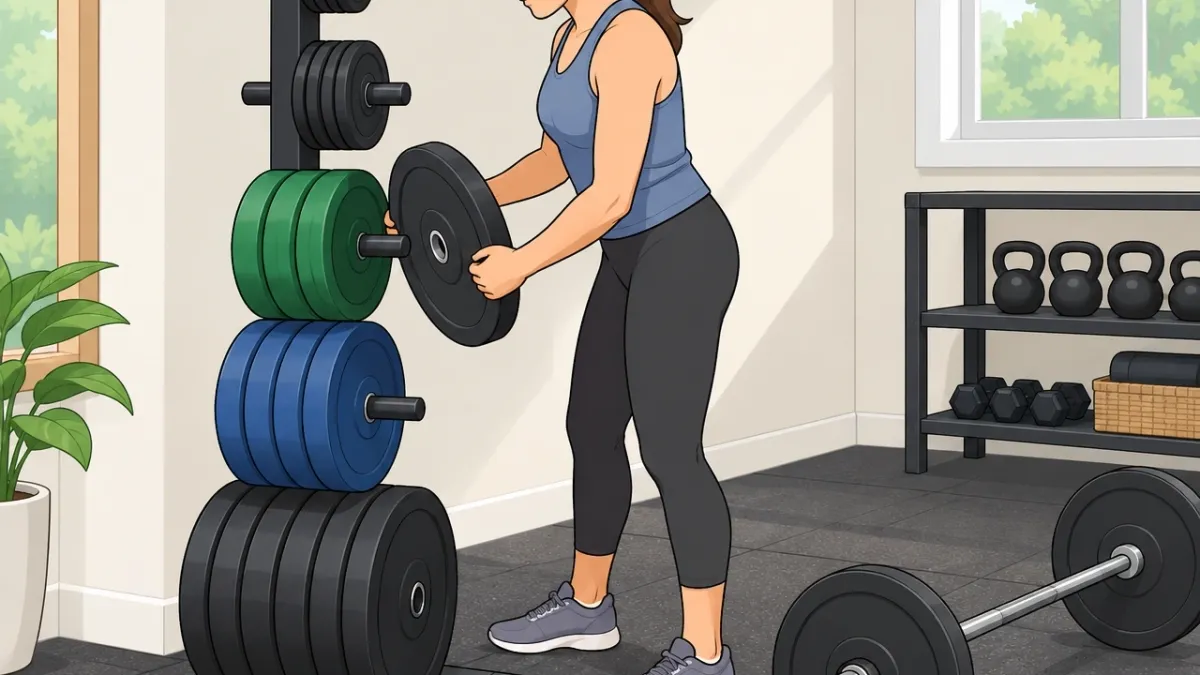
| Vertical plate tree | Small, and that is the problem as well as the appeal | High. A large total on four small feet | Good. Plates come off at hand height, sorted by size | Stability when loaded unevenly, and what the feet stand on |
| Horizontal bumper rack | Longer and lower | Spread along a bar or frame, lower center of gravity | Good for large-diameter plates, which slot in on edge | Length. It wants a wall run |
| Rack-mounted horns or pegs | None of its own | Transferred into the rack's uprights and its feet or anchors | The shortest distance to the bar of any option | Governed entirely by the rack's own manual and rated capacity |
| Wall-mounted storage | None on the floor | Into the wall structure, which is a different question entirely | Good, at whatever height it is fixed | Only as good as what it is fixed to. Fixings into structure, not into board alone |
| On the floor, stacked flat | Large | Spread, but under an awkward shape | Poor. Every plate change is a bent lift over other plates | Not storage. See below |
| On the floor, leaning against a wall | Small | Concentrated on a thin arc of rim | Poor, and plates walk outward over time | Chipping, wall damage, and a bar of iron sliding flat without warning |
Why the floor is not storage
Three reasons, in the order they usually bite.
It is a trip hazard in the one room where you carry heavy things. A plate lying flat is low, dark and easy to catch a foot on while your hands are full or your eyes are elsewhere.
It damages the plates and the floor. Plates on edge concentrate weight onto a small contact arc, which is where cast iron chips and where rubber-coated edges take a permanent flat spot.
On foam tiles it is worse, because the material compresses locally and the plate settles into it.
That is the same mechanism as a rack foot sinking, which is covered in what foam tiles do under real weight, and it is the main reason foam and heavy free weights are a poor combination.
It keeps steel in contact with the coldest, dampest surface in the room. A concrete slab holds moisture and is often the first surface in a garage to reach dew point.
Bare cast iron in contact with it rusts from the contact patch outward, which is the process described in what humidity does to iron in a garage gym.
The floor question, which comes before the product
This is the part the seller pages do not raise, and it is the reason this page exists.
Weight that was spread around the room arrives at four small feet when you buy a tree.
The total weight in the building has not changed at all, and for most ground-floor slabs none of this is a concern.
Where it matters is on a suspended wood floor, on an upper story, or over a finished ceiling, because a floor's capacity is not only about the total load but about how that load is applied and where.
We do not answer that question and neither does any article. What a specific floor, joist span or slab will carry is a licensed structural engineer's judgment about that building.
What we can tell you is which numbers people quote at each other and why the common ones do not settle it, which is the subject of what a home gym floor weight limit really means.
If your gym is above another room, read that before choosing where storage stands, not after.
Two things you can do without an engineer: put storage against a wall rather than in the middle of a span, since that is generally where a floor is best supported, and use a base or a pad that spreads the feet's contact area rather than concentrating it.
What that pad should be is a flooring decision, and what a home gym floor actually has to survive covers the trade-offs between the common surfaces.
Capacity ratings, and how to read them
Makers publish a rated capacity for trees and racks, and the figures in the search results vary widely by model.
We are not reproducing any of them here, because the only figure that matters is the one on the listing for the item in front of you, and a number copied from a roundup is one revision away from being wrong.
Three things are worth knowing about those ratings. They describe the product, not your floor.
They generally assume the load is distributed as the maker intended, meaning pegs loaded evenly rather than all the weight on one side.
And they assume assembly per the manual, including any anchoring the manual calls for.
For rack-mounted storage the rule is stricter, and it is a genuine stop condition rather than a preference.
Hanging plates on a rack's uprights adds weight and changes how the rack behaves, especially when the load sits on one side.
Whether your rack takes plate horns at all, how many, and whether it must be bolted down before you use them is answered by that rack's manual and its manufacturer.
Not by us, and not by a forum post about a different rack.
Sorting, and the part you feel every session
Storage that is right for the room and wrong for the workflow gets abandoned within a month.
Sort by size so the plate you reach for most is at hand height and on the outside.
Keep the heaviest plates lowest, which is both a stability point for the storage and the reason not to put your largest plates on a high peg.
Keep storage within a step of where the bar is loaded, because the alternative is carrying every plate twice.
And leave room to walk around it, since the storage is another object in a room that is usually already tight: measuring the space before buying gym equipment is where that fits into the wider plan.
If your plates are rubber or urethane and their maker publishes storage guidance, that document governs.
Some makers say something specific about how their plates should sit when not in use, and the maker of your plates is a better authority on them than any general article.
What this page does not do
We publish no prices, no picks and no rankings, and we have handled none of the products described.
We reproduce no capacity figure from a roundup, because the number that governs is the one on your item's own listing.
And we do not tell you what your floor will carry, which is the one question here that has a professional answer.
Frequently asked questions
What is the best way to store weight plates at home? Off the floor, close to where the bar is loaded, sorted so the plates you use most are at hand height, and standing on something that spreads the load rather than concentrating it.
Which format achieves that depends on your room: a vertical tree for a small footprint, a horizontal rack for large-diameter plates along a wall, or pegs on the rack itself if that rack's manual permits them.
Is it bad to store weight plates on the floor? It creates three problems. It puts a low, easily missed obstacle in a room where you carry heavy objects.
It concentrates the plate's weight on a small contact area, which chips cast iron and flat-spots rubber edges, and it presses into foam flooring.
And it holds bare iron against the coldest, dampest surface in the room, which is where rust starts in a garage.
Can my floor take a loaded plate tree? Possibly, and it is not a question an article can answer.
A tree gathers a large total onto a small footprint and four feet, which is a different loading pattern from the same weight spread across a room. On a ground-floor slab this is rarely the constraint.
On a suspended wood floor or an upper story, the answer belongs to a licensed structural engineer looking at your actual building.
How much weight can a plate tree hold? Whatever its maker publishes for that model, and the range across the market is wide.
Read the rated capacity on the listing for the item you are considering rather than a figure quoted in a roundup, and note that ratings assume the load is spread across the pegs as intended and that the item is assembled and anchored as the manual specifies.
Should plate storage go against a wall or in the middle of the room? Against a wall, for two reasons.
A floor is generally best supported near its edges rather than in the middle of a span, and storage against a wall is out of the path you walk while carrying weight.
Wall-mounted storage moves the load into the wall structure instead, which is only as sound as what the fixings are anchored into.