Weight Bench Recall: What the CPSC Record Shows
See what a weight bench recall actually involves, how to check your model against CPSC records, and what to inspect before you load it again.
A weight bench recall is uncommon, but the ones the U.S. Consumer Product Safety Commission (CPSC) has issued share a pattern worth knowing before you assume yours is fine. The recorded failures are a weld breaking at a stress point, a bracket letting a loaded barbell fall, or a frame collapsing forward onto the user, not a slow wear-out. The fast check is the brand, model number and serial number on your bench or rack, matched against CPSC.gov. If it matches an open recall, the agency's own instruction is to stop using it immediately and go through the manufacturer's free remedy, not a workaround.
What has actually been recalled, and what failed
CPSC's public recall record for weight benches and racks is short, but every entry names a specific mechanical failure rather than a vague "safety concern." Three examples show the pattern:
| Recall | Hazard | Units | Sold |
|---|---|---|---|
| Cybex International decline free weight bench, models 16060-16062 (2016) | Frame can collapse forward onto the user | About 400 | Dec. 2008 to Sept. 2015 |
| Powertec weight workbenches WB-MP11, WB-OB11, WB-UB11 (2013) | Weld on the backrest adjustment bracket can break | About 565 | Sept. 2011 to May 2012 |
| Rogue Fitness J-Cup barbell brackets, recalled by Coulter Ventures (2011) | Weld between the bracket and retaining pin can break, dropping the loaded bar | About 5,500 | March 2009 to Dec. 2010 |
Read on CPSC.gov's Cybex International recall notice (accessed 2026-09-18), the Cybex bench's frame could give way while the user was on it, in the decline position, with no warning short of the weld actually failing. The Powertec and Rogue Fitness cases followed the same shape: a welded joint, not the main steel tube, was the part that let go. That is the useful detail. On a bench or rack, the tubing itself is rarely the weak point; the welds and brackets holding smaller parts to the frame are.
A CPSC recall itself is a voluntary corrective action a manufacturer agrees to after a pattern of incident reports meets the threshold in the Consumer Product Safety Act, not an automatic response to every complaint. That is part of why the record for benches and racks is short: a few isolated incidents do not trigger the same process a documented pattern across the same weld or bracket does. It also means the timeline between a defect surfacing and a public recall notice can run months, and a small production run, like the roughly 400 units in the Cybex case, still qualifies if the hazard is confirmed. A short list is not the same as a clean one.
How to check for a weight bench recall on your own equipment
- Find the brand, model number and serial number. Manufacturers typically put this on a sticker or embossed plate near the base, the foot, or the frame tube closest to where you sit or stand. Cybex's recalled units, for example, carried a decal near the foot position with the serial number stamped on it.
- Search CPSC.gov by product name and brand, not just "weight bench," since recalls are filed under the manufacturer's own name.
- Check the date range, not just the model number. A model name is sometimes reused across production runs; recalls are usually scoped to a serial number or manufacture-date range, so a later or earlier unit of the same model name can be unaffected.
- Sign up for CPSC email alerts if you own equipment from a brand with any recall history. New recalls post continuously, and a bench bought two years ago can be added to the list later.
If you find a match: the stop condition
Every recall notice above uses the same language: stop using the product immediately. That is not boilerplate caution, it is the specific instruction tied to a hazard the agency has already confirmed with the manufacturer. Continuing to use a recalled bench "carefully" does not address a weld that has already failed on other units in the field. Contact the manufacturer through the number or web page listed in the recall notice; the remedy is free in every recall on this list, whether that is a replacement, a retrofit kit, or a refund. Do not sell or hand off a recalled unit to someone else without disclosing the recall, since the hazard travels with the equipment.
What the pattern says about buying or bolting one today
The recurring failure point, welds and brackets rather than the main frame, points to two things worth checking before you buy or install a rack or bench, not after.
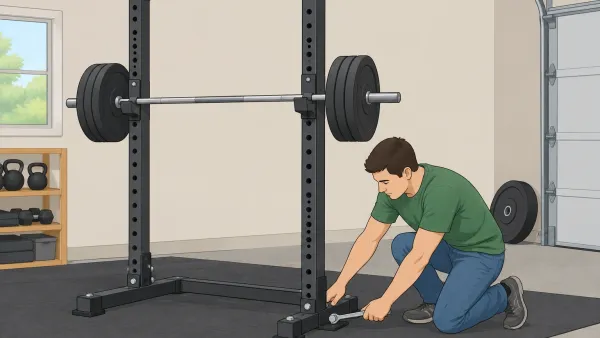
Mounting matters because it changes what the structure has to resist. Rogue Fitness's own equipment guide (accessed 2026-09-18) states that its racks are designed to be bolted to the floor, using hardware sized to the rack line, standard 5/8-inch bolts on its baseline racks and 1-inch hardware on its heavier-duty Monster series. An unbolted rack has to resist a heavy, uneven pull entirely through its own footprint and weight; a bolted rack transfers that load into the floor instead, which is the difference between a rack that rocks under an off-center pull and one that does not. If you are bolting into a concrete slab, checking what that slab can actually take, and confirming there is nothing embedded in that section of floor, before you drill is covered in protecting a garage floor used as a home gym. If your gym sits over a wood subfloor instead, the mounting question changes to finding the joists and any wiring or plumbing run beneath the decking before you drill, which is covered separately in protecting a wood subfloor and the ceiling below it.
Never guess a weight capacity figure. The manufacturer's own spec sheet or manual states the rated capacity for that specific model, engineered around the tube gauge, the weld points and the hardware used, and it is not the same number across a product line. A capacity rating is also not a guarantee against a manufacturing defect, which is exactly what the recalls above were: units built below their own rated spec because a weld was bad, not because the design was overloaded. Buy from the number the maker publishes for the exact model, not a marketplace listing's paraphrase of it, and if you are still assembling a first setup, the order to buy things in is covered in home gym free weights setup: most ground, least money.
What a recall record cannot tell you
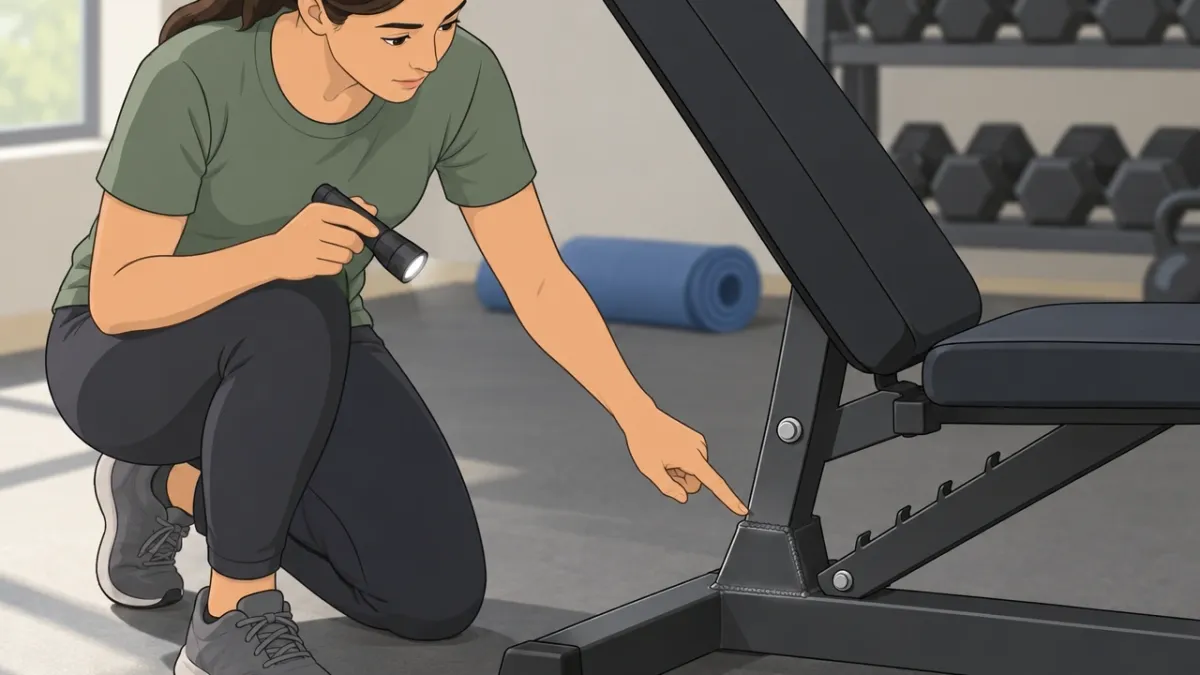
A recall means a defect was reported widely enough, and confirmed by the manufacturer, to cross CPSC's threshold for action. It does not mean everything not on the list has been checked and cleared. Ordinary wear, a rusted bolt from a humid garage, a hairline crack from years of dropped weight, or a previous owner's repair job will never trigger a recall, because a recall responds to a manufacturing defect pattern, not to age. That is the gap most "is my equipment recalled" articles leave alone: checking the CPSC list is a one-time lookup, but the welds, pins and mounting bolts on a bench or rack are worth a physical look on a routine basis, not just after a recall notice lands in your inbox. Look at the same points the recalls above named: welded joints, bracket pins, and the bolts anchoring the unit to the floor, for cracking, rust, or looseness, on a schedule, not only when you remember to.
FAQ
How do I find my weight bench's model and serial number? Check the frame near the base or the foot area first; most manufacturers place a sticker or embossed plate with the model number and a serial number or date-of-manufacture range there. If you cannot find one, the original purchase receipt or the manufacturer's own product registration page usually has it on file.
Does a recall cover a bench I bought used or secondhand? Yes. A recall is tied to the manufactured unit through its serial number, not to the original purchaser. If your bench's serial number falls inside the recalled range, the manufacturer's free remedy applies to you as the current owner.
What should I do if my bench or rack is under an open recall? Stop using it immediately, per the recall notice's own instruction, and contact the manufacturer using the phone number or web page listed on CPSC.gov for that specific recall. Do not continue using it while waiting for a response.
Are power racks required to be bolted to the floor? Requirements vary by model and manufacturer; check the specific rack's own manual. Rogue Fitness, for example, states that its racks are designed to be bolted down, and some models include an unbolted stabilizer option as an alternative, not a substitute with equal load performance.
Does the CPSC recall list cover normal wear and tear? No. CPSC recalls address manufacturing or design defects confirmed with the maker, not equipment that has simply aged, rusted, or been damaged through use. Routine inspection of welds, pins and mounting bolts covers the gap a recall list does not.