Home Gym Free Weights Setup: Most Ground, Least Money
The free-weight setup that covers the most ground is decided by load range, increment size and dependency, not by how long the seller's list is.
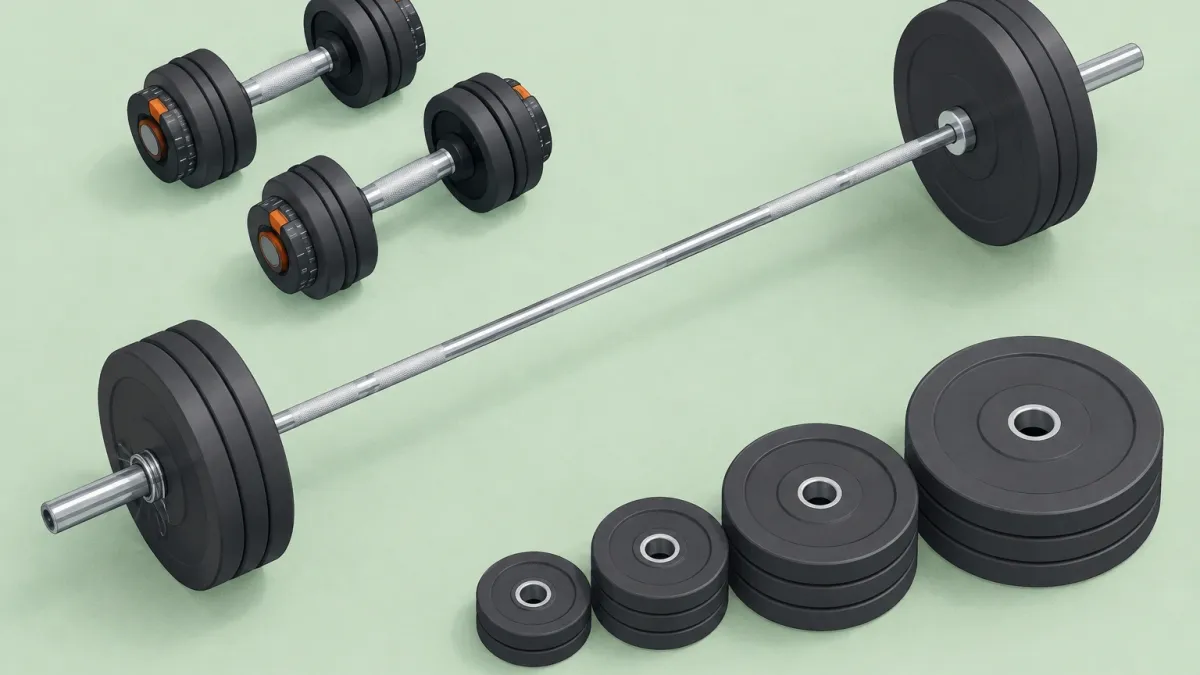
Short answer: the free-weight kit that covers the most ground for the least money is a loadable bar with plates, or one pair of adjustable dumbbells, and almost never both in the first purchase.
Coverage comes from three properties: how heavy the kit can go, how small its smallest jump is, and how many other purchases it makes necessary. The number of objects on the list is not one of them.
We own none of this equipment, have assembled none of it and have tested none of it. Everything below is a way of comparing what makers publish, not a report on what we have used.
Why every published list is a list of objects
We read the results for this query on 2026-09-07.
The first page is largely equipment sellers: RitFit publishes both a minimum home gym equipment guide and a free weight set buyer's guide, REP Fitness publishes a page on how much weight to buy, MiniBeast and Hamilton Home Fitness publish similar guides, and Home Depot has its own version.
Scott Abel Fitness and a University of Michigan news piece are the non-sellers on the page.
The seller pages are not dishonest and their lists are reasonable. They are all lists, though: bar, plates, dumbbells, bench, rack, storage. A list tells you what to add.
It cannot tell you what any of it covers, what stops working first, or which item on the list makes another item on the list pointless.
That is the question this page answers, and it is the one a company with a cart has no reason to ask.
Coverage is a property of the load, not of the object count
A free-weight setup is a way of putting a known amount of resistance into your hands, onto your back, or overhead.
Whether a kit covers a lot of ground or a little is decided by four things, and only one of them appears on a spec sheet.
Load range. The lightest and heaviest total the kit can be set to. A kit whose top end you will pass in a year is a kit you will replace.
Increment size. The smallest change you can make.
A set that jumps in ten pound steps at the top is a different object from one that jumps in two and a half pound steps, and small change plates are the cheapest thing in this category by weight.
Positions. How many ways the load can be held: one hand, two hands, at arm's length, on the shoulders, overhead.
A bar and a pair of handles differ here, and the difference is physical rather than a matter of preference.
Dependency. What else you must buy before the item does anything at all.
The dependency chain, which decides more than the list does
Half the regret in this category comes from buying something whose usefulness depends on a purchase that has not happened yet. The chain is short and worth reading before ordering anything.
| Item | Does nothing without | Becomes much more useful with | Useful on arrival |
|---|---|---|---|
| Barbell | Plates, and collars | A rack or stands, floor protection | No |
| Weight plates | A bar or a loadable handle that matches the hole diameter | Storage that is not the floor | No |
| Weight bench | Something to press or hold | An adjustable back | No |
| Power rack or squat stand | A bar and plates | Ceiling height, a bolt-down or a footprint | No |
| Adjustable dumbbells | Nothing | A bench | Yes |
| Fixed dumbbells | Nothing | A rack to hold them | Yes |
| Kettlebells | Nothing | Storage off the floor | Yes |
The right-hand column is the whole point. Adjustable dumbbells, fixed dumbbells and kettlebells work the moment they arrive.
A bar, a bench and a rack each need something else in the house first, which is why a bench bought early so often sits unused for a month.
The sequencing question that follows from this has its own page: what to buy first for a home gym sets out the order to spend in, and this page deliberately does not repeat it.
Where each free-weight kit runs out
Every kit has a ceiling, and the ceiling is usually reached in one of three ways: it will not go heavy enough, it cannot make a small enough change, or the next thing you want to do with it needs a second purchase.
| Kit | What it covers well | Where it runs out first |
|---|---|---|
| One pair of adjustable dumbbells | Two-handed and single-handed loading across a wide range from a single object, in a very small footprint | The top of the published range, and the mechanism, which is the part that fails. Increments are fixed by the design |
| A set of fixed dumbbells | Durability and instant use, with nothing to adjust or break | Money and floor space, both of which scale with every pair added, and a fixed top end |
| Kettlebells | Loading held in front of or beside the body, at a few discrete weights | Increments. You buy a new bell rather than change one, and the jumps between sizes are large |
| A bar and plates | Total load, small increments, and the widest set of positions of anything in the category | Everything else it requires: collars, storage, floor protection, and space to use it |
| A bar, plates and one pair of adjustable dumbbells | Almost the whole category | The budget, and the room |
Notice that no row of that table names a brand or a price. The ceiling of a kit is a property of the format, and it is knowable from published specifications before anything is in a cart.
The three ways money leaves this category
Weight itself. Plates and dumbbells are priced by the pound, and that is the honest way to compare them across sets of different sizes.
How to run that comparison, and what makes a low figure misleading, is a page of its own in this cluster.
Freight. This is the line that turns a cheap plate expensive, because heavy goods often ship as freight rather than as parcels, and the number arrives at checkout rather than on the product page.
What that adds and why it varies so much is covered in what shipping actually costs on gym equipment, and it belongs in the comparison before you choose between two sellers, not after.
Redundancy. Buying a kit whose coverage overlaps something you already own.
A second set of dumbbells overlapping the first is money spent on ground already covered, which is the most common quiet waste here and the reason the buy order matters at all.
The wider picture of where the money goes is in what a home gym actually costs, all in.
Increment size: the specification nobody lists
This is the information gain of this page, and it is the least discussed number in free weights.
Coverage is not only about the top end. A kit that can only change in large steps has gaps in the middle of its range, and those gaps are where a setup stops feeling usable.
Fixed dumbbells sold in pairs step in fives or tens depending on the range.
Adjustable dumbbells step in whatever the mechanism allows, which is published by every maker and is usually coarser at the top of the range than at the bottom.
A bar and plates has the finest increments available in the category, because change plates are made in small denominations and cost very little relative to their usefulness.
Read the increment before you read anything else on an adjustable dumbbell listing. It is the property most likely to be the reason a set gets replaced rather than kept.
What a free-weight setup does not cover, said plainly
A bar and plates on their own leave you with a loaded bar and no way to receive it if something goes wrong.
That is what a rack, stands and a bench are for, and it is a separate cluster of decisions with its own footprint, ceiling height and bolt-down questions.
Two things stay off this page permanently.
We publish no training program, no rep scheme, no load and no progression, because the author of this site states plainly that he is not a certified personal trainer, and prescribing training would be a credential we do not have.
And we do not tell you what your floor will carry. That is a licensed structural engineer's judgment about your specific building.
Anything loaded overhead or over your body needs collars on the bar and an even load on both sides. That is the one non-negotiable in this category, and it has its own page in this cluster.
Buying cheap on purpose, which is sometimes correct
There is an honest case for buying the least expensive version of a free-weight item first, and it is not the case sellers make.
It applies when you do not yet know your own top end, when the item is easy to resell, and when the expensive version differs mostly in finish.
It applies far less well to anything with a mechanism in it.
The trade-off, including which items genuinely survive being bought cheap and which cost more in the end, is set out in buying cheap gym equipment and upgrading later.
The resale side matters too, because free weights hold value better than most categories: what happens to unused home gym equipment on the resale market is a useful check on any purchase you are unsure about, since an item that resells easily is a smaller mistake than one that does not.
What this page does not do
We publish no prices, because prices in this category move and a wrong number costs a reader more than a missing one.
We name no best product, we rank nothing, and we have handled none of the equipment described. Brand names appear here only to identify who published a page we read, never as a recommendation.
Frequently asked questions
What is the minimum free-weight setup for a home gym? The smallest kit that still covers a wide range is one loadable format plus the accessories it requires: either a bar with plates and collars, or one pair of adjustable dumbbells.
Which of the two suits you depends on your room, your storage and whether you want the finest increments or the smallest footprint.
Adding a second format before the first is in regular use is the most common way money is wasted here.
Are dumbbells or a barbell better value for a home gym? By weight, a bar and plates is usually the most weight per dollar in the category and it offers the smallest increments, because change plates are made in small denominations.
It also carries the most dependencies: collars, storage, floor protection and space.
A pair of adjustable dumbbells has no dependencies and a much smaller footprint, and its ceiling is the published top of its range and the durability of its mechanism.
How much total weight should I buy? Sellers answer this with a number, and the honest answer is that it depends on your own top end, which you may not know yet.
What is checkable before buying is the range and the increment the kit can be set to, both of which every maker publishes.
We do not prescribe loads, sets or progressions on this site, and a purchase framework is not the place to start.
Do I need a bench and a rack to start with free weights? Not to use dumbbells or kettlebells, which work the moment they arrive.
A bar and plates is a different case: a loaded bar has to be received somewhere, and that is what stands, a rack and a bench are for.
Those items also carry their own space and structural questions, which is why they sit in a separate cluster on this site rather than in the free-weight purchase.
Why do so many free-weight guides recommend the same list? Because most of the pages ranking for this query are published by companies that sell the items on the list.
We read the results on 2026-09-07 and the first page was dominated by sellers including RitFit, REP Fitness, MiniBeast, Hamilton Home Fitness and Home Depot. Their lists are reasonable.
The answers a seller structurally cannot give are "you do not need the third item yet" and "wait", and those are often the correct ones.