Olympic Bar or Standard Bar: Does the Sleeve Diameter Matter?
Two published dimensions decide which plates fit, which racks fit, and who will buy it from you later. It is a compatibility decision, not a quality one.
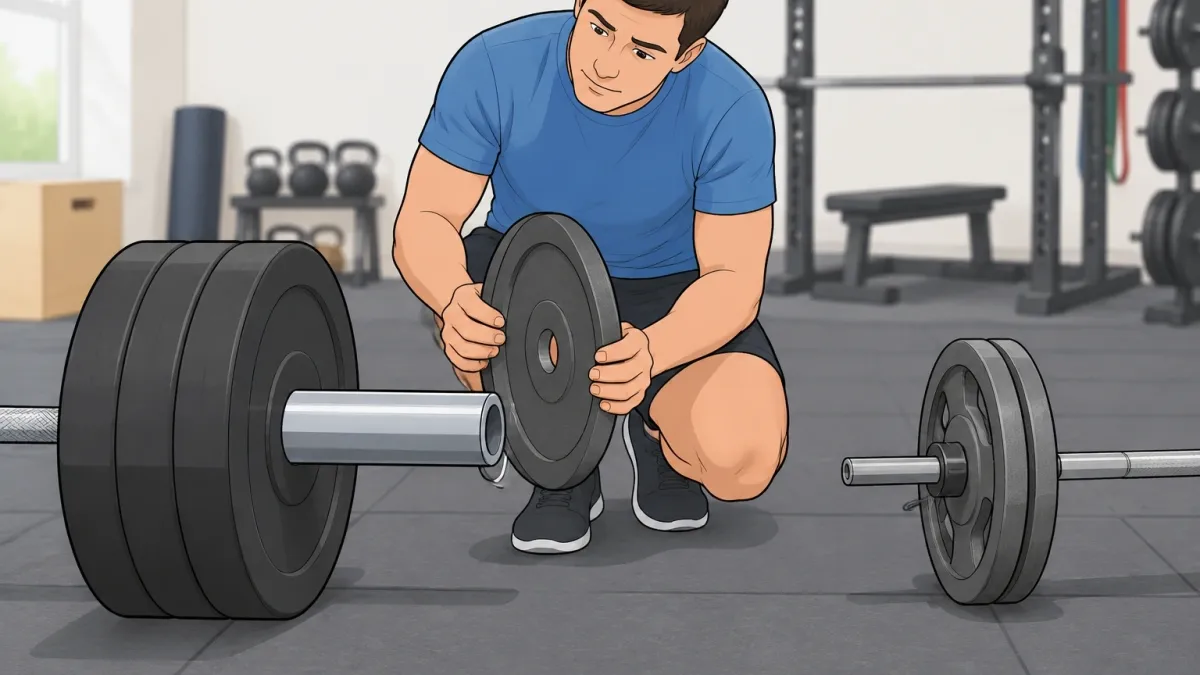
It matters, and not for the reason the question implies. The sleeve diameter is not a quality grade.
It is a compatibility decision, and it decides three things that follow you for as long as you own the bar.
We own no barbell of either type and have measured nothing. Nothing here is a report of experience.
The two dimensions
The sleeve is the part the plates go on, and there are two common sizes in the home market.
Olympic sleeves are 50 mm, about 2 inches.
Standard sleeves are 1 inch.
They do not fit each other. A 1 inch plate does not go on a 50 mm sleeve, and a 50 mm plate falls straight off a 1 inch one. That single incompatibility is the whole of this decision.
Those two figures are published specification numbers, and this site established them in its earlier used-market work, where they turn out to explain the resale split.
They are not measurements of ours.
What each choice commits you to
Plates
Every plate you ever buy for this bar has to match the sleeve. That is the commitment, and it is a larger financial commitment than the bar itself over time, because plates accumulate.
Olympic plates are the common format, so the range available new and second-hand is much wider, and bumper plates are essentially an Olympic-sleeve product.
Standard plates are cheaper and much less common, and the selection is thinner.
Racks and equipment
Rack J-cups, safeties and storage pegs are sized for a bar. Most home racks are built around an Olympic bar, because that is the market.
A standard bar in an Olympic rack is a loose fit and, more importantly, a standard bar is generally not designed for the loads a rack implies, which brings us to the point that decides most of these.
The bar itself
The two categories are not built to the same duty.
Most standard bars are lighter, thinner and made for lighter loading. That is not a criticism; it is the market they exist for.
Olympic bars, as a category, are built around heavier loading and around being racked.
We publish no load rating or tensile strength figure, because they vary by product and because a bar's rated capacity is a number the maker publishes, or does not.
Look for the maker's own published rating. If a listing gives you an adjective instead of a figure, that is information.
That absence is a pattern on this site rather than a one-off.
"Commercial grade" has no definition and no certifying body, while ISO 20957-1:2024 publishes real class designations, and on the same product page the marketing can say commercial while the warranty voids on commercial use.
That is on what commercial grade actually means, and the same discipline applies here: ask which document the claim comes from.
The resale consequence, which is the part nobody plans for
This is the sharpest reason to think about it before you buy.
A published dimension decides your market. An Olympic bar and Olympic plates have thousands of potential buyers in a city, because that is what everyone else has.
A 1 inch set has only the people who already own a 1 inch bar, which is a much smaller and shrinking group.
So the exit price is not really about condition. It is about who can use it, and that is decided by a number on a specification sheet before you ever buy it.
And there is no dataset behind any resale percentage you read. This site's earlier work established that no public sale-price dataset exists for this category at all, so anyone quoting a figure is quoting themselves.
What is knowable is liquidity, and liquidity here is a function of the sleeve.
That reasoning is on what resale tells you about unused equipment.
When standard is the right answer
Not never, and the honest cases are specific.
You already own 1 inch plates. Then the bar is the cheap part and the plates are the investment, and switching means replacing all of them.
Space and weight are the binding constraint, and a shorter, lighter bar fits a room where a full-length Olympic bar does not.
You are not going to load it heavily, and you know that.
Budget is genuinely the constraint today and you would rather start than wait. That is a legitimate position and it should be taken knowingly rather than by accident.
When Olympic is the right answer
Almost everywhere else, and the reasons stack: plate availability, rack compatibility, bumper plates, second-hand supply and resale.
If you are buying a rack, or think you might, buy Olympic. The rack decision effectively makes this one.
The thing to check on any listing
The sleeve diameter, in figures, not in words.
Listings say "fits standard plates" and "Olympic style" and both phrases are used loosely.
A specification is a number. If a listing does not give one, that is the question to ask the seller before buying, and it is the single most consequential question on the page.
Also check the bar's length and its weight, because both vary within each category more than people expect, and length is what decides whether it fits your rack and your room.
If you are still deciding what to buy at all
The order of purchase matters more than the specification of any single item, and that is on what to buy first for a home gym.
What this page does not publish
No load ratings, tensile strengths, weights, lengths or prices. Those are per product and the maker publishes them, or does not, which is itself the useful check.
No brands, product names or rankings. We have bought nothing.
No load, rep or programming guidance. This is an equipment site.