Is a Doorway Pull-Up Bar Safe? 4 Mount Types Compared
A doorway pull-up bar is safe under its rated capacity on a sound frame. Compare doorway, wall, ceiling and rack mounts before you drill.
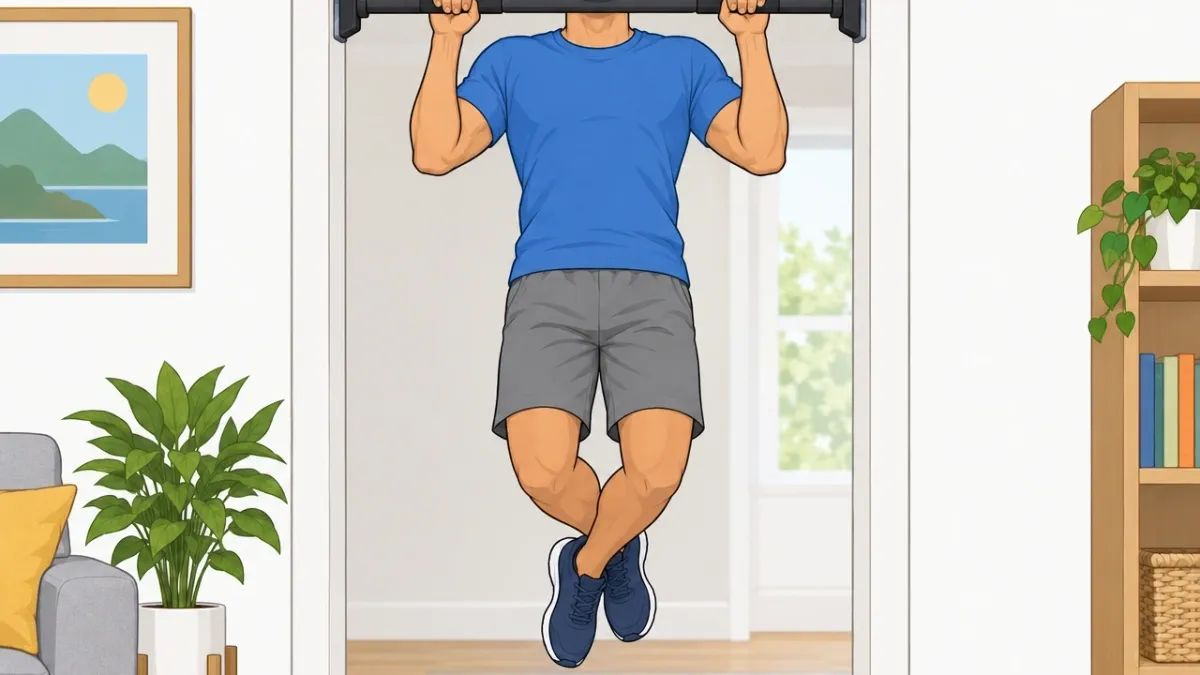
A doorway pull-up bar is safe when three things line up: your body weight sits well under the bar's rated capacity, the door frame is solid wood with no rot or hollow trim, and your reps are controlled rather than kipped or swung. Take away any one of those and the risk shifts from "unlikely" to "when," not "if." The real hazard is not a scraped knuckle. It is the bar's anchor point releasing under load while your feet are off the ground, which is a fall injury, not a workout mishap.
This guide compares the four ways a pull-up bar actually gets held up, what each one is rated for, where that rating comes from, and the point at which you should stop trusting a doorframe and mount into something structural instead.
What Makes a Doorway Pull-Up Bar Safe
A doorway pull-up bar is a lever, not a fixed point. It presses outward against the door trim (or wedges against the frame, depending on the design) using your body weight as the load. The manufacturer's weight rating describes a static number tested under controlled conditions, not what your body does mid-rep. A fast, bouncy pull-up or a kip can put considerably more force through the bar than your standing body weight alone, because you are adding acceleration on top of mass. That gap between the rated number and real-world dynamic load is the single most misunderstood spec in this category, and it is why "I only weigh 180 and the bar is rated for 220" is not the safety margin it sounds like.
This is not a hypothetical risk. The CPSC's 2011 recall of the Perfect Pullup doorway bar covered about 7,000 units after roughly 2,200 reports of the plastic handle cracking, with 38 injuries reported including bruises, strains and sprains (CPSC recall notice, read 2026-09-18). That is exactly the kind of contact-point failure the warning signs later in this guide are built to catch early.
ProsourceFit's own doorway bar, for example, lists a 220-pound capacity for a bar that clamps into a standard 25 to 39-inch frame with no drilling required (manufacturer product page, read 2026-09-18). That number is the ceiling for a controlled set, not a guideline for how close you can get to it.
The Door Frame Itself: What to Check Before You Hang Anything
The bar is only as good as what it presses against. Before mounting a no-drill doorway bar, check the trim for:
- Solid wood, not hollow composite trim. Some builder-grade door casings are lightweight molded material over a hollow core. A bar that clamps against this can crush the trim under load rather than hold.
- No rot, water staining, or old screw holes weakening the wood at the contact points.
- A frame that is actually load-bearing structure, not a lightweight closet or bifold-door surround installed for looks rather than strength.
- Door width within the bar's stated range. Forcing an oversized bar into a narrow frame, or the reverse, changes the angle the bar presses at and can walk it loose over a session instead of the first rep.
If the frame fails any of these, the fix is not a stronger doorway bar. It is a different mounting type.
Wall-Mounted Bars: When the Doorway Isn't Enough
A wall-mounted bar bolts into structural framing rather than pressing against trim, which is why manufacturers rate them meaningfully higher than clamp-in doorway bars. That higher number only holds if the bolts land in real studs. US residential framing is almost always spaced 16 inches on center, occasionally 24, so locating studs with a stud finder and confirming the spacing before drilling matters more than the bar itself.
Before you drill into any wall, run a stud finder that also flags wiring and pipes, and mark every hit before the first hole. Interior walls sometimes route electrical cable or, less often, plumbing at heights that intersect a pull-up bar's typical 7 to 8-foot mounting zone. A cable nicked by a drill bit is a shock and fire hazard that has nothing to do with the pull-up bar itself, and it is entirely preventable by checking first. If a stud finder gives an ambiguous reading, or the wall is masonry, tile over concrete, or anything other than standard drywall-over-stud framing, stop and get the wall confirmed before drilling rather than guessing.
Once studs are confirmed, lag bolts go into the center of the stud, driven with a drill rather than muscled in by hand, since overtorquing a lag bolt can shear it. For anyone weighing more, training with added load, or simply wanting a wider margin than a doorway bar offers, this is the upgrade path, and it is also where a home gym free weights setup usually starts adding fixed anchor points instead of clamp-on gear.
Ceiling-Mounted Bars: Joists, Not Drywall
A ceiling mount carries your full bodyweight in tension straight down, which is the least forgiving load path of the four. It must land in a ceiling joist, never in drywall alone, and the installer needs to know what is running through that ceiling cavity before drilling: wiring, HVAC ducting, and in older homes sometimes plumbing vents. The same detector-first approach that applies to walls applies overhead, and the stakes are higher because you are drilling upward into a cavity you cannot see into as easily.
If you are mounting into the ceiling of a room with a finished floor above it, such as a garage below a bedroom or a basement below the main living space, the joist spacing and the load path through the floor above are both worth understanding before you commit to a location, which is the same structural logic covered in protecting a wood subfloor and the ceiling below it. A ceiling mount is not a project for uncertain framing; if you cannot positively identify joist locations and spacing, this is the mounting type to skip in favor of a wall or rack-based option.
Rack-Mounted Pull-Up Stations: The Structural Frame You Bring With You
A power rack or a dedicated pull-up station with its own frame does not depend on your home's structure at all. The rated capacity comes from the rack manufacturer's own steel gauge and weld specs, published on the maker's site, and the load path runs straight down to the floor through the rack's own feet rather than through your walls or ceiling. This is the highest-capacity option and the one to choose if you plan on adding a band, a dip attachment, or eventually hanging additional weight.
What it does ask of you is a stable floor. A rack sitting on carpet padding can rock slightly with every rep, which loosens floor bolts over time, and a rack on an unprotected slab can chip the concrete at the feet under repeated impact. If the station is going in a garage, the same prep covered in protecting a concrete garage floor from cracking and drop zones applies before the rack goes down, not after. If it is going onto a carpeted spare room instead, setting a home gym up over carpet the right way keeps the base from shifting under a full-bodyweight pull.
Warning Signs That Mean Stop, Not Reset
Most failures give a warning before they happen. Stop using any pull-up bar, of any mounting type, if you notice:
- The bar shifts or creeps after every set, even after you reset and re-tighten it.
- Cracks, dents, or peeling paint at the contact points on a doorway bar's trim.
- Any wobble in wall or ceiling brackets that wasn't there on day one.
- Rust or visible weld separation on a rack-mounted station.
None of these are cosmetic. They are the structure telling you the load path has already started to fail.
Which Type Fits Your Space and Body Weight
There is no single "safest" bar, only a match between your body weight, your training style, and what the mounting point can actually carry. A lighter user doing strict, controlled reps on a solid wood frame is a reasonable fit for a doorway bar rated well above that weight, such as the 220-pound example cited above. Anyone heavier than a clamp-in bar's rated capacity, doing kipping or dynamic work, or planning to add load, is better served by a wall mount into confirmed studs, a ceiling mount into confirmed joists, or a freestanding rack that carries its own weight to the floor.
FAQ
Is it safe to do pull-ups every day on a doorway bar? Frequency is a training question, not primarily a structural one, provided the bar stays within its rated capacity and the frame shows no wear signs described above. Check the mounting points periodically rather than assuming a bar that held on day one still holds after months of use.
Can a doorway pull-up bar damage the door frame? Yes. Clamp-style bars press outward against the trim, and repeated use can crack or loosen molding, especially on hollow composite trim. Solid wood frames handle this far better than lightweight builder-grade casing.
Do I need to find a stud for a doorway pull-up bar? No-drill doorway bars rely on frame pressure, not studs, which is the entire point of that design. Wall-mounted and ceiling-mounted bars are the two types that require confirmed studs or joists.
What weight capacity should I look for in a pull-up bar? Choose a rated capacity comfortably above your body weight, not just above it, since dynamic movement adds force beyond your static weight. Check the manufacturer's own published spec rather than a marketplace listing, since capacity claims vary between the two for the same product.
Are wall-mounted pull-up bars stronger than doorway bars? Generally yes, because a wall mount bolts into structural framing rather than pressing against door trim, which is why manufacturers rate them for higher capacities. That higher rating still depends on the bolts landing in real studs, confirmed before drilling.