Barbell Specs Explained: What the Numbers Actually Govern
Shaft diameter, knurl, sleeve length, spin and tensile strength: what each barbell spec governs, and why your bar's numbers come from its own listing.
Short answer: a barbell spec sheet is five decisions in disguise.
Shaft diameter governs how the bar feels in the hand and how much it flexes, knurling governs grip, loadable sleeve length governs how much weight physically fits, sleeve rotation governs how much twist reaches your wrists, and tensile strength governs how the steel behaves under load.
None of them is a quality score, and none of the numbers below is universal. Your bar's numbers come from your bar's listing.
We own no barbells and have handled none. Every figure here is attributed to the company or body that published it, with the date we read it.
The spec sheet, and the decision each line governs
| Spec | Usually printed as | What it actually governs |
|---|---|---|
| Bar weight | Pounds or kilograms | The starting number in your total load, before any plate |
| Overall length | Inches or millimeters | Whether the bar fits your room and your rack's inside width |
| Shaft diameter | Millimeters | Grip feel, and how much the bar flexes under load |
| Knurling pattern | A name, sometimes a depth | How much friction there is between hand and steel |
| Knurl marks | Position, single or dual | Reference points for hand position, set by discipline |
| Center knurl | Present or absent | Whether the middle of the bar grips a shirt or bare skin |
| Sleeve diameter | Millimeters or inches | Which plates fit at all |
| Loadable sleeve length | Millimeters or inches | How much weight physically fits before you run out of sleeve |
| Sleeve rotation | Bushings or bearings, sometimes a count | How much of the plates' spin is transmitted to your wrists |
| Tensile strength | PSI | The stress the steel is rated to before it fails in a tensile test |
| Load or capacity rating | Pounds, sometimes with a test named | What the maker says the assembled bar will take |
| Finish | Bare steel, zinc, black oxide, chrome, cerakote, stainless | Rust behavior, feel through the knurl, and maintenance |
Read that table right to left. The right-hand column is what you are actually choosing between, and the left-hand column is only how it gets advertised.
Tensile strength is not a load rating, and this is the confusion worth clearing
This is the single most misread number in the category, and it is the reason this page exists.
Tensile strength is a property of the steel, quoted in pounds per square inch, and it describes the stress at which the material fails in a standardized tensile test.
It is not a statement about how much weight you can hang on the bar, and it does not become one by being large.
Vulcan Strength, which makes barbells, publishes brackets on its buying guide: it describes 150,000 to 180,000 PSI as "mid-range and suitable for most lifters", 180,000 PSI and above as recommended "for experienced lifters who are into powerlifting", and 200,000 PSI and above as "practically indestructible" for advanced lifters (blog.vulcanstrength.com, read 2026-09-07).
Those are one maker's brackets, published to sell its own range, and another maker's page will bracket them differently.
The separate number is capacity.
Vulcan distinguishes tensile strength from total load capacity and states that its barbells go through a "1500 lb deflection test" and a "140 kg dropping test" (read 2026-09-07).
That is a far more useful kind of claim, because it names a test rather than a material property.
When a listing gives you a capacity figure with no test behind it, you are reading marketing, and what the phrase commercial grade actually means on gym equipment covers why that language is worth so little in this industry.
Shaft diameter: feel first, flex second
Shaft diameter is quoted in millimeters and it changes two things at once: how the bar sits in your hand, and how much it bends under load.
Vulcan Strength publishes the conventions by discipline: 25 mm as the standard for women in Olympic weightlifting, 28 mm as the standard men's Olympic weightlifting bar, 28.5 mm as a hybrid or mixed-use diameter for the squat, bench press and deadlift, 29 mm as the powerlifting standard for both men and women, and 32 mm as a squat bar diameter (read 2026-09-07).
Those conventions are widely shared across makers, and the exact figure for any given bar is on that bar's own listing.
The practical consequence is grip, not prestige. A thinner shaft is easier for a smaller hand to hold and flexes more; a thicker shaft is stiffer and harder to grip.
Neither is better in the abstract, and this site does not tell you which lifts to do with which bar.
Knurling: a friction spec with names instead of numbers
Knurling is the crosshatched pattern cut into the shaft, and its job is friction between hand and steel.
Most makers name the pattern rather than publish a depth, which makes this the least standardized line on any spec sheet.
Vulcan Strength names three common patterns: hill knurling, which it describes as having "flat tops with minimal grip" and associates with cheaper barbells; volcano knurling, a pattern of "small craters" offering "good grip without tearing"; and mountain knurling, "the most aggressive and pointy knurling" for maximum grip (read 2026-09-07).
Other makers use other names for similar patterns, so the name on one listing is not comparable with the name on another.
Two related lines are more objective. Knurl marks are the smooth rings that break the pattern, and their spacing follows the discipline the bar is built for.
A center knurl is a patch of knurling in the middle of the shaft. Both are simply present or absent, and both are visible in the product photograph.
Loadable sleeve length: the spec that decides whether your plates fit
This is the most useful number on the sheet and the one most often skipped, because it is arithmetic rather than adjective.
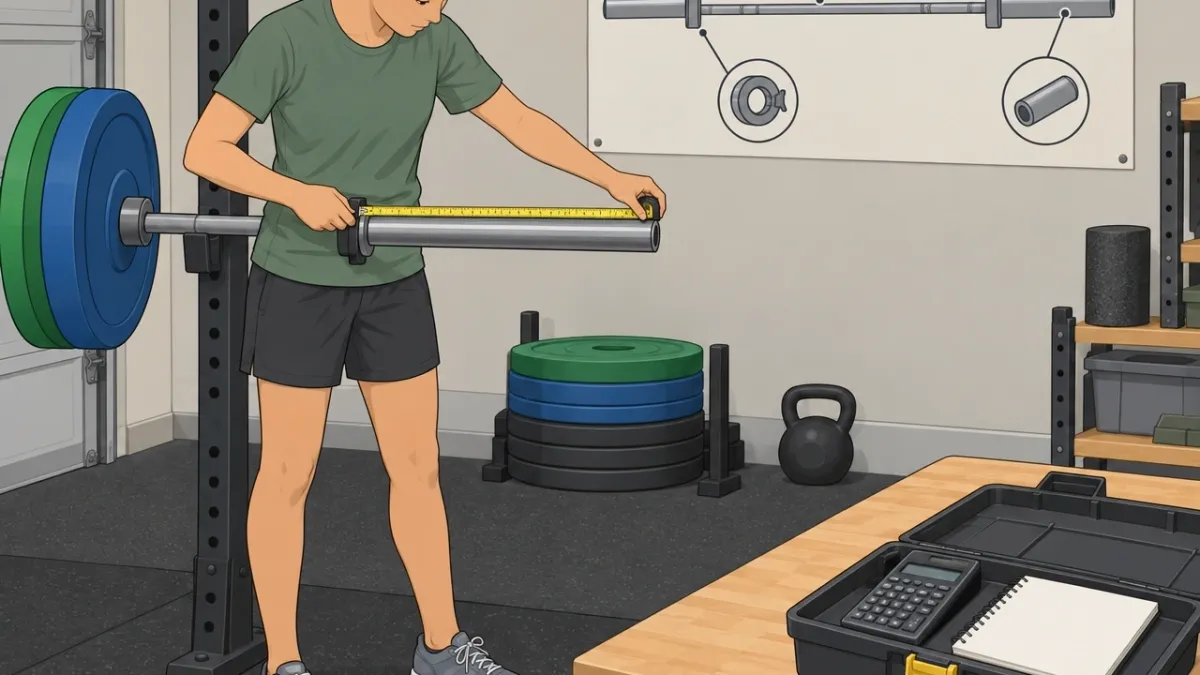
The loadable sleeve length is how much of each sleeve is available for plates. Subtract the space your collar occupies, then divide what is left by the width of the plates you own or intend to buy.
That gives you the number of plates that physically fit on each side, and therefore the highest total the bar can hold regardless of what its capacity rating says.
Two things eat this length faster than people expect. Rubber bumper plates are considerably wider than iron plates of the same weight, because rubber is less dense than cast iron.
And competition collars are not weightless: the IWF's Technical and Competition Rules specify collars of 2.5 kg each, a figure reproduced in the published rules of national federations, which is where we read it on 2026-09-07 rather than from the IWF document itself.
Both the width and the weight of what you clamp on belong in the calculation before you order plates.
Sleeve rotation: bushings, bearings, and what spin is for
Sleeves rotate so that the plates can spin without the bar twisting your wrists with them.
There are two common mechanisms and makers publish which one a bar uses.
Vulcan Strength describes bushings as the slower option, "less complicated, they last longer, and are more affordable", and better suited to powerlifting bars; and bearings as "much faster" and preferred for Olympic lifts, while noting that "durability is usually lower, and they cost far more" (read 2026-09-07).
Fringe Sport, another maker, describes the purpose in terms of what reaches the lifter: spin reduces the torque felt during explosive movements, which it frames as easier on shoulders, elbows and wrists (fringesport.com, read 2026-09-07).
Note that this is a description of a mechanism, not a health claim, and we make none. If you have a joint question, that belongs with a clinician who has examined you, not with a spec sheet.
Whip: a real property with no agreed number
Whip is the flex and rebound of a loaded bar, and it is the spec where language gets loosest.
Fringe Sport defines it as "the difference between yield strength and tensile strength", and adds that "Whip occurs in a barbell when it changes directions quickly, and allows the lifter to use the momentum from the barbell initially in their lift, not them." (read 2026-09-07).
Other makers describe whip primarily as a function of shaft diameter, length and steel treatment.
There is no single published figure for whip on a spec sheet, which is exactly why it is worth being suspicious when a listing sells it as if there were.
Treat whip as a qualitative claim that is influenced by numbers you can check, mainly diameter and length, rather than a number in its own right.
Finish: the line that matters most in a garage
The finish is the only spec on the sheet whose consequences show up on a timetable. Bare steel gives the most direct feel through the knurl and rusts fastest.
Zinc, black oxide, chrome, cerakote and stainless trade some of that feel for protection, and makers publish which one a bar has.
If the bar is going to live in a garage, this line is worth more attention than tensile strength.
What humidity does to iron and steel in a garage gym covers the conditions that decide it and what the maintenance actually involves.
Where your bar's numbers come from
Not from this page. Every figure above belongs to the company or body that published it, on the date we read it, and it applies to that maker's own products.
Your bar's shaft diameter, sleeve length, capacity rating, finish and rotation type are on your bar's listing or in its manual, and if a seller cannot produce them, that absence is itself information.
Two more numbers come from your room rather than the listing: a full-length bar needs clear width to load and to carry, which is why measuring the space before buying gym equipment and what space a home gym actually needs both belong before the order, not after it.
What this page does not do
We publish no price and no ranked list, we recommend no bar, and we have handled none.
We do not tell you which lifts to do or how to load a bar, because the author of this site is not a certified trainer and says so publicly.
And we do not present any figure above as an industry standard: they are one maker's published claims, dated, and there to show you what a spec sheet is telling you when it uses the same words.
Buying the least expensive bar is sometimes the right call and sometimes the expensive one, and when cheap equipment is worth upgrading later sets out which side of that line different items fall on.
Frequently asked questions
What tensile strength do I need in a barbell? Tensile strength describes the steel, not the bar's carrying capacity, so the question does not have a universal answer.
Vulcan Strength, a barbell maker, brackets 150,000 to 180,000 PSI as suitable for most lifters and 200,000 PSI and above as "practically indestructible" on its own guide (read 2026-09-07).
Treat those as one maker's framing. The number that describes what the assembled bar will take is a capacity or deflection rating with a named test behind it.
What does loadable sleeve length mean? It is the usable length of each sleeve, the part where plates go.
It sets a hard ceiling on how much weight fits, independent of any capacity rating. Subtract the width your collars need, then divide by the width of your plates.
Bumper plates are wider than iron plates of the same weight, so a bar that holds a lot of iron may hold much less in rubber.
Is a thicker barbell better? No, it is different. Shaft diameter changes grip and flex.
Vulcan Strength publishes 25 mm and 28 mm as Olympic weightlifting conventions, 28.5 mm as a hybrid diameter, 29 mm as the powerlifting standard and 32 mm for squat bars (read 2026-09-07).
Which one suits you is a hand-size and discipline question, and your own bar's figure is on its listing.
Do I need spinning sleeves on a home gym barbell? Sleeve rotation exists so plates can turn without twisting the bar in your hands.
Makers publish whether a bar uses bushings or bearings; Vulcan Strength describes bushings as slower, cheaper and longer lasting, and bearings as faster, more expensive and generally less durable (read 2026-09-07).
Which matters depends on what you intend to do with the bar, which is a question for you rather than for us.
Why do two bars with the same tensile strength cost so differently? Because tensile strength is one property of one component.
Finish, machining of the knurl, sleeve assembly and rotation hardware, tolerances, testing and warranty all sit outside that number, and only some of them are published.
A single impressive figure on a listing that omits sleeve length, rotation type and a tested capacity is telling you what the seller chose to lead with.