Barbell Collars for a Home Gym: Why Cheap Ones Slip
What a barbell collar does, why spring clips and plastic snap collars lose grip, what to check before you load, and when to replace them.
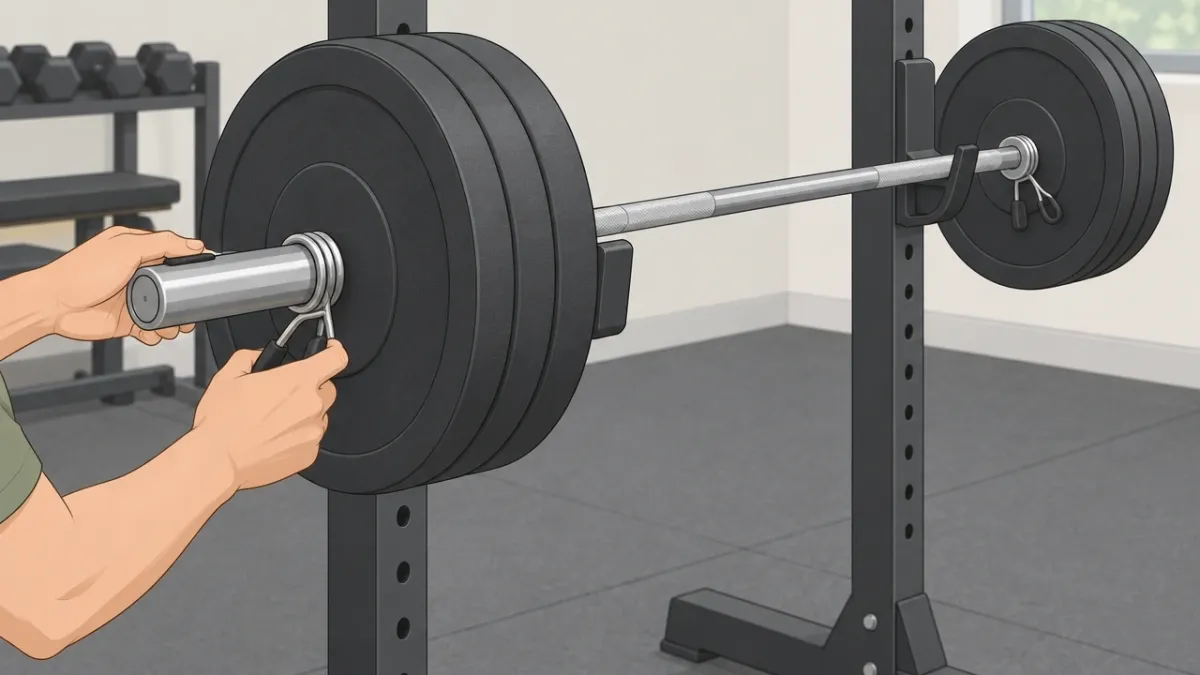
Short answer: a collar has one job, which is to stop weight plates migrating along the sleeve while the bar moves.
It holds by friction, not by structure, and that friction degrades as a spring fatigues, as a lever's cam wears, as plastic ages, and as the sleeve gets worn, dusty or oily.
A bar is loaded evenly on both sides, and collars go on for anything lifted overhead or over your body.
If a collar can be slid by hand once it is closed, it is not doing its job and it needs replacing.
We have not tested any collar, we own none, and we name no brand as unsafe. Everything below is either mechanism or a quotation from a company that publishes about its own products.
What a collar actually does, and what it does not
A collar resists plates sliding outward along the sleeve. It does that by pressing against the sleeve hard enough that friction holds it in place, and by physically standing in the plates' way.
Three things it does not do, all of which get assumed.
It is not a structural fastener. It is not designed to hold a plate on a bar that is being dropped, tipped past a steep angle, or landed on one end, and no collar is rated as if it were.
It does not correct an unevenly loaded bar. If one side has more weight than the other, the collar holds that imbalance in place rather than fixing it.
It does not replace whatever receives the bar.
On a rack, the arms, pins or straps that catch a failed lift are separate equipment with their own ratings, and how to set them is answered by that rack's manual and its maker, not by an article.
The failure that this article exists to prevent
The dangerous sequence is not a plate falling straight off a level bar. It is a runaway, and it happens in an order.
The bar tips slightly, because a lift finishes unevenly, because it is set down on one side first, or because it is racked at an angle.
Gravity now has a component pulling the plates outward along the low sleeve. If the collar's grip is less than that force, the plates start to travel.
As soon as the low side loses even one plate, that side becomes lighter, the bar tips harder the other way, and the process accelerates on the opposite sleeve.
A bar that was balanced two seconds ago is now unloading itself in both directions.
That is why the failure is worse than it first sounds. It is not one plate coming off.
It is a bar whose balance is changing while you are still holding it, or while it is over your body or over your head.
Why the inexpensive ones lose grip
The grip a collar has is clamping force multiplied by friction, and every cheap collar type loses one or both of those over time.
Spring clips. These are two handles on a coiled spring, and the spring provides all of the clamping force.
Springs take a permanent set when they are over-opened repeatedly, which is exactly what happens every time plates are changed, so the force falls off gradually rather than suddenly.
Bells of Steel USA, which sells them, publishes this plainly on its own page: spring collars are "totally fine for most general strength training", they can "lose their grip, especially on well-worn bars with thinner sleeves", and "Spring collars aren't immortal.
Over time, they can bend, loosen, or get stuck." (bellsofsteel.us, read 2026-09-07).
Plastic snap or clamp collars. The lever multiplies your hand force and a plastic body carries it.
Plastic creeps under sustained load, gets brittle in a cold garage, and the cam or the hinge wears where it rubs.
A lever that closes with noticeably less resistance than it used to is telling you the clamping force has fallen.
Screw collars. These hold well when tightened and rely entirely on the user tightening them. Worn threads, grit in the threads and a habit of nipping them up loosely are the failure modes.
Marcy, which manufactures fitness equipment, describes the same pattern in its collar guide: spring clips "Can loosen over time" and are "Less secure during high-impact lifts", and collars should be replaced when they "show signs of wear" or "no longer secure plates properly" (marcypro.com, read 2026-09-07).
Neither that page nor the Bells of Steel page publishes a weight limit or a holding force for a spring collar, and we are not going to invent one.
The sleeve is half of the problem
A collar's friction is a partnership with the surface it grips, so an identical collar behaves differently on two different bars.
A worn sleeve is slightly smaller in diameter than a new one, and a smaller sleeve inside the same spring means less clamping force.
A sleeve carrying oil, protectant or fresh grease is a low-friction surface by design. Chalk dust, rubber crumb and paint flakes from plate holes all sit between the collar and the steel.
And corrosion changes the surface in both directions: pitting can grab, while a loose flaky rust layer shears and lets the collar creep.
Bells of Steel names worn bars with thinner sleeves specifically as where its own spring collars lose grip (read 2026-09-07).
Corrosion is a live issue in most home setups, since bars and collars usually live in a garage.
What humidity does to iron and steel in a garage gym covers the conditions and the maintenance, and a wiped, dry sleeve is the cheapest grip improvement available to anyone.
What to check, and when
Two of these take seconds and belong before every loaded set. The rest belong on whatever schedule you keep for the rest of the equipment.
| Check | How | What a fail looks like |
|---|---|---|
| Plates seated | Push both plate stacks in against the shoulder of the sleeve before closing the collar | A visible gap between plates, or a plate that rocks |
| Collar holds | Once closed, try to slide it outward by hand | It moves at all |
| Even load | Count the plates on both sides, and count the collars | Different plates, or different collar types, on each side |
| Spring condition | Open and release the clip off the bar | It does not return to its original shape, or it opens with much less force than it used to |
| Lever or cam | Close the collar on the bar and feel the resistance | It closes with little or no resistance, or the plastic has whitened or cracked at the hinge |
| Threads | Run a screw collar all the way on and off | Grit, binding, or a knob that turns past tight without gripping |
| Sleeve surface | Look and wipe | Oil, grease, dust, crumb, loose rust |
Stop conditions, written down rather than left to judgment. If the collar slides by hand, stop and replace it before loading.
If a spring clip is visibly bent or no longer returns, stop and replace it. If plastic is cracked, whitened at the hinge, or the lever has gone slack, stop and replace it.
If the sleeve is oily, wipe it before loading. And if plates move during a set, unload the bar before doing anything else.
The rules that do not depend on which collar you own
A bar is loaded evenly on both sides, with the same plates in the same order, every time. This is the one that prevents the runaway described above, and no collar substitutes for it.
Collars go on for anything lifted overhead or over your body. This is the second non-negotiable.
On movements where the bar travels over your face, your neck or your torso, an unloading plate is not a dropped-weight problem, it is a bar rotating over you.
Change one side at a time and keep the difference small. A bar sitting in a rack with three plates on one side and none on the other is a tipping load, particularly on narrow stands.
Use matching collars.
Collars have real weight of their own: the IWF's Technical and Competition Rules specify competition collars at 2.5 kg each, a figure we read on 2026-09-07 in national federation reproductions of those rules rather than in the IWF document itself.
Two different collar types on one bar is an imbalance you built deliberately.
Where the plates land if something does go wrong is a floor question, and it is worth having settled before it happens rather than after: what a home gym floor actually has to survive covers what is under the bar.
Buying collars, without ranking any
This site's monetization gate is shut and we rank nothing, so what follows is a way of reading a listing rather than a recommendation.
Match the bore to your sleeve: a two inch Olympic collar does not fit a one inch standard bar.
Check that the collar's width fits the sleeve length you have left after your plates, because a collar that will not close on the outside of a full load is not usable.
Prefer a mechanism whose clamping force you can feel and inspect.
And note that "commercial grade" on a collar listing certifies nothing at all, which is the subject of what commercial grade actually means on gym equipment.
Collars are one of the few items where buying the cheapest version has a failure mode rather than just a shorter life, which is a distinction buying cheap gym equipment and upgrading later draws in general terms.
They also belong in the first purchase alongside the bar rather than being added afterwards, which is where the buy order for a home gym puts them.
What this page does not do
We do not name a brand as unsafe, we rank no collars, and we publish no price. We have tested nothing.
We publish no holding-force or weight-limit figure for any collar type, because neither maker page we read publishes one and inventing a number on a safety page is the worst thing an article like this can do.
We also do not tell you how to lift, how much to load, or how to set a rack's safety hardware.
That last one is governed by the manual for your specific rack and by its maker, and it is the right place to take those questions.
Frequently asked questions
Are spring clips safe for a home gym? Bells of Steel, which sells them, describes spring collars as "totally fine for most general strength training" while stating that they can "lose their grip, especially on well-worn bars with thinner sleeves" and that "Spring collars aren't immortal.
Over time, they can bend, loosen, or get stuck." (read 2026-09-07). The test that matters is the one you can run yourself: if a closed clip can be slid along the sleeve by hand, it is not holding.
Replace it rather than working around it.
Do I need collars for every lift? Collars go on for anything overhead or over your body, without exception, because an unloading plate there changes the balance of a bar you are underneath.
Some people leave collars off deliberately in other situations for reasons of their own; that is a decision about their own setup and their own risk, and this site does not prescribe technique.
The even-loading rule applies either way.
How often should barbell collars be replaced? There is no published interval, and neither maker page we read gives one.
Replacement is triggered by condition rather than by time: a clip that no longer returns to shape, a lever that closes with little resistance, cracked or whitened plastic, worn threads, or any collar that can be moved by hand once closed.
Marcy's own guidance is to replace collars when they show signs of wear or no longer secure plates properly (read 2026-09-07).
Why do my plates slide even with collars on? Usually because the friction is lower than assumed.
Common causes are an oiled or greasy sleeve, dust and rubber crumb between collar and steel, a worn sleeve of slightly reduced diameter, plates not pushed fully in before the collar was closed, or a spring that has taken a permanent set.
Wipe the sleeve, seat the plates, and test the collar by hand before loading again.
Do collars add weight to the bar? Yes, and it is not always trivial.
Competition collars are specified at 2.5 kg each under the IWF's Technical and Competition Rules, read on 2026-09-07 in national federation reproductions of those rules.
Home collars vary from a few ounces for a spring clip upward. Use a matching pair, count them in your total, and never put different types on opposite sleeves.