Treadmill Dedicated Circuit: What You Need Before Buying
Treadmill dedicated circuit basics: what 15A vs 20A means, why GFCI outlets and extension cords cause trouble, and when to call a licensed electrician.
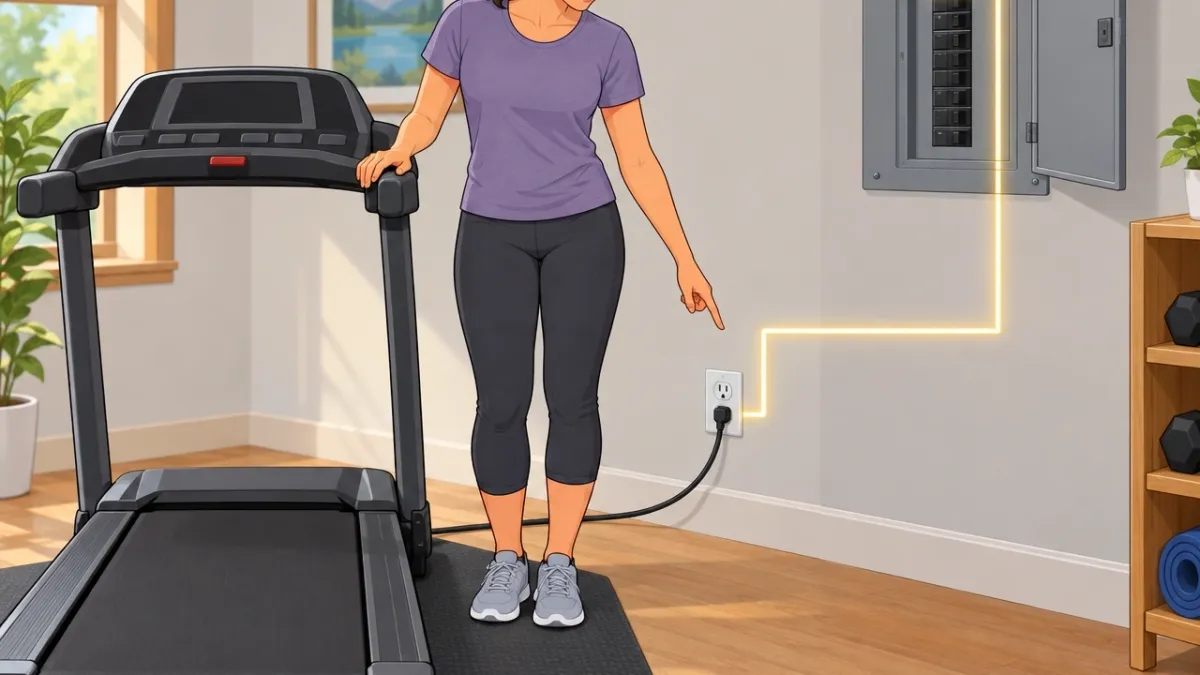
Short answer: most home treadmill makers ask for a treadmill dedicated circuit, meaning one breaker in your panel that feeds only the treadmill's outlet and nothing else. The circuit is usually 120 volts at 15 or 20 amps, depending on the model. Manufacturers also tell you to plug straight into a grounded wall outlet, with no extension cord, power strip or surge protector in between. If the room you picked cannot offer that, a licensed electrician adds the circuit. Check the outlet before you buy the treadmill, not after it arrives.
That last point is the whole reason this page exists. A treadmill is one of the few pieces of home gym equipment that can fail because of the wall it is plugged into, and the fix sits outside the product's price tag.
What "dedicated circuit" actually means
A dedicated circuit is a branch circuit that starts at a single breaker in your main panel and serves a single outlet. Nothing else shares it: no lamp, no TV, no space heater, no dehumidifier, no fridge in the garage.
The distinction matters because most rooms in a house run several outlets off one breaker. A bedroom, a basement or a garage wall can have four or five receptacles and the ceiling light all on the same circuit. Plug a treadmill into any one of them and it shares the circuit's capacity with everything else.
Horizon Fitness, a treadmill brand of Johnson Health Tech, defines it plainly on its Treadmill Electrical Requirements support page (read 2026-09-23): a dedicated outlet means no other electronic devices share power from the same 15 to 20 amp circuit. Wahoo Fitness, in its power requirements for the KICKR RUN treadmill (read 2026-09-23), describes a dedicated circuit as a direct wired connection from a single breaker in the main panel to only a single outlet.
Two outlets on the same wall are not two circuits. The only way to know what shares a breaker is to trace it.
15 amp or 20 amp: read your model's spec, not a forum
Manufacturers do not agree on one number, so do not let anyone tell you there is a universal treadmill requirement. Here is what the sources we checked on 2026-09-23 say, side by side:
| Source | Circuit | Extension cord | Surge protector or power strip | GFCI |
|---|---|---|---|---|
| Horizon Fitness support page | Dedicated, 15 to 20 amp | Not allowed; may void warranty | Not allowed; may void warranty | Warns a GFCI outlet can cause tripping and a hot motor |
| Wahoo Fitness, KICKR RUN (US) | Dedicated, 120 V, 15 or 20 amp | Allowed only if rated 15 amp minimum, 25 feet maximum, single connection | Not allowed | Requires a non-GFCI outlet and breaker |
| Revalue Fitness, dealer setup guide | Dedicated, 20 amp, 120 V | If unavoidable: under 6 feet, three-prong, 14-gauge | The cord should not include one | Not specified in the guide |
Notice the conflict on extension cords. Horizon says none. Wahoo allows one with conditions. A dealer guide from Revalue Fitness allows a short, heavy one only when there is no other option. Which one applies to you depends entirely on which treadmill you buy, which is why the owner's manual and the label on the machine outrank every general article, including this one.
Where to find your number:
- The owner's manual, usually in an "Electrical requirements" or "Grounding instructions" section near the front.
- The product page spec sheet, sometimes listed as "power requirements."
- The label on the machine, typically near the power cord inlet, showing voltage and amperage.
- The plug itself. A 20 amp plug (NEMA 5-20) has one blade turned sideways and will not fit a standard 15 amp outlet. If the treadmill you are eyeing ships with that plug, a standard outlet cannot serve it without an electrician.
If the listing does not state the requirement and the manual is not downloadable before purchase, ask the seller in writing. That answer decides whether the room is ready.
Why the circuit matters: what fails on a shared circuit
The failure is rarely dramatic. It is usually a slow pile-up of small problems that look like a faulty treadmill.
Nuisance tripping. A treadmill motor draws more current as it starts and as the belt works against a moving user. If a space heater, a dehumidifier or a TV already draws from the same breaker, the combined load can trip it mid-session. Dealer Bicycle Garage Indy writes in its treadmill guide that most manufacturers recommend a dedicated 20 amp circuit "whenever possible" to avoid electrical problems.
Undervoltage and heat. Horizon warns on its support page that a GFCI outlet can keep the motor from getting full voltage and cause a hot motor or a burning smell. Starving a motor of voltage does not stop it; it makes it work harder.
Warranty exposure. Horizon states that plugging into a surge protector or extension cord instead of directly into a grounded outlet may void the warranty. Read your own warranty for similar wording before you plan around a cord.
Extension cords and power strips: why most makers say no
An extension cord adds length, resistance and connections between the outlet and the motor. Each of those is a place for voltage to drop and heat to build.
The U.S. Consumer Product Safety Commission's safety guide "Household Extension Cords Can Cause Fires" (read 2026-09-23) says extension cords can overheat and cause fires when overloaded, should only be used temporarily, and should not be run under carpets or rugs, which trap heat. A treadmill is the opposite of temporary: it sits in one place for years, often on a rubber mat or carpet.
Power strips and surge protectors raise a separate issue. Wahoo says most surge protectors and power strips will intermittently throttle the power connection, and suggests asking an electrician about whole-house or breaker-level protection if you want surge protection. Revalue Fitness notes that most cardio equipment already has built-in surge protection.
If your manual permits a cord at all, follow its exact limits on gauge, length and rating. If it does not, the answer is a wall outlet in the right place, which may mean moving the treadmill or adding an outlet.
GFCI and AFCI: where code and the manual can disagree
This is the part most treadmill pages skip, and it is where a garage or basement gym runs into trouble.
A GFCI (ground-fault circuit interrupter) cuts power when it senses current leaking to ground, which protects people from shock. Under the 2023 National Electrical Code, published by NFPA as NFPA 70, section 210.8(A) requires GFCI protection for 125 through 250 volt receptacles in dwelling garages and basements, finished or not, along with kitchens, bathrooms, outdoors and laundry areas. States and cities adopt the code on their own schedule and sometimes amend it, so your local version may differ.
Now set that beside the manufacturers. Wahoo requires a non-GFCI outlet and breaker for the KICKR RUN in the US. Horizon warns that a GFCI outlet can cause tripping and motor heat. So the two most common home gym rooms are exactly the rooms where code expects GFCI protection and some treadmill manuals ask you to avoid it.
AFCI (arc-fault) breakers, which the NEC requires on many living-area circuits, can also react to treadmill motors. Treadmill dealer ConnectFit notes in its buyer guide that AFCI circuits can have issues as well.
Do not remove, bypass or swap out a GFCI or AFCI device to make a treadmill run. That protection is there for the person on the belt and anyone else in the room. Resolving the conflict is a licensed electrician's job, working from your local code, your inspector's requirements and the manufacturer's current guidance, and some manufacturers will tell a customer directly what they accept for a given model. Get that answer in writing before you buy.
What you can check yourself, and where it stops
You can learn a lot without touching a wire.
- Read the requirement. Manual, spec sheet or seller, as above.
- Look at the outlet. Is it three-prong and grounded? Is it a GFCI outlet (test and reset buttons)? Does it take a 20 amp plug?
- Map the circuit. With the treadmill not yet installed, plug a lamp into the target outlet. Switch breakers off one at a time at the panel, using only the handles, until the lamp goes out. Then walk the house and note every other outlet and light that also lost power. If anything else went dark, the circuit is shared.
- Check the panel label. The breaker's handle shows its rating (15 or 20). A missing or unreadable panel directory is itself worth mentioning to an electrician.
Stop here. Switching a breaker handle is where homeowner work ends on this job. Do not remove the panel cover, do not open an outlet box, do not replace a receptacle with a 20 amp one, and do not run new cable. If you notice a warm or discolored outlet cover, a buzzing sound, a burning smell or a breaker that trips repeatedly, stop using that outlet and call a licensed electrician. Anyone working on wiring must shut off the breaker and test that the circuit is dead before touching it, and that work, including adding a circuit, belongs to a licensed electrician.
When you need a licensed electrician, and what the job involves
If the outlet is shared, is the wrong rating, sits too far from where the treadmill will fit, or lands in a GFCI-versus-manual conflict, the fix is a licensed electrician.
Adding a dedicated circuit typically means installing a new breaker in your panel, running new cable of the correct gauge from the panel to the treadmill's location, and installing a matching receptacle. In many jurisdictions this work needs a permit and an inspection, which the electrician usually handles. The electrician also checks whether your panel has a free space and enough capacity, which is the question nobody can answer from a product page.
What moves the cost, so you can plan before buying:
- Distance from the panel. A garage wall right beside the panel is a very different job from a finished second-floor bedroom across the house.
- Wall access. Open studs in an unfinished basement are simpler than finished drywall.
- Panel capacity. A full panel may need more work than one new breaker.
- Permit fees, which vary by city or county.
We do not publish a price because it varies too much by region and house to be useful. Get at least two written quotes that name the circuit rating, the receptacle type and whether a permit is included. Add that figure to the treadmill's price, along with delivery and flooring, the way our breakdown of the hidden costs of a home gym does for the rest of the room. For the questions to bring to that visit, see our guide to home gym electrical requirements.
Do not buy the treadmill yet if...
- You rent. Adding a circuit needs the landlord's permission, and you may be stuck with whatever outlet is there. Choose a model whose manual accepts that outlet, or wait.
- The only outlet is in a garage or basement on a GFCI, and your target model's manual forbids GFCI. Resolve that with an electrician and the manufacturer first.
- The treadmill ships with a 20 amp plug and you have no 20 amp outlet. That is an electrician visit before first use.
- The only workable spot needs a cord across a walkway or under a mat. Move the plan, not the cord.
- You are planning an upstairs room. Distance from the panel and the floor itself both change the job; read what changes for a home gym on the second floor before you commit.
Placement and power are linked. Before you measure the outlet's distance, confirm the machine fits with clearance using our steps for measuring space for gym equipment, then plan the outlet around where the treadmill will actually sit.
FAQ
Does a treadmill really need a dedicated circuit? Most manufacturers ask for one, and some tie it to the warranty. Horizon Fitness and Wahoo Fitness both specify a dedicated 15 or 20 amp circuit. Your model's owner's manual is the final word.
Can I plug a treadmill into an extension cord? It depends on the manufacturer. Horizon says no and warns it may void the warranty. Wahoo allows one only if it is rated at least 15 amps, is no longer than 25 feet and is a single connection. The CPSC says extension cords are for temporary use only.
Is a surge protector safe for a treadmill? Horizon and Wahoo both say not to plug a treadmill into a surge protector or power strip. If you want surge protection, Wahoo suggests asking an electrician about whole-house or breaker-level protection.
Why does my treadmill keep tripping the GFCI? Some treadmill motors trigger GFCI devices, and Horizon and Wahoo both warn about it. Do not remove or bypass the GFCI, because the NEC requires it in garages and basements. Call a licensed electrician to resolve it with your local code and the manufacturer.
How do I know if my outlet is on a dedicated circuit? Switch breakers off one at a time until the target outlet loses power, then check whether any other outlet or light went off too. If anything else lost power, the circuit is shared.