Rowing Machine Space Requirements: Use, Storage, Ceiling
Rowing machine space requirements from Concept2, Hydrow and RP3 specs: the floor it needs in use, the ceiling upright storage needs, and what fails.
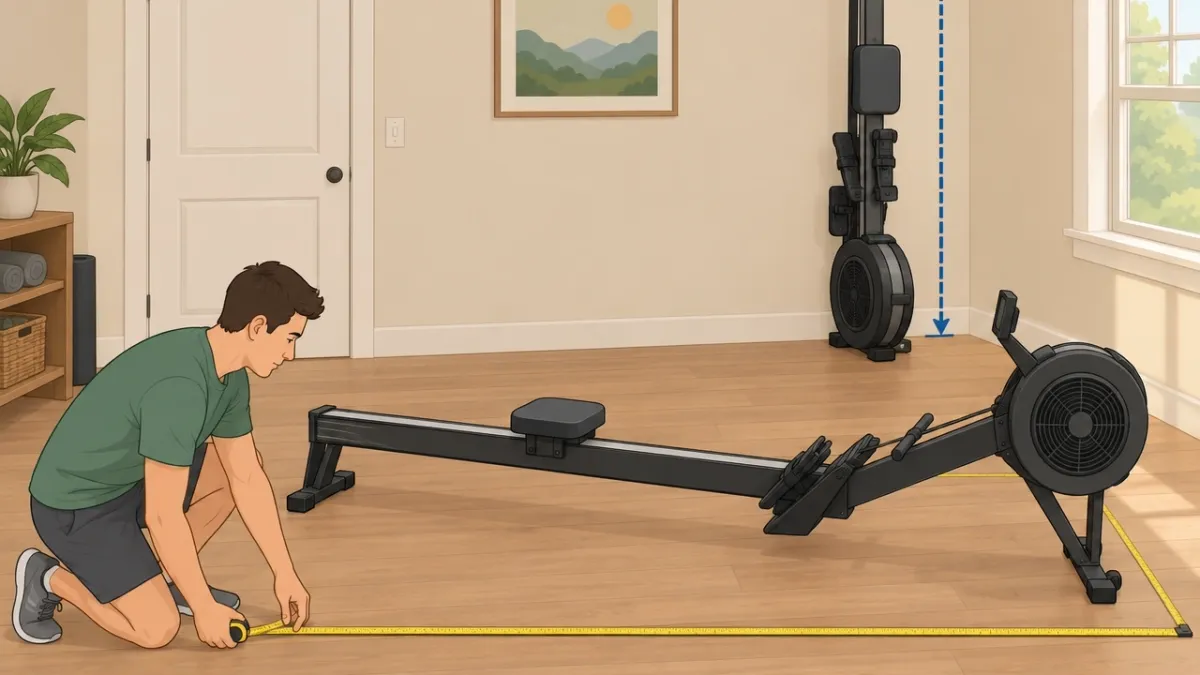
Rowing machine space requirements are bigger than the box suggests. Concept2 lists its RowErg at 8 ft by 2 ft assembled but asks for 9 ft by 4 ft with clearance for use (Concept2 spec page, read 2026-09-23), and RP3 Rowing plans for about 3 m by 1.5 m, roughly 9.8 ft by 4.9 ft, in its own space guide. So budget a clear rectangle of about 9 to 10 ft long and 4 to 5 ft wide while rowing. Upright storage is real, but it trades floor for ceiling: a rower stored on end stands roughly as tall as it is long.
That last sentence is the one most product pages skip, and it is the reason this page exists.
Rowing machine space requirements in use: three numbers, not one
A rower needs three separate measurements, and a listing usually gives you only the first.
- The assembled footprint. The machine's own length and width, sitting still.
- The in-use rectangle. The footprint plus room behind the seat, room in front of the flywheel or tank, and room on each side for your hands and elbows.
- The storage envelope. Either a smaller floor rectangle (if it separates or folds) or a tall column (if it stands on end), plus the room it takes to get it there.
Here is what named manufacturers and sellers publish for the first two, as read on 2026-09-23.
| Machine | Assembled (per source) | In-use guidance (per source) |
|---|---|---|
| Concept2 RowErg | 96 in by 24 in, per Concept2's RowErg specifications | 9 ft by 4 ft with clearance, per Concept2 |
| WaterRower Natural | 82.25 in by 22.25 in, per retailer Best Fitness Equipment | At least 20 in behind and about 12 in each side, per the same retailer |
| Hydrow Wave | 80 in by 19 in by 43 in high, per Hydrow's product page | See the conflict below |
| Any rower (general) | Not applicable | About 3 m by 1.5 m total, with about 0.5 m at the rear, per RP3 Rowing's space guide |
Where the sources disagree, and why both are printed here
The clearance advice is not consistent, even inside one brand. Hydrow's support article on placing its rower recommends at least 12 inches of clearance in front and behind the machine, while a Hydrow blog post on space gives a rule of thumb of about 2 feet on each side and about 4 feet behind. Both were published by Hydrow and both surfaced on 2026-09-23. We are not picking one. The practical reading is that 12 inches is Hydrow's floor and the larger figure is its comfortable version.
Concept2's own numbers imply something similar. Its 9 ft by 4 ft rectangle adds 1 ft of length and 2 ft of width to an 8 ft by 2 ft machine, per the Concept2 spec page. RP3 Rowing asks for more length than that, around 3 m, in its guide. Neither is wrong. They are describing different machines and different comfort margins, which is exactly why the number to trust is the one in the manual for the machine you are actually considering.
What the rectangle has to survive
A rectangle on paper is not the same as a clear rectangle in a room. Before you accept any of the figures above, subtract what the room already takes:
- Door swing. A door that opens into the rowing rectangle takes it back every time someone walks in.
- Walkways. If the only path to a closet or window crosses the monorail, the machine will be moved constantly, and the in-use rectangle becomes a daily negotiation.
- Heat vents and outlets. A rower parked over a floor register blocks it. An outlet behind the flywheel end may matter if the machine has a screen that plugs in.
Our walk-through on how to measure space for gym equipment covers the full sequence, including the delivery path, which is where long machines tend to get stuck.
Does it really store upright, or is that marketing?
It depends entirely on the design, and the three common designs work differently.
Machines that stand on end
The WaterRower and the Hydrow Wave both stand on end. Retailer Best Fitness Equipment lists the WaterRower Natural at 20 by 22.25 by 82.25 inches stored vertically, which is about the floor area of a small side table but nearly 7 feet tall. Hydrow lists the Wave at 26.5 by 30 by 82 inches when stored upright, on the Hydrow Wave Vertical Anchor product page (read 2026-09-23). Hydrow's FAQ and product page label the 26.5 and 30 inch sides differently, so measure for the larger of the two in both directions.
The storage claim is true. What it leaves out is height.
Machines that separate
The Concept2 RowErg does not stand on end as one piece in its standard configuration. Concept2 describes it as separating into two pieces for storage, and its spec page gives stored dimensions of 25 by 33 by 54 inches with standard legs and 27 by 47 by 54 inches with tall legs, as read on 2026-09-23. The monorail alone is 54 inches, per the same page. That means the tall-leg version, which Concept2 lists with a 20 inch seat height instead of 14 inches, costs you 14 more inches of stored depth. If you are choosing tall legs for easier getting on and off, the storage spot has to grow with it.
Machines that fold
Some rowers fold their rail. There is no single standard for how much a fold saves, and seller claims vary widely, so the only number worth using is the folded dimension printed in that specific model's manual. If the manual does not print one, treat the fold as unverified.
The ceiling is the footprint upright storage moves to
This is the information most "saves space" claims skip. A rower stored on end is roughly as tall as it is long. Best Fitness Equipment lists the WaterRower Natural at 82.25 inches tall when upright. Hydrow lists the Wave at 82 inches upright, and its placement guidance for the original Hydrow says upright storage needs a minimum of 86 inches of ceiling height for that 86 inch machine.
Two things follow.
The ceiling has to clear the stored height, not your idea of the room's height. A basement with a nominal 7 ft ceiling, 84 inches, can still have a duct, beam or pipe that sits lower exactly where the rower would stand. An 82 inch machine and an 84 inch ceiling leave 2 inches, and that assumes the floor is flat. If your space is tight overhead, our guide to what fits under a low ceiling home gym walks through measuring to the lowest obstruction rather than to the drywall.
Tipping it up needs more than the final height. As a long machine swings from horizontal to vertical, its far corner traces an arc. Because the machine has thickness as well as length, that corner sits farther from the pivot than the machine's length alone, so a ceiling that exactly matches the stored height can catch the top edge partway through the tilt. Hydrow's own figure for the original Hydrow builds in no margin (86 inches of ceiling for an 86 inch machine), so treat a few extra inches as your own buffer, not a published spec.
There is also a weight question. Best Fitness Equipment lists the WaterRower Natural at 66.5 lb empty and 103.5 lb with water, and the tank is normally left full in storage. Tipping 100 lb upright every day is a different routine from rolling a 57 lb machine aside, which is the Concept2 RowErg's weight with standard legs per Concept2. Whether that is manageable is a question about your own strength and routine that we cannot answer for you, which is one reason to rehearse the move before buying.
Wall anchors: the part that needs a drill
Some upright storage is freestanding and some is not. Hydrow states that the Wave must not be stored upright without its Vertical Anchor, which consists of a wall mount and a stand, sold separately on its product page. That makes the real price of upright storage on that machine the rower plus the anchor, a line item covered in our breakdown of the hidden costs of a home gym.
A wall mount means drilling, and drilling into a wall is where people hit things they cannot see:
- Find studs and services first. Use a stud finder that also detects live AC wiring, and treat the areas directly above and below outlets and switches as likely wiring routes. Plumbing tends to sit in walls shared with bathrooms and kitchens.
- Know what a hit looks like. Sparks, a tripped breaker, or the lights going out means you have struck wiring. Water or a sudden give behind the drywall means a pipe.
- Stop conditions. If you hit wiring or a pipe, stop and leave the bit where it is until the power or water is off. Damaged wiring is a licensed electrician's job, and a damaged supply pipe is a licensed plumber's job. If the only possible mounting point is masonry you cannot identify, a party wall in a rental, or a wall you suspect is load-bearing and already weakened, stop there too; the landlord or a structural engineer decides, not the product page.
Follow the anchor's own installation instructions for fastener type and for stud or masonry mounting. The manufacturer's instructions are the document that governs it, not a general guide like this one.
Power and floors: the two questions the footprint drags in
Power. Not every rower needs an outlet. Concept2's help center lists the RowErg's monitor as running on two D cell batteries and drawing power from the flywheel during use. Screen-based rowers usually plug in. If the only outlet near your rowing rectangle is on the far wall, an extension cord across a walkway becomes a trip hazard, and any new outlet or circuit is work for a licensed electrician, not a weekend project. Our guide to home gym electrical requirements covers what to ask before you buy.
Floors. A water rower is heavier than an air rower of similar length once filled, per the retailer and Concept2 figures above. On a second floor, the question is less about static weight and more about vibration and noise traveling through joists, which our page on a home gym on the second floor addresses without guessing at your building's load rating.
Who a rower is wrong for, space-wise
Do not buy a rower yet if any of these describe your room:
- Your clear rectangle is shorter than about 9 ft. Concept2's 9 ft in-use length is already the tighter end of the published range.
- Your planned storage spot has a ceiling or obstruction under about 7 ft. The upright rowers above all need more than 80 inches of vertical space per their listed stored heights.
- The storage spot is on a wall you cannot drill, and the model you want requires an anchor.
- Getting it to the room means a tight stair turn. A 96 inch Concept2, even in two pieces, has a 54 inch monorail to carry around a landing.
- The machine will live across a walkway. In practice it will be moved daily, and the storage method becomes the whole experience.
If two or more apply, a shorter machine, a different cardio category, or waiting until the room changes is a better answer than hoping the storage claim covers the gap.
FAQ
How much space do you need for a rowing machine?
Concept2 asks for 9 ft by 4 ft with clearance for its RowErg, per its spec page read 2026-09-23. RP3 Rowing plans for about 3 m by 1.5 m. Plan a clear rectangle of roughly 9 to 10 ft by 4 to 5 ft, then check the manual for the specific model.
How tall a ceiling do I need to store a rowing machine upright?
At least the machine's stored height, plus your own margin for the tilt. Best Fitness Equipment lists the WaterRower Natural at 82.25 inches upright, Hydrow lists the Wave at 82 inches, and Hydrow says the original Hydrow needs a minimum 86 inch ceiling.
Does a Concept2 rower stand upright?
Concept2 describes the RowErg as separating into two pieces for storage, with stored dimensions of 25 by 33 by 54 inches on standard legs and 27 by 47 by 54 inches on tall legs, per its spec page.
Do upright rowers need to be bolted to the wall?
Some do. Hydrow says the Wave must not be stored upright without its Vertical Anchor, which includes a wall mount. Check each model's manual; if drilling reveals wiring or pipes, stop and call a licensed electrician or plumber.
Is a water rower harder to store than an air rower?
It is heavier to move. Best Fitness Equipment lists the WaterRower Natural at 103.5 lb with water, while Concept2 lists its RowErg at 57 lb with standard legs.