Quietest Cardio Machine for Apartment: What Neighbors Hear
The quietest cardio machine for apartment use depends on what your neighbor hears. Compare impact, hum and whoosh before you buy.
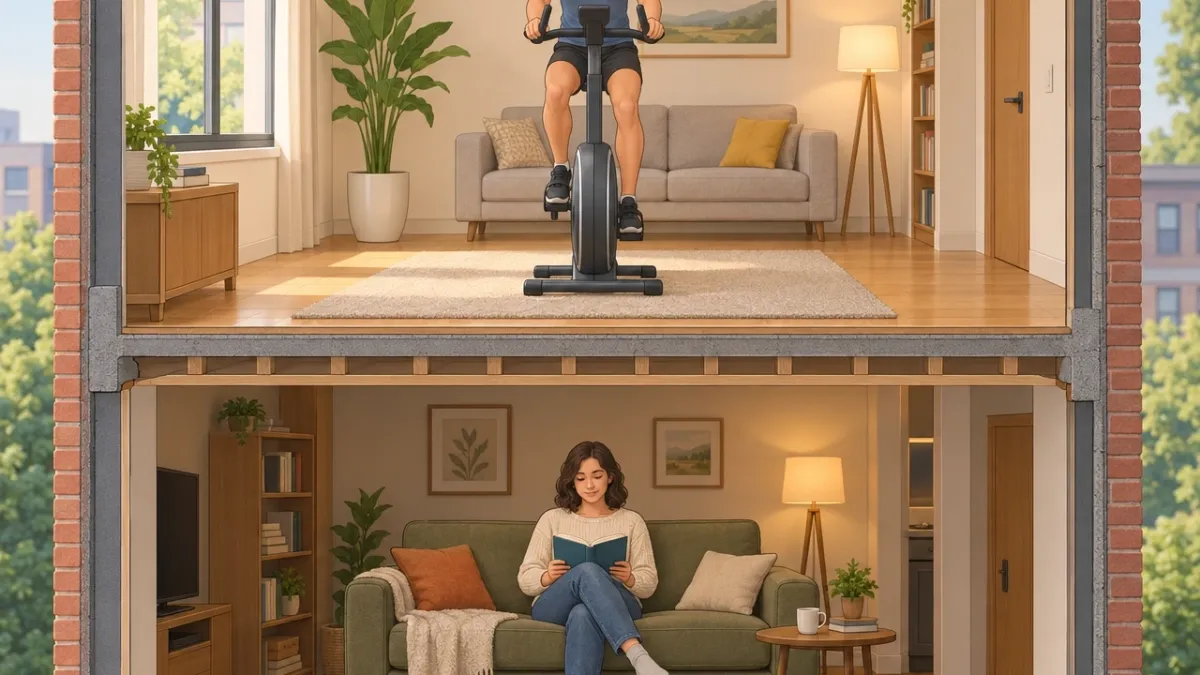
Short answer: the quietest cardio machine for apartment living is usually a magnetic-resistance exercise bike with a belt drive, because nothing in it strikes the floor and nothing in it pushes air. A magnetic rower and a solidly built elliptical come next. A treadmill used for running is the hardest machine to keep quiet, and the motor is not the reason: every footstrike travels into the floor and down to the unit below. Fan bikes and air rowers sound loud in your own room, but most of that noise stays there. The decibel figure on a product page does not tell you which kind of noise reaches your neighbor.
That last point is where most buying advice goes wrong, so it is where this guide starts.
Two noises, and only one of them goes downstairs
A cardio machine makes two different kinds of sound, and they behave in completely different ways once they leave the machine.
Airborne noise is sound traveling through the air: a motor hum, a fan whoosh, a belt whirring, music from the console. Walls, doors and floors block a good share of it. You hear it clearly standing next to the machine. Your neighbor hears much less of it.
Impact noise (acousticians call it structure-borne sound) is energy that goes straight into the building. A foot landing on a treadmill deck, a rower seat hitting the end of its rail, an elliptical rocking on a slightly uneven floor: each one pushes into the floor, and the floor carries it into the ceiling below. The person downstairs hears it as a thud, a rumble or a rhythm, often louder than you do.
For the question "can I use this at six in the morning?", impact noise is the one that matters. A machine can be quiet in your room and still be the loudest thing in your neighbor's bedroom.
Why the decibel number on the product page answers the wrong question
Many product pages list a decibel figure, and plenty of buying guides rank machines by it. Treat those numbers with care, for three reasons.
First, a decibel figure measured in the air near a machine describes airborne noise. It says nothing about how much energy the machine sends into the floor.
Second, product pages rarely say how the number was measured: how far from the machine, at what speed or resistance, with what user weight, on what floor. Two figures measured different ways cannot be compared, even when they sit side by side in a table.
Third, what your neighbor hears depends heavily on the building, not only the machine. For new construction, the 2021 International Building Code, Section 1206 (International Code Council, read 2026-09-23) sets two separate requirements for floor-ceiling assemblies between dwelling units: a Sound Transmission Class (STC) of at least 50 for airborne sound, and an Impact Insulation Class (IIC) of at least 50 for impact sound when lab tested, with 45 accepted for each when tested in the field. The code treats airborne and impact sound as two separate problems, which is exactly the split above.
The impact test behind that IIC rating, ASTM E492, uses a standardized tapping machine to strike the floor, a stand-in for footsteps. A running treadmill is close to that test's worst case: a steady, repeated strike for as long as the workout lasts.
Two honest limits on that code figure. It is a minimum for construction, not a promise of quiet. And it only applies to a building permitted under a code edition that contains it, in a jurisdiction that adopted it, so older buildings and local amendments can differ. You usually cannot see a floor's rating by looking at it; your building manager may know whether the floors are concrete or wood-framed, which is the practical first question.
Noise profile by machine type
This table sorts machine types by the kind of noise each one makes, not by a decibel score. It describes typical designs; a specific model can be better or worse.
| Machine type | Main noise source | Mostly airborne or impact? | Six a.m. risk for the unit below | Wrong for |
|---|---|---|---|---|
| Magnetic exercise bike, belt drive | Faint flywheel and belt hum | Airborne, low level | Lowest of the group | Anyone who wants a running or rowing motion |
| Magnetic rower | Seat rolling on the rail, handle return | Mostly airborne; some impact at the ends of the stroke | Low to moderate | Rooms too short for the full rail length |
| Water rower | Water swish in the tank | Airborne, rhythmic | Low to moderate | Readers who find the swish itself distracting |
| Elliptical | Linkage and pedal motion, squeaks as parts wear | Mixed; rocking can reach the floor | Moderate, depends on build and leveling | Low ceilings, narrow rooms |
| Air rower | Fan whoosh | Airborne, loud in your room | Moderate; the seat and catch still reach the floor | Thin walls shared side to side |
| Fan (air) bike | Fan whoosh that rises with effort | Airborne, loud in your room | Moderate | Shared walls, sleeping partners in the next room |
| Treadmill, walking pace | Motor, belt, lighter footfall | Mixed | Moderate | Wood-framed floors over a bedroom |
| Treadmill, running pace | Footstrike on the deck | Impact, heavy | Highest of the group | Most upper-floor apartments at quiet hours |
The quietest cardio machine for apartment use, machine by machine
Magnetic exercise bikes
A magnetic bike creates resistance with magnets near a flywheel that never touch it, so there is no friction pad rubbing and no fan moving air. Pair that with a belt drive rather than a chain and the moving parts make very little sound. Your body stays seated, so nothing lands on the floor. This is why the bike category comes up first in almost every quiet-cardio discussion. The trade-off is the motion itself: if you want to run or row, a bike is a compromise, not a substitute.
Watch for friction-resistance spin bikes, which use a pad pressing on the flywheel. They can be quiet when new, but the pad wears and the sound changes over time.
Rowers: magnetic, water and air
Rowers split three ways on noise. A magnetic rower is the quietest of the three. A water rower makes a steady swish that some people find pleasant and others find distracting. An air rower uses a fan, and the whoosh is the loudest sound of the three in your own room.
All three share an impact source that the resistance type does not fix: the seat traveling along the rail and the rhythm of the stroke, which can pass through the machine's feet into the floor. A rower is also long. Before choosing one, check that the full rail length plus room at each end actually fits the space.
Ellipticals
An elliptical keeps both feet on the pedals, so there is no footstrike. That makes it a common suggestion for apartments. The noise that does reach the floor comes from the machine rocking or flexing, which a heavier, well-leveled frame resists better than a light one. Squeaks from joints and linkages tend to appear as the machine ages.
One constraint catches people out: an elliptical lifts you higher off the floor than you stand. If your ceiling is on the low side, read what fits under a low ceiling before buying one.
Treadmills
A treadmill motor is rarely the problem. Running is. Each footstrike lands on the deck, and even a cushioned deck sends much of that energy into the floor. Walking pace is far gentler than running, which is why the table splits the two.
A treadmill is also the one machine in this list with a real electrical question. Some manufacturer manuals call for a dedicated circuit, and some prohibit extension cords. Check the manual for your specific model, and read what to ask about home gym electrical requirements before you plug it in. Installing a new circuit or outlet is work for a licensed electrician, not a homeowner project, and in an apartment it also needs your landlord's permission.
Fan (air) bikes
A fan bike is loud in the room: the harder you push, the louder the fan gets. Because you stay seated, very little of that effort lands on the floor as impact. That makes it a better neighbor downstairs than its volume suggests, and a worse one through a thin shared wall or for someone sleeping in the next room.
What a mat can and cannot do
A mat under a cardio machine does real work, but it is often sold as more than it is.
Horizon Fitness, for example, describes its own equipment mat (product page, read 2026-09-23) as one that "reduces noise and vibration from equipment" and lists it at 82 by 39 inches, 5 mm thick, made of shock-absorbing foam. Note the manufacturer's own word: reduces. A thin foam mat protects the floor and takes the edge off vibration. It will not stop a running footstrike from reaching the ceiling below.
Thicker rubber flooring does more, and costs more. That cost belongs in your budget from day one, alongside the other hidden costs of a home gym.
One safety line: a treadmill or elliptical needs to sit level and stable. Do not stack soft materials under a machine until it wobbles, and do not raise it on improvised blocks. The owner's manual for your model states the surface it needs; follow it over any forum tip.
Where you put it matters as much as what you buy
The same machine can be a non-event in one spot and a complaint in another.
- Above a bedroom is the worst spot if you train early or late. If you can, ask a neighbor what room sits under the space you are planning to use.
- Ground floor or slab removes most of the problem. If you live upstairs, read what changes for a home gym on the second floor before choosing a machine.
- Distance from shared walls helps with airborne noise, which matters most for fan bikes and air rowers.
- Your lease may already decide this. Some leases set quiet hours or require floor coverings. Read yours before buying, not after the first complaint.
Do not buy one yet if...
- You do not know what is under the floor you plan to use, and you plan to run.
- Your only realistic workout time falls inside your building's quiet hours, and the machine you want is a treadmill.
- The seller's return window is shorter than the time it will take you to hear back from a neighbor.
- You are choosing between models on decibel figures alone, with no stated test method.
- The machine needs an electrical change your lease does not allow.
Test it inside the return window
Whatever you buy, treat the first two weeks as a test. Use the machine at the times you actually plan to train. If you are on good terms with the neighbor below, ask them directly whether they can hear it, and at what intensity. Before buying, confirm the seller's return policy and who pays return shipping on a heavy machine, because that policy is your only way out if the answer is yes.
FAQ
What is the quietest cardio machine for an apartment?
For most upper-floor apartments, a magnetic-resistance exercise bike with a belt drive is the quietest option, because it creates no floor impact and moves no air. A magnetic rower and a well-built elliptical usually come next.
Is a treadmill too loud for an upstairs apartment?
Running on a treadmill is the hardest cardio activity to keep quiet upstairs, because each footstrike is impact noise that travels through the floor. Walking is much gentler. Whether it is too loud depends on your floor construction, what room is below, and when you use it.
Do treadmill mats stop noise for downstairs neighbors?
A mat reduces vibration and protects the floor, but it does not stop impact noise. Horizon Fitness describes its own 5 mm equipment mat as one that "reduces noise and vibration," not one that eliminates it.
Are decibel ratings on cardio machines reliable?
They describe airborne noise near the machine, usually without stating how it was measured. They do not measure the impact noise that neighbors below tend to hear, so they are a weak basis for comparing machines for apartment use.
Is a fan bike quiet enough for an apartment?
A fan bike is loud in your own room, and the noise rises with effort. Because you stay seated, it sends little impact into the floor, so it tends to bother the unit below less than a shared wall or a light sleeper in the next room.