Power Rack vs Squat Stand vs Half Rack: The Footprint Call
Power rack, half rack or squat stand? Compare footprint, ceiling height, safeties and anchoring rules from makers' own pages before you buy.
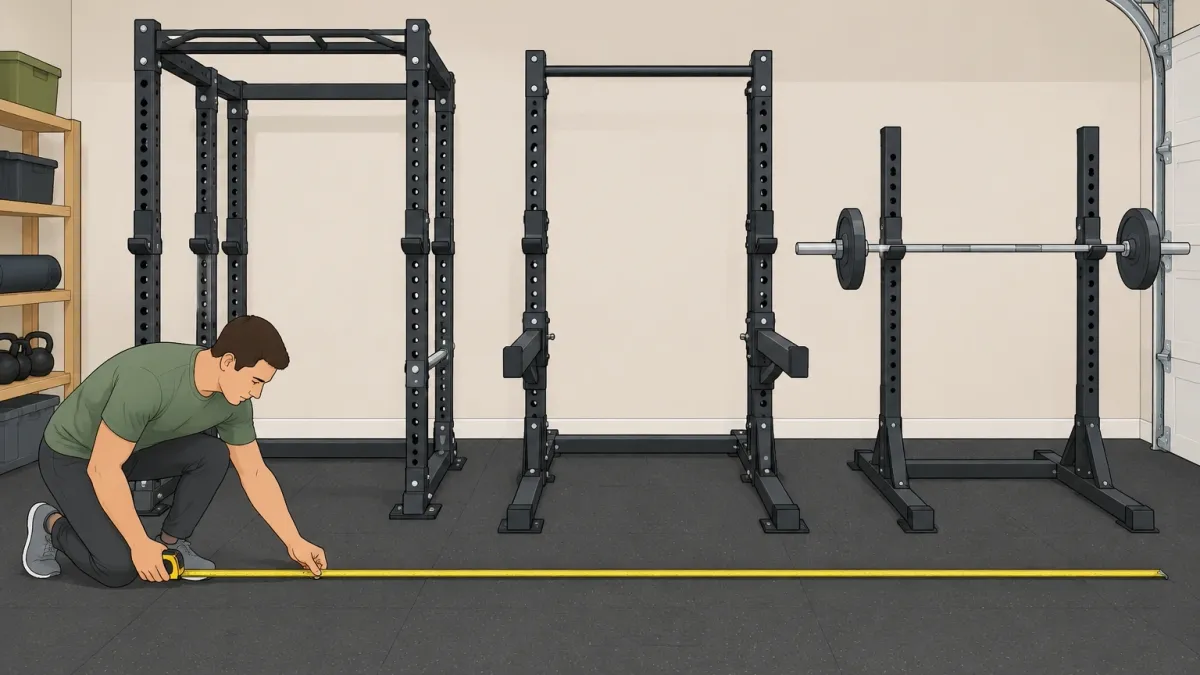
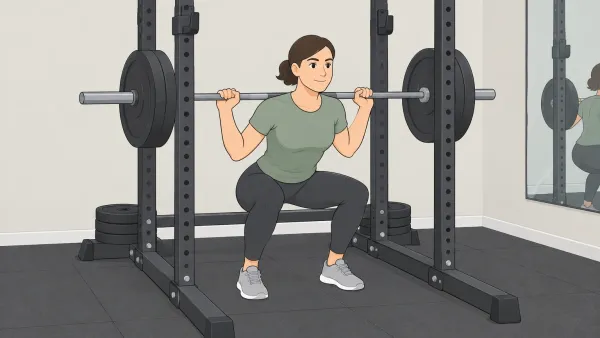
Short answer: a power rack is a four-post cage that surrounds the bar and holds its safeties inside the frame. A squat stand is two posts that hold the bar and leave open space around you. A half rack sits between them: a two-post frame, usually with a short base behind it and safeties or spotter arms reaching forward. In a home gym, three measurements decide the power rack vs squat stand question before preference does. They are the floor space the frame needs in use, the ceiling height, and whether the frame can be anchored the way its maker requires for the attachments you plan to add.
We have not owned, assembled or used any of the racks named on this page. Every dimension below is quoted from the maker's own page as read on 2026-09-11. Read the listing for the exact model in front of you, because specifications change between versions.
What the search results cover, and what they leave out
We read the results for this query on 2026-09-11. Most of the first page comes from companies that sell racks: Titan Fitness, Iron Bull Strength, Bells of Steel, Fringe Sport, XMARK, Ritfit and several others. BarBend, Garage Gym Reviews and Breaking Muscle cover it editorially, and a Starting Strength forum thread and a Reddit thread round it out.
They agree on the basics. A stand has two posts and a rack has four. A rack costs more because it uses more steel. A rack is described as more versatile because it takes more attachments. What they rarely do is separate the footprint printed on a spec sheet from the space the frame needs once a bar is loaded. They also skip the part the makers themselves are specific about: whether a frame is stable enough on its own depends on its configuration, and some makers say so in writing.
The three frames, defined
| Frame | Posts | Where a missed bar is caught | What it asks of the room | Watch for |
|---|---|---|---|---|
| Power rack | Four, joined front and back | Inside the cage, on safeties running front to back | The largest floor area and a fixed height | Ceiling clearance, and a depth that suits the attachments you want |
| Half rack | Two main posts, usually with a rear base or short rear posts | In front of the posts, on safeties or spotter arms that reach forward | Less floor than a full cage, more than a stand | Forward-reaching arms put load outside the base, and makers write rules about that |
| Squat stand | Two, sometimes independent, sometimes joined by a base | Only if safeties or spotter arms are fitted | The least floor area and usually the lowest height | Titan notes some stands have no catch at all |
Power rack vs squat stand: the floor space you really need
The footprint on a product page is the steel's outline. The space the frame needs in use is larger, because a loaded bar is wider than most racks and you have to stand beside it to load plates.
Two examples from one maker's pages, read on 2026-09-11, show how much listings vary even within one brand. REP Fitness lists the PR-1100 power rack at 58.1 inches wide by 48.5 inches deep. It lists the PR-4000 at 50.8 inches wide, with depth options of 16, 24, 30 and 41 inches. Those are two different power racks from the same company, and the depth range on the second one alone runs from a stand-like frame to a full cage.
So the first measurement is not "how big is the rack". It is the rack's listed footprint, plus room for the bar sleeves and plates on both sides, plus room to walk around it with a plate in your hands. Our step-by-step guide to measuring space for gym equipment covers how to mark that out on the floor before anything is ordered. Doing it with tape on the floor catches the problems a spec sheet hides, like a door swing or a water heater.
A squat stand usually wins this comparison, and that is the main reason people choose one. Titan Fitness states on its comparison page that a stand "takes up considerably less room and doesn't need a high ceiling."
Ceiling height: the measurement that rules racks out
A power rack has a fixed height set by its uprights, and most add a pull-up bar across the top. The rack has to fit under the ceiling, under any joists, ducts or light fittings in that spot, and under the garage door track if it runs overhead. Anything done standing with the bar overhead needs clearance above the rack's own height as well.
That is why the ceiling so often decides this for people. It is the one room measurement you cannot change. Our guide to what each home gym ceiling height allows walks through what fits at each common height. If your room is already tight, the article on what fits in a low-ceiling home gym is the one to read before comparing frames at all. Short-height versions of racks and stands exist from several makers. Compare the listed height of the specific model, not the category.
Where a missed bar is caught
This is the functional difference between the frames, and it matters most to anyone who trains without a partner.
On its power rack collection page, read on 2026-09-11, REP Fitness states that "a full power rack with inside pin/strap safeties provides the most coverage for failed squats and presses." Titan Fitness, on the other side of the comparison, notes that squat stands sometimes lack safety catches entirely, so "a failed rep means you have to lower the bar to the floor yourself."
A half rack usually catches the bar on spotter arms or safeties that project forward from the posts. The next section explains why that projection matters for stability.
Which catch a frame accepts (straps, pin-pipes, flip-downs or spotter arms) is worth checking at the same time as the frame itself, because the choice of safety matters as much as the choice of frame.
One boundary, stated plainly. The HHS Physical Activity Guidelines for Americans state that "adults also need muscle-strengthening activity, like lifting weights or doing push-ups, at least 2 days each week" (read 2026-09-11). The ACSM says every adult should do strength and endurance activity on at least two days a week (read 2026-09-11). Neither says which frame, which lift or what load, and neither do we. If you have pain, a heart condition, are pregnant, or are coming back from an injury, what you should lift, and whether you should, is a question for your clinician before it is a question about equipment.
Stability and anchoring: the maker decides, per configuration
This is the part the comparison pages flatten, and it is where the three frames really differ.
Titan Fitness, asked whether racks and stands should be anchored, answers on its comparison page: "It's good practice for both, especially a squat stand, since it's lighter and less stable than a full cage."
REP Fitness is specific per model. On the PR-1100 product page, its FAQ states: "No, you cannot bolt the PR-1100 Home Gym Power Rack down." The same page adds that "due to the weight of the rack (130lbs) and the potential for tipping, banded movements are not recommended." On the PR-4000 page, the FAQ says a rack with 41-inch depth and the Rear Base Stabilizer does not need bolting for general use. It also says that "if you're using the Iso Arms, Spotter Arms, or Globe Pull-Up Bar, you do need to bolt your rack down."
Put those together and the choice looks different. You are not choosing a power rack, a half rack or a squat stand in the abstract. You are choosing a frame in a configuration: its depth, its base, and the attachments you will hang on it. Attachments that reach forward past the base, or that pull sideways or upward on the frame, are the ones makers attach conditions to. If your floor cannot be drilled, that narrows you to frames the maker rates for free-standing use in the configuration you want.
If the gym sits on a suspended wood floor or an upper story, a separate question comes first: what that floor will carry. No article can answer that for your building. Our explainer on what a home gym floor weight limit really means sets out why, and why the answer belongs to a licensed structural engineer.
Which frame the room points to
| If your room... | The frame it tends to point to | Check on the specific model |
|---|---|---|
| Has limited height | A squat stand or a short-height rack | Listed height against your lowest overhead obstruction |
| Is narrow or shared with a car | A squat stand or a shallow half rack | Working width with a loaded bar, not the steel outline |
| Is a garage slab you are allowed to drill | Any of the three | Whether the maker specifies bolting, and with which anchors |
| Cannot be drilled | A frame the maker rates for free-standing use in your configuration | The FAQ or manual line on bolting, per attachment |
| Is used mostly without a training partner | A power rack, or a half rack or stand with catches fitted | Which safeties the model accepts, and their conditions |
| Is on an upper floor | Decide nothing until the floor question is answered | A structural engineer's view of that floor |
Who each frame is wrong for
A power rack is wrong for a room whose ceiling it will not clear, a space that has to hold a car the rest of the week, or a buyer planning a configuration the maker says must be bolted when the floor cannot be drilled.
A half rack is wrong for anyone who assumes forward-reaching arms come with no conditions. They are the attachment makers most often name when they require bolting or a wider base.
A squat stand is wrong for anyone who trains alone and would be using one with no catch fitted. By Titan's own description, a stand without safeties leaves you to lower a failed bar to the floor yourself.
If you are still deciding whether a rack belongs in the first round of purchases at all, what to buy first for a home gym sets out the order that usually holds up.
Children and a loaded frame
The CPSC's Anchor It campaign concerns furniture and TVs, not gym equipment. It states that "anchoring all furniture with drawers, doors, and shelves to the wall prevents tip-over injuries and deaths" (read 2026-09-11). A rack is not furniture under that rule, but the same physics applies to a tall steel frame. Uprights and a pull-up bar invite climbing. A bar left loaded in the hooks, or plates stored on one side only, change how a frame behaves when someone pulls on it. Where children share the house, keep the gym closed to them, unload bars after use, and follow the maker's anchoring instructions in full.
What this page does not do
It names no prices, makes no picks and ranks nothing. It gives no training advice, and it does not tell you what your floor will carry. We have handled none of the products named. The figures here are the makers' own, read on 2026-09-11, and the listing for the model you are considering governs over anything written here.
Frequently asked questions
Is a power rack or a squat stand better for a small home gym? A squat stand usually needs less floor space and less height. Titan Fitness says a stand "takes up considerably less room and doesn't need a high ceiling." The trade-off is how a missed bar is caught, and whether the stand you choose accepts safeties at all.
Can you use a squat stand without safeties? Some stands are sold without catches. Titan Fitness notes that on those, "a failed rep means you have to lower the bar to the floor yourself." Whether a given stand accepts safeties or spotter arms, and on what conditions, is set by its maker.
Does a power rack need to be bolted down? It depends on the model and configuration. REP Fitness says its PR-1100 cannot be bolted down. It says its PR-4000 needs no bolting for general use at 41-inch depth with the Rear Base Stabilizer, but must be bolted for Iso Arms, Spotter Arms or the Globe Pull-Up Bar. Read your rack's own FAQ or manual.
What is a half rack? A two-post frame, usually with a base or short posts behind it, that catches the bar in front of the posts on safeties or spotter arms. It generally needs less floor space than a full cage and more than a stand. Its forward-reaching arms are the attachment makers most often attach bolting or base conditions to.
The short version
Measure the working footprint, not the steel outline. Measure the ceiling at the exact spot the frame will stand. Then read the maker's own line on bolting for the configuration you want, before you order. The frame that passes all three is the right one for your room, whatever the comparison pages call the best.