Power Rack Upright Size: 2x2, 2x3 and 3x3 Explained
Why 2x3 and 3x3 uprights keep coming up, how hole size and spacing decide which attachments fit, and how to check a rack before you buy it.
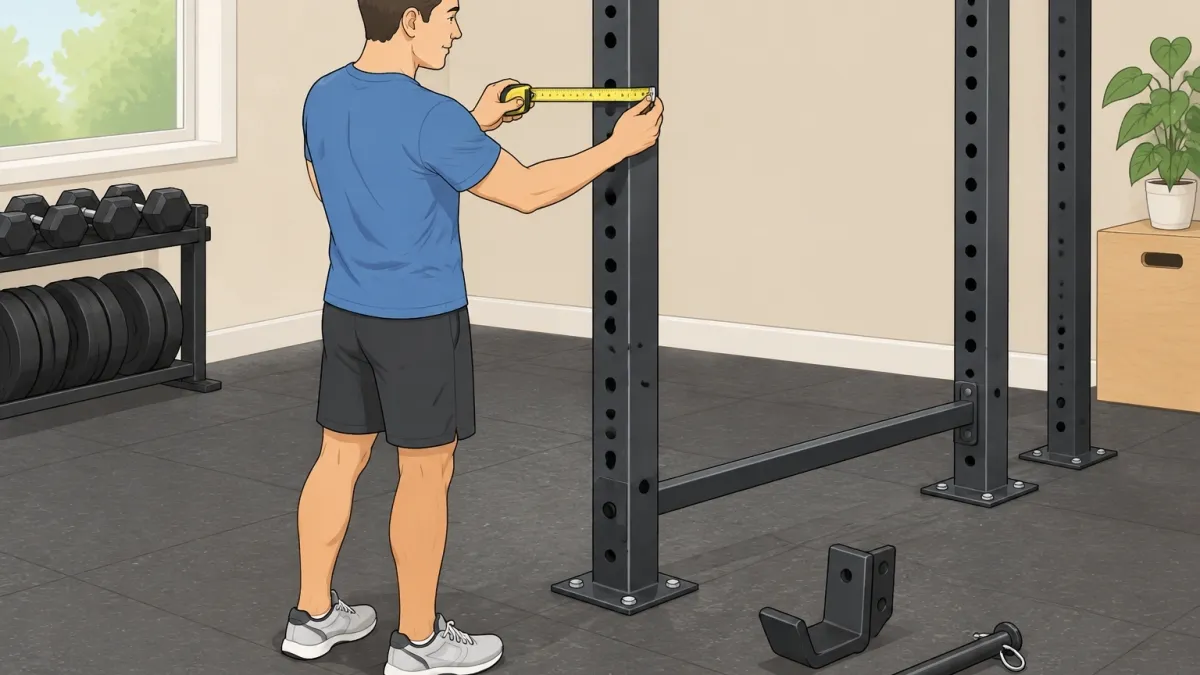
Short answer: power rack upright size is the outside cross-section of each upright tube, in inches. 2x2 means two inches by two, 2x3 means two by three, and 3x3 means three by three. It matters mainly because of what it decides, together with hole diameter and hole spacing: which J-cups, safeties and attachments will fit the rack. 2x3 and 3x3 keep coming up because most attachment systems are built around one of them. An attachment made for one family generally does not fit another. That makes upright size a decision about the next few years of add-ons, not just about the rack you buy today.
We have not owned, assembled or used any rack named on this page. Specifications are quoted from the makers' own pages as read on 2026-09-11.
What the search results cover, and what they miss
We read the results for this query on 2026-09-11. The first page is unusually forum-heavy: five Reddit threads and a Starting Strength forum thread. Alongside them are explainers from Knurl Knock, Rack and Bar, GymValid, Glucks Gym and Two Rep Cave, and a Bells of Steel page.
The definitions are consistent. Knurl Knock puts it cleanly: "A 2x2 rack uses two-inch-by-two-inch uprights, a 3x3 rack uses three-inch-by-three-inch uprights, and 2x3 is a common middle." The forum threads are full of strong opinions, mostly that a 3x3 with 1-inch holes is worth stretching for.
What is missing is a method. Upright size is one of three numbers that together decide compatibility, and the only reliable check is the attachment maker's own compatibility list against your rack's own spec sheet. A tube size on its own does not tell you whether a given attachment will fit.
The three numbers that decide compatibility
| Number | What it is | What it decides |
|---|---|---|
| Upright size | The outside dimensions of the tube, such as 2x3 or 3x3 | Whether an attachment's sleeve or bracket physically wraps or seats on the upright |
| Hole diameter | The size of the holes drilled through the upright, such as 5/8 in or 1 in | Whether the attachment's pin passes through |
| Hole spacing | The distance between hole centers, sometimes varying along the upright | How finely you can set heights, and whether multi-pin attachments line up |
Some makers also number the holes. That does not affect fit, but it makes it easier to set the same height twice.
How three racks from one maker compare
REP Fitness's pages, read on 2026-09-11, show how much these numbers vary even within one brand:
| REP model | Upright | Wall | Hole diameter | Hole spacing |
|---|---|---|---|---|
| PR-1100 | 2x2 | 14-gauge | 1 in | 3 in |
| PR-4000 | 3x3 | 11-gauge | 5/8 in | 1 in within the bench zone, 2 in elsewhere |
| PR-5000 | 3x3 | 11-gauge | 1 in | 2 in |
The PR-4000 and PR-5000 have the same tube size and wall, but different hole diameters. So "3x3" alone does not guarantee that a 3x3 attachment's pin will fit. REP's own Safeties Comparison Guide (published December 15, 2022, updated August 3, 2026, read 2026-09-11) lists its pin-pipe safeties as compatible with the 1000, 4000 and 5000 Series. Compatibility is defined by series, not by tube size.
Why 2x3 and 3x3 keep coming up
2x3 has been a long-running standard. Two Rep Cave, describing a custom 2x3 rack, notes that "5/8″ bolts and 5/8″ holes were the standard choice for that size tubing." Racks, safeties and J-cups in that family were built to match.
3x3 is where much of the larger attachment ecosystem sits, and it comes in more than one hole size, as the REP table shows. That is why forum advice so often specifies "3x3 with 1-inch holes" rather than just "3x3."
2x2 tends to appear on entry frames, like the REP PR-1100 above. Its attachment range is usually narrower.
On stiffness, Rack and Bar makes a fair structural point. An 11-gauge 2x2 upright and an 11-gauge 3x3 upright have the same wall thickness, "but the 3×3 has significantly more cross-sectional steel and a larger moment of inertia." A bigger tube resists bending more at the same wall thickness. That is a real difference. It is not the same as a higher rated capacity for your rack, which only the maker states.
Hole spacing: what the finer spacing is for
Tighter hole spacing lets J-cups and safeties sit at more heights. That matters most where small changes in height make the biggest difference, which is why some racks tighten the spacing in the bench zone and leave it wider above and below. REP lists the PR-4000 that way: 1-inch spacing within the bench zone and 2-inch elsewhere.
Wider spacing is not a defect. It means fewer height options, and whether that matters depends on how you use the rack. Which heights suit which movement is a coaching question, and not one this page answers.
The two-year question: will accessories still fit?
This is the practical reason upright size matters. Most people buy a rack and then add to it: different J-cups, spotter arms, a landmine, dip handles, plate storage, a cable attachment. Every one of those is built for particular tube and hole dimensions.
A check that avoids the expensive surprise:
- Write down the attachments you think you will want within two years. Be honest, not aspirational.
- For each one, read the attachment maker's compatibility list. It usually names tube size, hole size and sometimes specific rack series.
- Compare against the rack's spec sheet on the maker's own site, not a reseller copy.
- Check the depth and width between uprights if the attachment spans them. Safeties and pull-up bars are cut to fit particular inside dimensions.
- Check whether the attachment changes the rack's anchoring rule. Some makers state that certain attachments require the rack to be bolted down.
A rack that fits your room but not the attachments you will want is the classic "buy it twice" purchase. Our look at cheap gym equipment and when upgrading later costs more covers that trade-off in general terms.
Ecosystem also matters when you sell. A rack in a widely supported size and hole pattern is easier to hand on than an orphan format. What the used market reveals about home gym equipment looks at which items keep their value.
What power rack upright size does not tell you
- Rated capacity. That belongs to the whole assembly and is stated by the maker.
- Stability. That comes from base depth, footprint and anchoring.
- Quality. A larger tube is not automatically better made, a point that runs through what "commercial grade" means on a home product page.
- Room fit. Tube size changes a rack's outer dimensions slightly. The listed footprint and height are what go on the tape. How to measure space for gym equipment covers that step.
Rack sizing is an equipment question. What you do in the rack, and whether it suits your body, is not. Pain, injury, pregnancy or a heart condition are questions for a clinician.
What this page does not do
It names no prices, makes no picks and ranks nothing. It does not reproduce rack widths from third-party tables, because we could not verify them against the makers. And it does not promise that any attachment fits any rack. Only the two makers' own documents can tell you that.
Frequently asked questions
Is a 2x3 or a 3x3 power rack better? Neither is better in general. 3x3 tubes have more cross-sectional steel at the same wall thickness, and much of the larger attachment ecosystem is built for them. 2x3 has long been a standard with its own compatible equipment. The right size is the one whose attachment system covers what you will add.
Will 3x3 attachments fit a 2x3 rack? Generally not, because an attachment's sleeve or bracket is made for a particular tube size. Hole diameter and spacing also have to match. Check the attachment maker's compatibility list against your rack's spec sheet.
What hole size does a power rack need, 5/8 or 1 inch? Whichever your attachments are made for. Both are in current use. REP Fitness, for example, lists its PR-4000 with 5/8-inch holes and its PR-5000 with 1-inch holes, on the same 3x3 tube.
Does upright size change a rack's weight capacity? A larger tube resists bending more at the same wall thickness. But rated capacity belongs to the whole assembly, and only the maker states it. Read the rated capacity for the specific model and attachment, not the tube size.
The short version
Upright size, hole diameter and hole spacing are the three numbers that decide what will fit your rack. Two racks can share a tube size and still take different attachments. List what you will add, read each attachment maker's compatibility against your rack's own spec sheet, and buy the rack whose system you will still be able to add to in two years.