Power Rack Safety Straps vs Pins vs Spotter Arms
Straps, pin-pipes, flip-downs and spotter arms all catch a bar differently. What each one does, what it needs from the rack, and where each falls short.
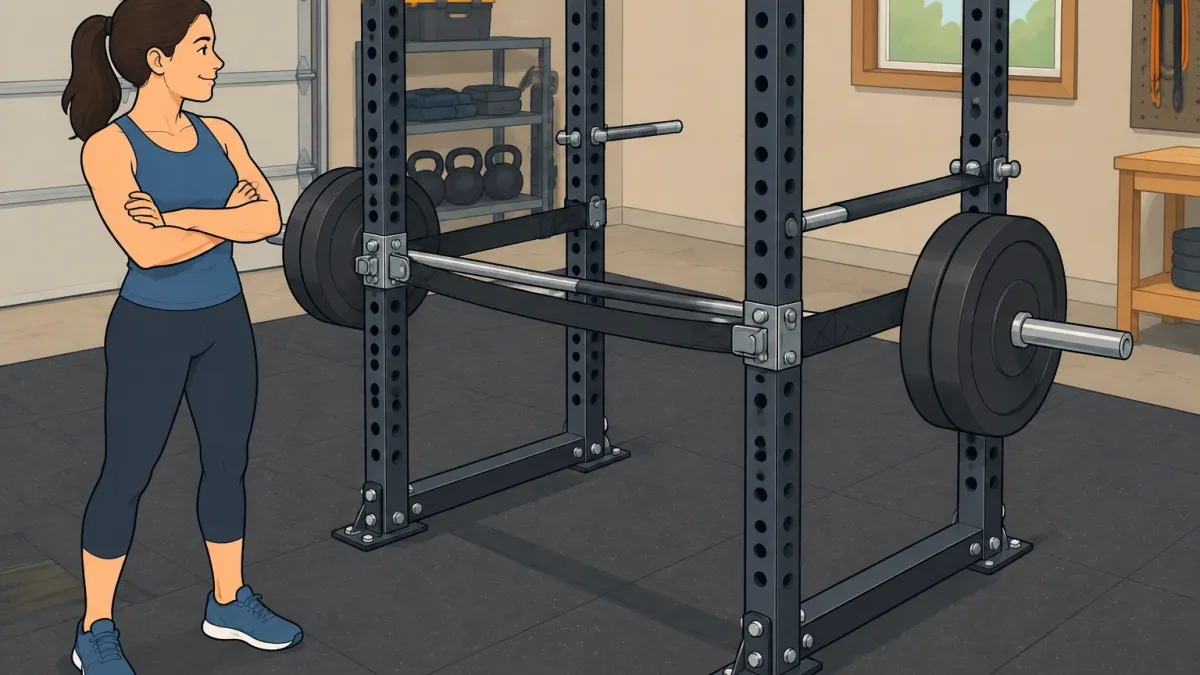
Short answer: all four catch a barbell at a height you set, but they do it differently. Pin-pipe safeties are steel tubes that run through the rack from front to back and stop the bar hard. Safety straps are heavy nylon slung between brackets, which REP Fitness describes as "virtually noiseless" and "gentler on your barbell." Flip-down safeties are steel arms locked in with a clevis pin. Spotter arms project forward from the uprights, outside the rack's frame. In the power rack safety straps vs pins choice, the type matters less than three things: the safety is rated for your rack, it is compatible with it, and it is inspected. Spotter arms add a fourth, because makers often require the rack to be bolted down or on a wider base before they are used.
We have not owned, installed or used any product on this page. Every rating below is the maker's own, read on 2026-09-11. This page is about equipment function only. It gives no advice on loads, technique or training to failure. If you have pain, an injury, a heart condition or are pregnant, whether and how you train is a question for your clinician before it is a question about safeties.
What the search results cover, and what they miss
We read the results for this query on 2026-09-11. The first page is Gym Crafter, Bells of Steel, Gym Mikolo, Two Rep Cave, Garage Gym Reviews, YourWorkoutBook and two guides from REP Fitness.
The table stakes are consistent. Pins are rigid and loud, straps are quieter and cushion the contact, and arms are for open frames. What most pages treat as a footnote is that a safety is only as good as the conditions its maker attaches to it: the rack series it is built for, the rated capacity for that series, how it has to be inspected, and in the case of spotter arms, what the rack has to be anchored to.
The four types, compared
| Type | What it is | How it meets the bar | What it asks of the rack | Limitation |
|---|---|---|---|---|
| Pin-pipe safeties | Steel tubes that span front to back inside a power rack | Rigid steel contact; stops the bar without give | Four posts and matching holes; REP lists its pin-pipes as 11-gauge, 2-inch diameter pipes | Loud, harder on the bar's finish, and set at fixed hole heights |
| Safety straps | Nylon straps held in brackets front and back | Fabric contact; REP calls them "gentler on your barbell" | Four posts and compatible brackets; REP notes front and back can be set at different heights | Fabric can be cut or abraded, and inspection is the maker's routine to follow |
| Flip-down safeties | Steel arms that slide in like a J-cup, lock with a clevis pin and flip down | Rigid steel contact | Compatible holes and series | A pin that is not fully engaged is a pin that is not working |
| Spotter arms | Arms projecting forward from the uprights | Rigid contact, outside the frame | Often a bolted rack or a wider base, per the maker | Load sits outside the footprint, which is why makers attach conditions |
Descriptions of the REP products are from REP's Safeties Comparison Guide, published December 15, 2022 and updated August 3, 2026, read on 2026-09-11.
Power rack safety straps vs pins: the real differences
Contact. Steel pins stop a bar with no give. Nylon straps take up a little as the bar settles. REP describes its straps as "reinforced nylon straps, secured to brackets with heavy-duty bolts," "virtually noiseless" and "gentler on your barbell." Gym Mikolo, in the search results, makes the same comparison from the other side: pins provide "a more stable, immovable point of contact."
Noise. In a garage that may not matter. In a basement or an attached home it can matter a great deal. It is the single biggest reason straps are chosen.
Adjustment. Both sit at the rack's hole heights. REP notes its straps can be mounted "at different heights" front and back. It says the Strap Safeties 2.0 are "shorter, reducing slack" and that the brackets are designed to prevent rotation.
Wear. Steel pins scuff and mark. Nylon can be cut or frayed by sharp edges or rough knurling over time. Neither is maintenance-free. REP's PR-1100 guide says to "check bolts, pins, and straps monthly for tightness and wear." Where a maker gives a replacement rule for a strap, that rule governs.
Rating. Safeties carry their own rated capacity, and it can differ by rack series. REP lists its Strap Safeties 2.0 at 700 lb per pair for the 1000 Series and 1,000 lb per pair for the 5000 Series, and its flip-down safeties at 700 lb for the 1000 Series and 1,000 lb for the 4000 and 5000 Series (all read 2026-09-11). The same accessory is rated differently depending on the rack it hangs from. That is the number to read, not the category.
Spotter arms: the one with conditions attached
Spotter arms put the catch in front of the uprights, which is how a half rack or squat stand gets a catch at all. That position is also why they come with rules. A bar landing on an arm that sticks out past the base pushes the rack to tip forward in a way that a bar landing inside a cage does not.
REP's Spotter Arms page, read on 2026-09-11, states the condition plainly: "Rack must be bolted down, have front foot extensions, or a flat foot base to safely use the Spotter Arms." The PR-4000 and PR-5000 pages name Spotter Arms among the attachments that require the rack to be bolted down. On the PR-5000 page, that applies "even with the Rear Base Stabilizer, regardless of your rack's depth."
If your floor cannot be drilled, read that condition before you buy arms, not after.
Training alone, without a partner
This is the question behind the search: what catches a missed bar when nobody is there to take it?
REP's power rack collection page states that "a full power rack with inside pin/strap safeties provides the most coverage for failed squats and presses." It also advises setting up "on a stable, level surface" and keeping "clear bailout space around the rack." Titan Fitness notes that some squat stands have no catch at all, so that "a failed rep means you have to lower the bar to the floor yourself."
Bailout space is a room decision as much as an equipment one. Our guide to how much space a home gym needs covers clearances around equipment. If the ceiling is low, what fits in a low-ceiling home gym matters too, because it limits which frames and catches you can fit at all.
Whether to train to a point where a catch is needed, and at what load, is not an equipment question. It is not answered here.
What happens below the safeties
A bar that comes down onto safeties is sitting over the floor, and a bar that is dumped from a stand lands on it. That is a floor question: what a home gym floor has to survive covers surfaces. For bars that are routinely lowered or dropped to the floor, what crash pads, drop pads and silencer pads each solve explains the products made for that job.
Inspection, in the maker's terms
- Follow the maker's routine. REP's is monthly checks of bolts, pins and straps for tightness and wear.
- Check engagement every time. A clevis pin that is not fully seated, or a pin-pipe that is not fully through both uprights, is not a safety.
- Replace on the maker's criteria, and use the maker's replacement parts for that series.
- Never mix series or brands unless both makers' compatibility lists say it works.
Children and loaded equipment
The CPSC's Anchor It campaign addresses furniture and TVs. It states that "anchoring all furniture with drawers, doors, and shelves to the wall prevents tip-over injuries and deaths" (read 2026-09-11). A rack is not furniture under that rule, but a tall steel frame with forward-reaching arms is exactly the kind of object children climb and pull on. Keep children out of the gym, unload bars, and treat the maker's anchoring condition for arms as a requirement, not a suggestion.
What this page does not do
It names no prices, makes no picks and ranks nothing. It gives no advice on loads, technique or training to failure. It quotes ratings only as the maker states them, for the product and series named, on the date read.
Frequently asked questions
Are safety straps better than pins? They differ rather than rank. REP Fitness describes its straps as "virtually noiseless" and "gentler on your barbell." Pins give rigid steel contact with no give. Choose based on noise, bar wear and what your rack is compatible with, then read the rated capacity for your rack series.
Can safety straps break? Any safety has a rated capacity and can wear. Nylon can be cut or abraded. Follow the maker's inspection routine (REP's is a monthly check of bolts, pins and straps for tightness and wear) and replace on the maker's criteria.
Do spotter arms need the rack bolted down? Often, yes. REP Fitness states that for its Spotter Arms the "rack must be bolted down, have front foot extensions, or a flat foot base." Its PR-4000 and PR-5000 FAQs name Spotter Arms among the attachments that require bolting. Check your own rack's rule.
Is a squat stand without safeties usable for training alone? Titan Fitness notes that without catches, "a failed rep means you have to lower the bar to the floor yourself." Whether that is acceptable is a question about training, which is for a qualified coach and, if health is involved, a clinician. The equipment point is simple: a stand with no catch has no catch.
The short version
Choose the safety your rack is built for. Read its rated capacity for your rack series, follow the maker's inspection routine, and check the conditions before you add arms that reach outside the frame. Straps against pins is a question of noise and contact. Arms are a question of anchoring.