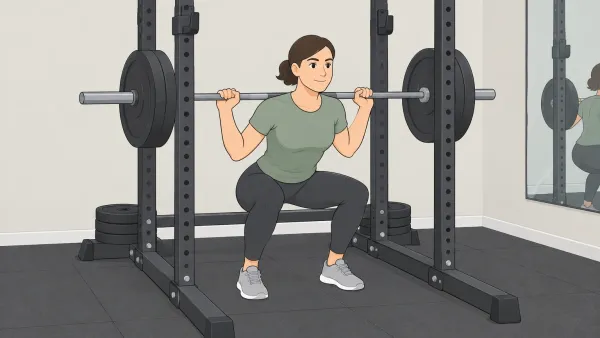
11 Gauge vs 14 Gauge Power Rack: What the Number Governs
11-gauge steel is about 3 mm thick, 14-gauge about 1.9 mm. What that difference governs on a rack, what it does not, and what to read instead.
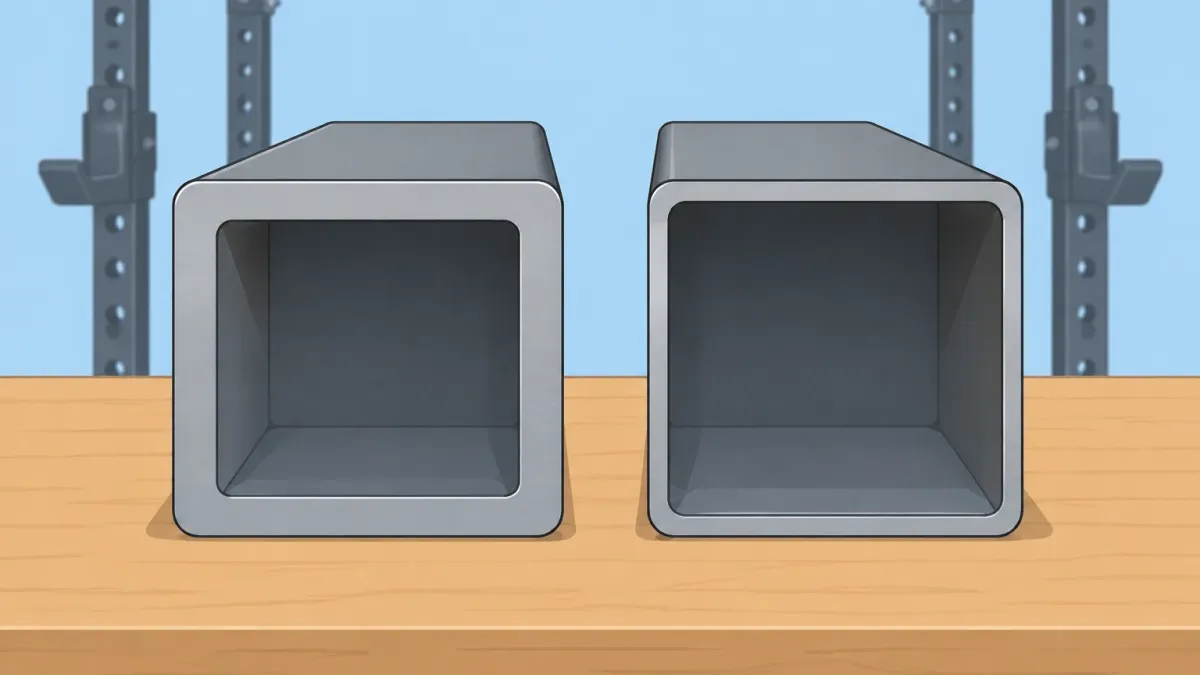
Short answer: gauge is the wall thickness of the steel tube the rack is built from, and a lower number means thicker steel. On the Manufacturers' Standard Gauge for sheet steel, 11 gauge is 0.1196 inches (3.04 mm) and 14 gauge is 0.0747 inches (1.90 mm), so an 11-gauge wall is about 1.6 times as thick. In the 11 gauge vs 14 gauge power rack comparison, that thickness governs how stiff each tube is, how well its holes keep their shape and how heavy the rack is. It does not, on its own, tell you the rated capacity, the stability or which attachments fit. The maker's spec sheet tells you those.
Those thickness figures come from the gauge table in Wikipedia's sheet metal article, read on 2026-09-11. We have not owned, assembled or used any rack named on this page.
What the search results say, and whose claims they are
We read the results for this query on 2026-09-11. The first page mixes two Reddit threads with pages from companies that sell racks or rack content: XMARK, MAXUM Fitness, Major Fitness, Body-Solid, CTX Home Gyms, GXMMAT, Fitness Avenue and several independent blogs.
They agree that 11-gauge is thicker, that it costs more and that it is common on established brands' racks. They disagree on everything after that. CTX Home Gyms calls 11-gauge "the minimum for serious lifting." Fitness Avenue says 14-gauge "works for moderate loads but flexes under dynamic stress." YourWorkoutBook says 11-gauge "is sufficient for nearly everyone," and GarageGymBuilders says going from 12-gauge to 11-gauge "provides diminishing returns for home use."
None of those pages shows a test. They are opinions from businesses, some of which sell only one of the two. The useful move is to stop treating gauge as a grade and read it as one number among several that together describe a rack.
How gauge numbering works
Gauge is an old sizing system in which, as the Wikipedia article puts it, "the larger the gauge number, the thinner the metal." It is not a unit. The same article notes that gauge "differs between ferrous (iron-based) metals and nonferrous metals such as aluminum or copper," so a gauge number only means a thickness once you know the material and the table. For steel rack tube, the figures above are the ones that apply.
| Gauge | Thickness (inches) | Thickness (mm) | Source |
|---|---|---|---|
| 11 | 0.1196 | 3.04 | Manufacturers' Standard Gauge, via Wikipedia, read 2026-09-11 |
| 14 | 0.0747 | 1.90 | Manufacturers' Standard Gauge, via Wikipedia, read 2026-09-11 |
The rounded figures sellers quote match this table: CTX Home Gyms gives 11-gauge as 0.120 inches, and Fitness Avenue gives 3 mm and 1.9 mm.
11 gauge vs 14 gauge power rack: what the number governs
Wall stiffness. A thicker wall bends less for a given load and tube size. That is the property sellers mean when they talk about "flex" or "wobble."
How the holes behave. A rack's uprights are drilled along their length, and every J-cup, safety and attachment hangs from those holes. Steel around a hole in a thicker wall has more material to resist deforming under repeated loading. This is one reason gauge matters more on a rack than on a bench frame.
Mass. More steel means a heavier rack. A heavier frame is harder to tip, all else equal. It is also harder to move, costs more to ship and arrives in heavier boxes. Our breakdown of gym equipment shipping costs, freight and liftgate fees covers what that weight adds before the rack is even unboxed.
What the gauge number does not govern
| Question | Governed by | Where to find it |
|---|---|---|
| How much the rack is rated to hold | The whole assembly: tube size, wall, welds, hardware and attachments | The maker's rated capacity, per model and per attachment |
| Whether it will tip or walk | Base depth, footprint, anchoring and what is attached | The maker's FAQ or manual on bolting |
| Which attachments fit | Upright tube size, hole diameter and hole spacing | The spec sheet |
| Whether it rusts | Coating and the room's humidity | The finish description, and your garage |
| Whether the listing is accurate | The seller | The maker's own spec page, not a marketplace copy |
The last row matters. At least one discussion thread on the first page for this query is about a buyer who found that a rack advertised as 11-gauge was listed elsewhere as 14-gauge. Check gauge on the maker's own specification, not on a reseller's listing.
Gauge also has nothing to do with corrosion. A thick wall rusts as readily as a thin one if the coating is breached in a damp garage, which is covered in what humidity does to steel in a garage gym.
Gauge rarely travels alone
In practice, you seldom meet two racks that differ only in gauge. The gauge usually comes as part of a package with the tube size, the hole size and the rack's place in the maker's range.
REP Fitness's pages, read on 2026-09-11, show this within a single brand. The PR-1100 is listed as "2x2" 14-Gauge Steel" with 1-inch holes at 3-inch spacing, and its FAQ says it cannot be bolted down. The PR-4000 is listed as "3x3" 11-gauge Steel" with 5/8-inch holes, spaced 1 inch within the bench zone and 2 inches elsewhere, and its FAQ sets out when it must be bolted.
So when a listing offers "11 gauge vs 14 gauge," you are usually comparing a smaller, lighter entry frame with a larger, heavier one that belongs to a bigger attachment system. The gauge is the most visible difference and rarely the most important.
This is the same trap as the phrase on many product pages covered in what "commercial grade" means on a home product page: a label that sounds like a standard, standing in for the specific numbers you actually need.
A way to decide whether thicker is worth it for you
Five questions, in the order that usually settles it.
- What attachments do you plan to add within a couple of years? Attachment systems tend to be built around particular tube and hole sizes, which often come with the heavier gauge. If you plan to add them, check compatibility first. Gauge follows from that choice.
- Can the rack be anchored in your room? If the floor cannot be drilled, the maker's free-standing configurations matter more than the wall thickness.
- Will the bar come down onto the safeties? Safeties load the uprights at the holes. The maker's rated capacity for the safeties and the rack is the number that answers this, not the gauge alone.
- Will you move house with it? A heavier rack is a real cost every time it moves.
- Is this a rack you intend to keep? Buying the lighter frame and replacing it later is sometimes the right call and sometimes the expensive one. Cheap gym equipment and when upgrading later costs more sets out how to tell which applies to you.
Budget tiers usually track gauge. Entry frames tend to be lighter-gauge and smaller-tube, and mid-range and premium frames tend to be 11-gauge. We are not quoting prices, because they change faster than this page will.
What you lift on any rack, and how, is outside this page. If health or an injury is part of the question, that belongs with a clinician.
What this page does not do
It names no prices, makes no picks and ranks nothing. It does not claim a 14-gauge rack is inadequate or an 11-gauge rack is sufficient for any particular load. That is what the maker's rated capacity is for, and it depends on the whole assembly. We have handled none of the products named.
Frequently asked questions
Is 11 gauge thicker than 14 gauge? Yes. In the gauge system, a larger number means thinner metal. On the Manufacturers' Standard Gauge for sheet steel, 11 gauge is 0.1196 inches (3.04 mm) and 14 gauge is 0.0747 inches (1.90 mm).
Is a 14-gauge power rack strong enough? The gauge alone does not answer that. Strength and capacity belong to the whole assembly: tube size, wall thickness, welds, hardware and attachments. The number to read is the maker's rated capacity for that model, together with any conditions it sets on bolting and attachments.
Does gauge affect which attachments fit my rack? Not directly. Fit is set by the upright tube size, the hole diameter and the hole spacing. In practice, heavier-gauge racks are often built in larger tube sizes that belong to bigger attachment systems, which is why the two get confused.
Where does 12-gauge fit? It sits between 11 and 14 in thickness, following the same rule that a lower number means thicker steel. Some sellers offer it as a middle option. The same advice applies: read the maker's own specification and rated capacity rather than the gauge on its own.
The short version
Gauge tells you how thick the walls are. Treat it as one line on the spec sheet, beside tube size, hole size, rated capacity and the maker's anchoring rules, and read all of them from the maker's own page. A thicker wall on the wrong rack for your room is still the wrong rack.